
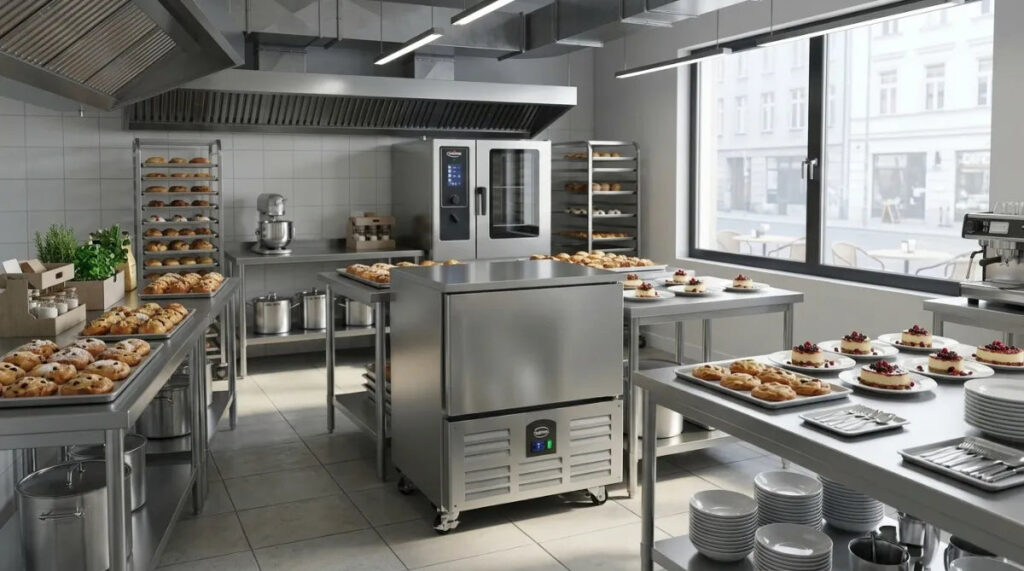
When people talk about a roll-in blast chiller, many professionals simply imagine an easy-to-move unit. In reality, it is often a much more specific piece of equipment, designed for heavy production flows. Conversely, a chiller on wheels generally refers to a classic chiller made mobile for reasons of flexibility and hygiene.
The right choice therefore depends not only on the number of levels. It Maynly depends on your logistics, your production volume, and the level of complexity you are willing to manage in your kitchen.
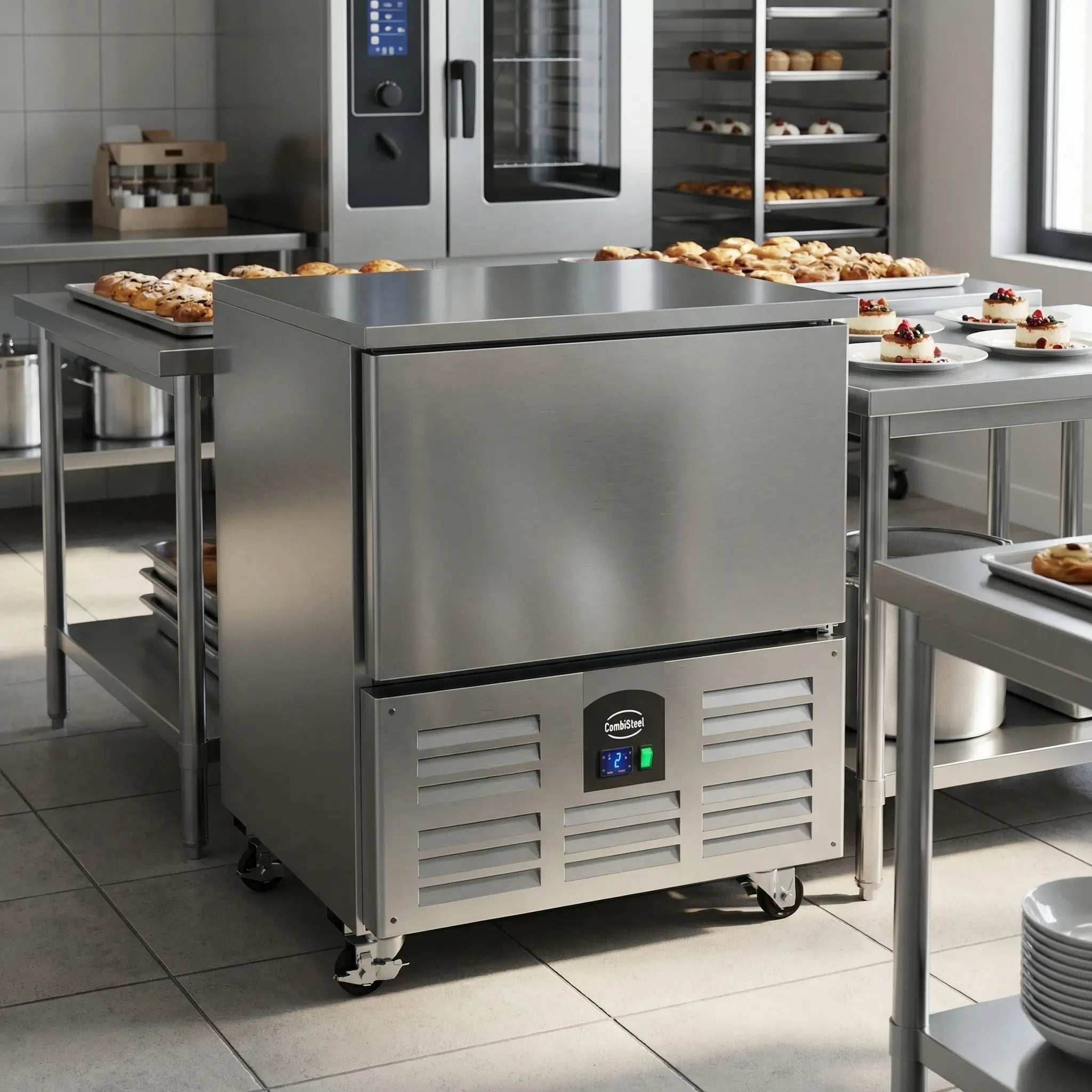
Mobile Blast Chiller & Shock Freezer – 5 levels
- Very good compromise for a kitchen that wants mobility without moving into a heavy industrial logic
- Wheels useful for hygiene, cleaning and workstation organization
- Coherent solution for structured restaurants, patisseries, and caterers
What is a roll-in blast chiller?
A roll-in chiller is designed to accommodate an entire trolley directly inside the cabinet. Instead of loading trays one by one, you push the entire trolley inside, then roll it out once the cycle is complete.
This type of solution is particularly relevant in environments where volumes are very high and handling needs to be reduced as much as possible:
- central kitchens,
- large production units,
- very large caterers,
- semi-industrial or industrial setups.
It’s not a universal “more practical” option. It’s a different level of equipment, with a different level of cost and footprint.
What is a chiller on wheels?
Here, it’s not the trolley that enters the chiller: it’s the chiller itself that moves. You maintain classic operation with trays or plates loaded into the machine, but you gain mobility for maintenance and placement.
This solution makes a lot of sense in kitchens where floor hygiene, rear access, and daily flexibility are real concerns. It’s often a better compromise than a roll-in unit for most establishments.
Which solution is most relevant for a restaurant, pastry shop, or caterer?
In most cases, a chiller on wheels is the most rational choice. It already provides a lot of flexibility without the constraints of a full roll-in system.
| Criterion | Roll-in Chiller | Chiller on Wheels |
|---|---|---|
| Usage Logic | Very high volumes | Common to heavy professional use |
| Handling | Ultra-optimized for large flows | Flexible and practical for daily use |
| Footprint | Very large | Much more reasonable |
| Budget | High to very high | Much more accessible |
| Relevance for a classic kitchen | Often oversized | Often very coherent |
Verdict: If you are not in a mass production logic with actual circulation of full trolleys, a mobile chiller on wheels will often be smarter, more cost-effective, and simpler to operate.
Why does mobility truly change hygiene?
Because a chiller that can be moved is easier to clean around and underneath. This point may seem secondary at the time of purchase, but it quickly becomes very important in the daily life of a kitchen.
Wheels specifically allow for:
- easier floor cleaning,
- avoiding stagnant dirty areas behind the unit,
- greater flexibility in organization,
- limiting certain heavy handling constraints.
If you also want to delve into daily maintenance, you can read our article on how to clean a blast chiller.
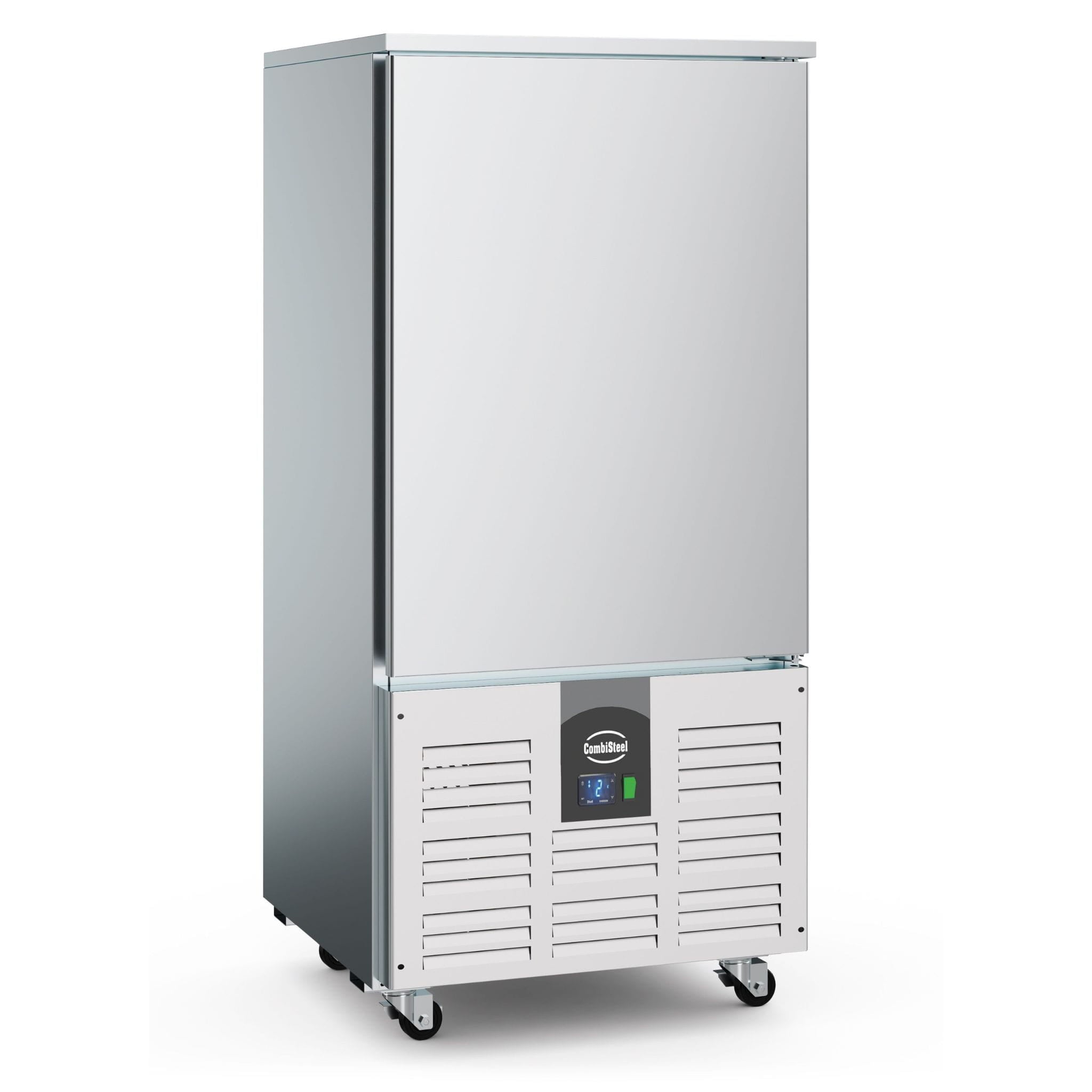
Mobile Blast Chiller & Shock Freezer – 9 levels
- Allows for increased volume without sacrificing the benefits of wheels
- Excellent choice if you’re looking for more capacity while maintaining mobile functionality
- More relevant than a true roll-in if you’re not in a full industrial flow
When is a roll-in chiller truly justified?
Only when the full trolley is part of the natural production flow. If you need to cook, load, move, and process massive volumes continuously, then a true roll-in solution makes sense.
But for the vast majority of independent restaurants, pastry shops, and caterers, this level of equipment is too heavy, too expensive, and often unnecessarily complex.
If you are still comparing needs based on your production size, you can also read our article on the impact of a roll-in blast chiller on the pace of a professional kitchen as well as our guide on the budget to plan for a truly suitable chiller.
Need a powerful chiller that fits your kitchen?
Explore our range to compare mobile formats, levels, and capacities based on your actual production volume.
FAQ
Is a roll-in chiller better than a chiller on wheels?
Not automatically. It is primarily better suited for very high volumes and a specific logistical flow.
Why are wheels so useful?
Because they facilitate cleaning, rear access, and daily flexibility at the workstation.
Can a mobile chiller be sufficient for a caterer?
Yes, in many cases, especially if the volume remains significant but without a full industrial roll-in logic.
When should one switch to a heavier format?
As soon as production genuinely operates with full trolley flows and manual handling becomes a structural bottleneck.