
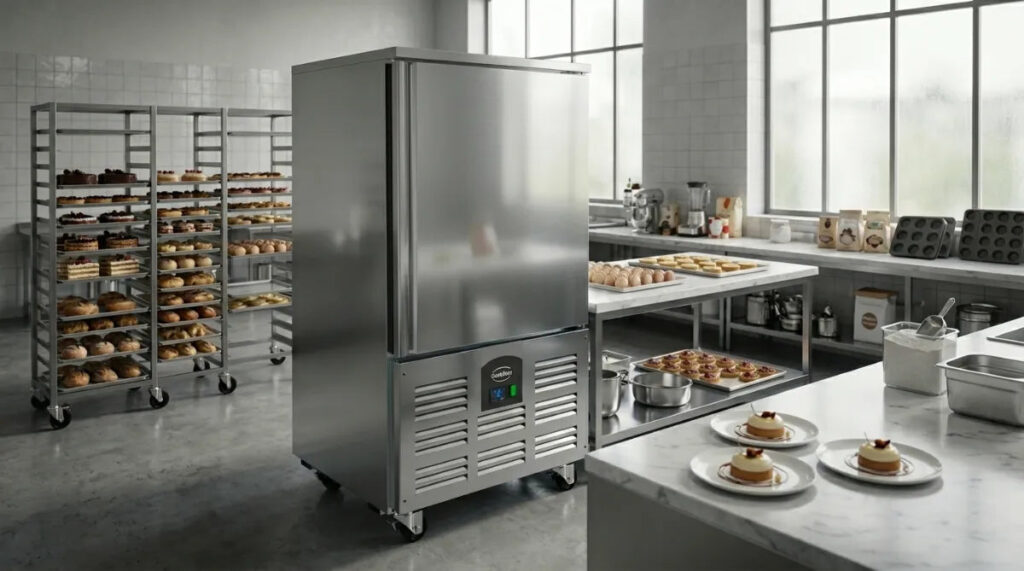
A roll-in blast chiller becomes relevant as soon as a kitchen needs to chill multiple GN levels without increasing handling. It saves time, better secures the cold chain, and streamlines production output when volumes increase. In a hospitality setting, it’s not just a convenience; it’s often a real lever for speed and hygiene.
What is a roll-in blast chiller really used for?
A roll-in blast chiller is used to rapidly lower the temperature of large preparations while maintaining simple and stable loading. The real benefit is not just refrigeration power; it’s the ability to integrate chilling into an already busy production flow.
In a central kitchen, a catering laboratory, or a brigade working with delayed reheating, the trolley avoids reloading tray by tray. You prepare, you load your GN trays onto the trolley, then you move the entire unit to the chiller without breaking your work rhythm.
- less handling between cooking completion and rapid chilling;
- better consistency when several trays need to go in together;
- a cleaner organization to meet HACCP requirements for sensitive volumes.
If you first want to review the overall role of the equipment in your process, you can also read our article on the usefulness of a blast chiller.
When is the roll-in format better than a simpler model?
The roll-in format is better as soon as volume, cycle repetition, and service pressure make manual handling detrimental. The denser the production, the more concrete the gain becomes.
In practice, this format is particularly interesting for establishments that handle multiple preparations in GN trays, advance productions, or services where several items need to be chilled within the same time window.
| Criterion | Standard Chiller | Roll-in Chiller |
|---|---|---|
| Loading | Tray by tray or level by level | Full or near-full trolley depending on configuration |
| Throughput | Suitable for small to medium volumes | More relevant for sustained production |
| Handling Risk | More movements and re-handling | Fewer intermediate manipulations |
| Operator Comfort | Good for small batches | Superior when cycles are frequent |
| Layout | More compact | Requires more circulation space |
Verdict: If your production remains occasional or very compact, a standard chiller is often sufficient. However, if your team frequently chills multiple GN levels at once, a roll-in chiller quickly becomes the most logical choice to save brigade time.
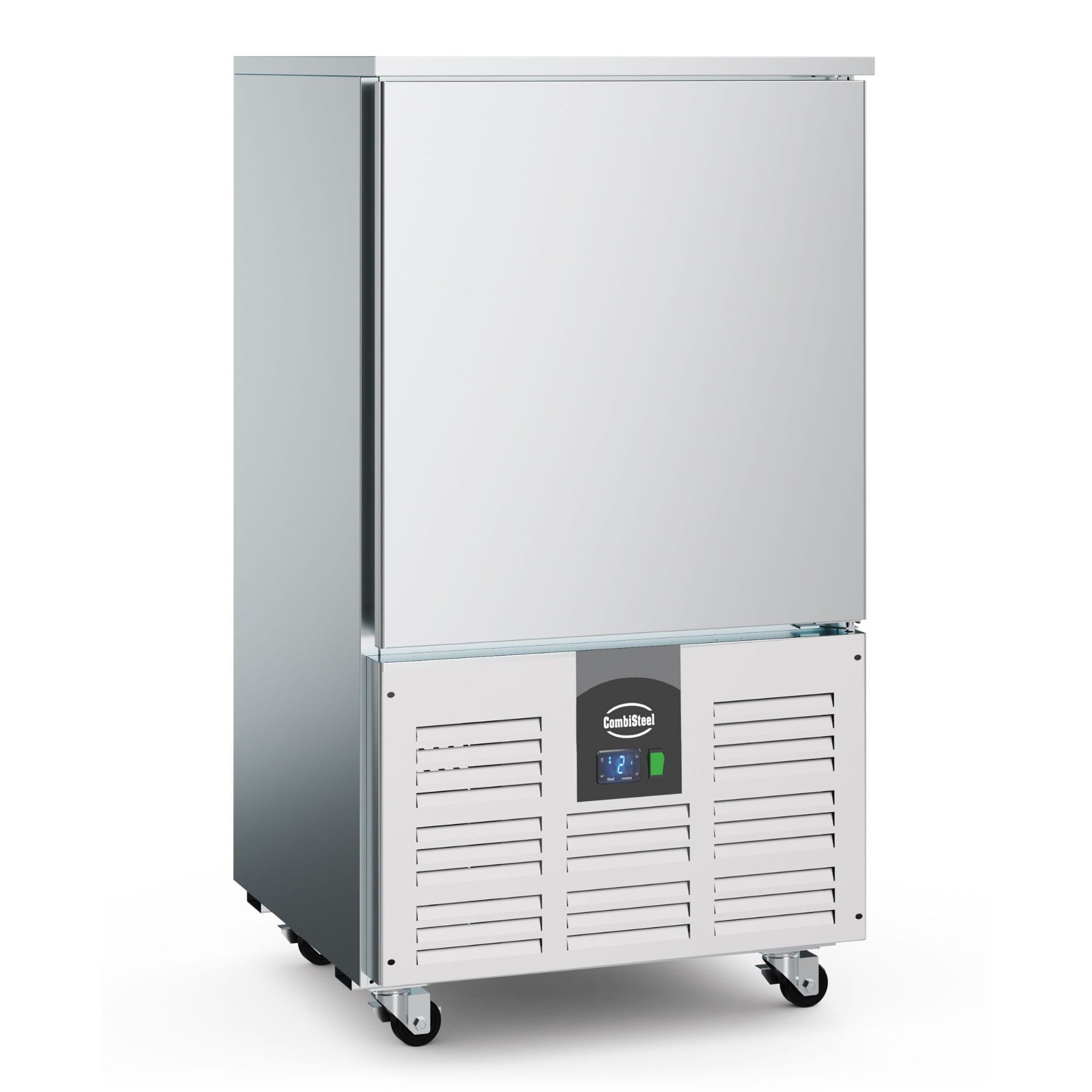
Mobile Blast Chiller & Freezer – 7 levels
- Practical mobile format for streamlined production transfers
- 7-level capacity suitable for a brigade increasing its pace
- Good compromise between volume, maneuverability, and hot/cold versatility
What to check before buying a roll-in blast chiller?
Before buying, you must first check the compatibility between your actual production, the available space, and the format of your trays. A poorly sized roll-in chiller may be powerful on paper but poorly utilized daily.
The criteria that matter most in the field are rarely the most marketed ones. For a profitable purchase, primarily look at:
- the actual number of levels used on a busy day;
- the width of circulation areas and access in front of the machine;
- the frequency of chilling, but also the potential need for freezing;
- GN compatibility and loading logic with your existing equipment;
- the ease of cleaning guides, handles, wheels, and seals.
Pro Tip: In a kitchen with tight passages, the right choice isn’t always the largest capacity. A well-placed and truly usable roll-in chiller is more valuable than a large model that obstructs circulation and slows down teams.
Hygiene must remain central. A roll-in chiller often handles more intensive flows, so the rigor of cleaning and protocol matters even more. On this point, our guide on cleaning a blast chiller usefully complements the purchase consideration.
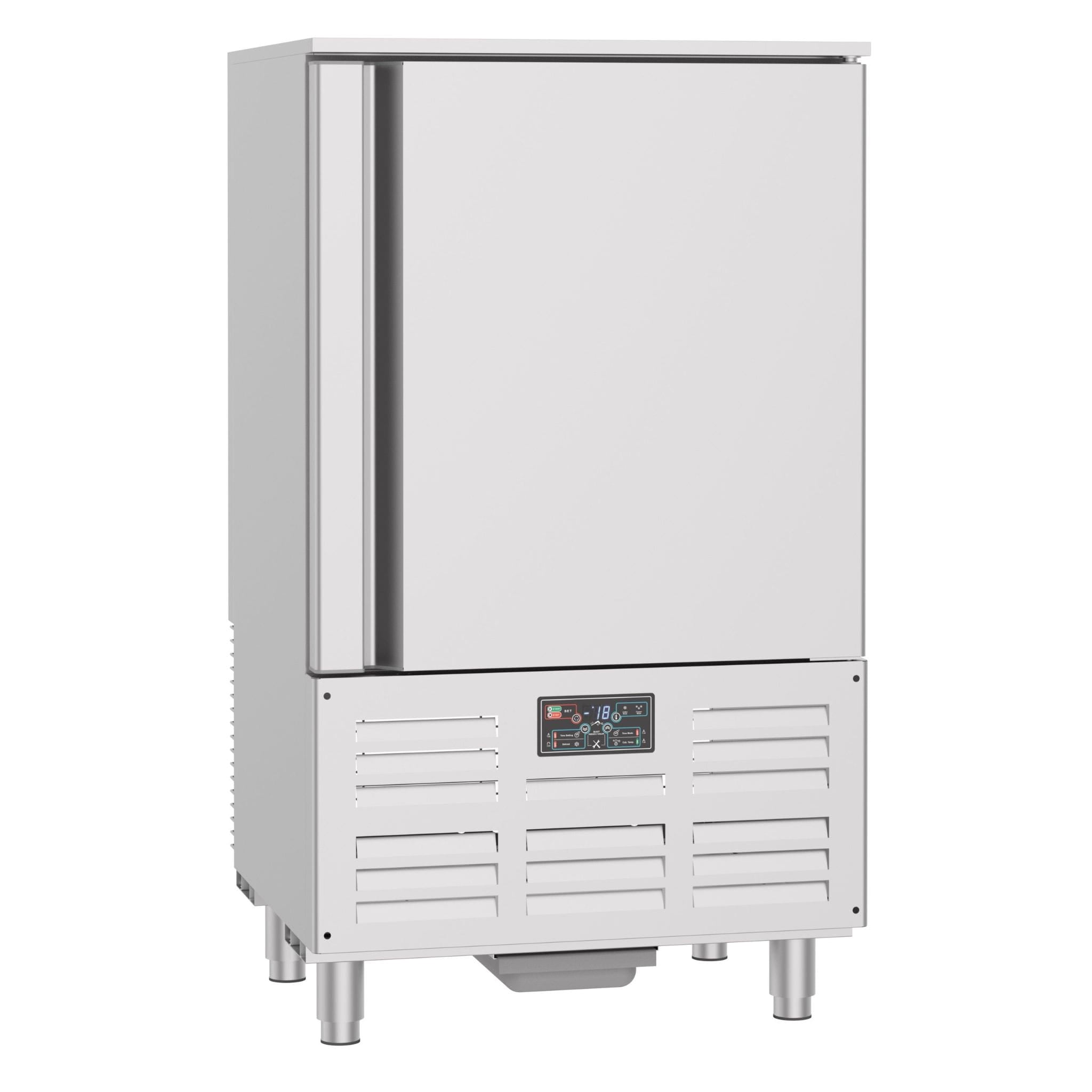
Fixed Blast Chiller – Pro Line Stainless Steel 304 – 10 levels
- Generous capacity for more sustained production
- Stainless steel 304 construction designed for intensive use in hospitality environments
- Relevant format if you are looking for the stability of a dedicated installation
Is a roll-in chiller always the best choice in professional catering?
No, a roll-in chiller is not always the best choice. It is excellent for absorbing volume and structuring flow, but it is not automatically the most cost-effective in a small kitchen with few cycles and limited space.
If you work with low volumes, a more compact model can offer a better space/cost ratio. However, as soon as production is repetitive, trays are produced in series, or multiple operators use the same circuit, the roll-in format gains the advantage by reducing handling and providing better service continuity.
The right arbitration therefore comes down to a simple question: is your Mayn problem refrigeration power alone, or the fluidity of the flow between preparation, chilling, and storage? If the bottleneck comes from organization, the roll-in format clearly deserves your attention.
Want to compare available formats?
Browse our selection of professional blast chillers to choose the right level of capacity, mobility, and HACCP requirements.
FAQ on roll-in blast chillers
What is the difference between a roll-in chiller and a classic chiller?
The Mayn difference is loading: the roll-in version reduces handling and becomes more interesting when volumes and pace increase.
Does a roll-in chiller take up much more space?
Yes, it requires more circulation space in front of the machine and around the loading area. It is therefore necessary to check the layout before purchasing.
Is it useful for a caterer or a central kitchen?
Yes, it is often a very good choice for structures that chill multiple GN trays in series and need a more fluid production flow.
Can a roll-in chiller be used to strengthen an HACCP approach?
Yes, provided it is integrated into a rigorous chilling, traceability, and cleaning protocol. The equipment helps, but organization remains decisive.