
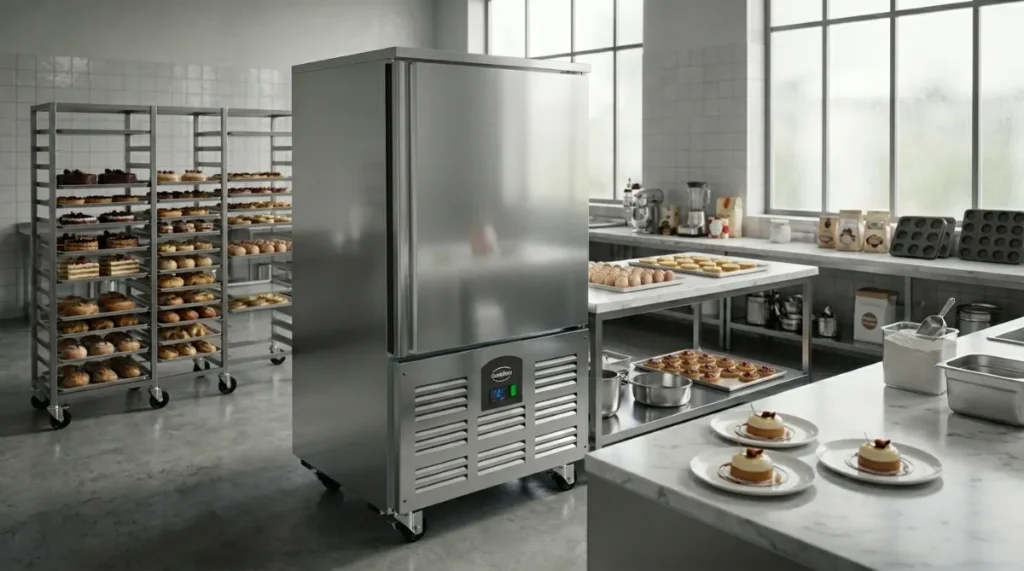
An industrial blast chiller becomes relevant when a kitchen no longer needs to cool just a few pans, but has to absorb repeated cycles without blocking production. The right signal is not only the stated volume: it is the ability to pull temperatures down quickly, run services back to back and remain compatible with your HACCP organization.
When should you move to an industrial blast chiller ?
You should move to an industrial format as soon as chilling becomes a production bottleneck. If dishes are waiting, if trolleys are piling up or if cycles run into the next service, a small blast chiller no longer secures the flow sufficiently.
In the field, this need often appears in central kitchens, caterers, pastry labs, dark kitchens and restaurants with heavy mise en place. The challenge is not only to respect the cold chain: you must also protect texture, limit the microbiological risk zone and quickly free up trays or GN pans.
- You produce several hot batches before service or delivery.
- You chill GN 1/1 pans, 600 x 400 trays or dense preparations.
- You need to document a clear and repeatable HACCP method.
- Your team loses time waiting for a cycle to finish.
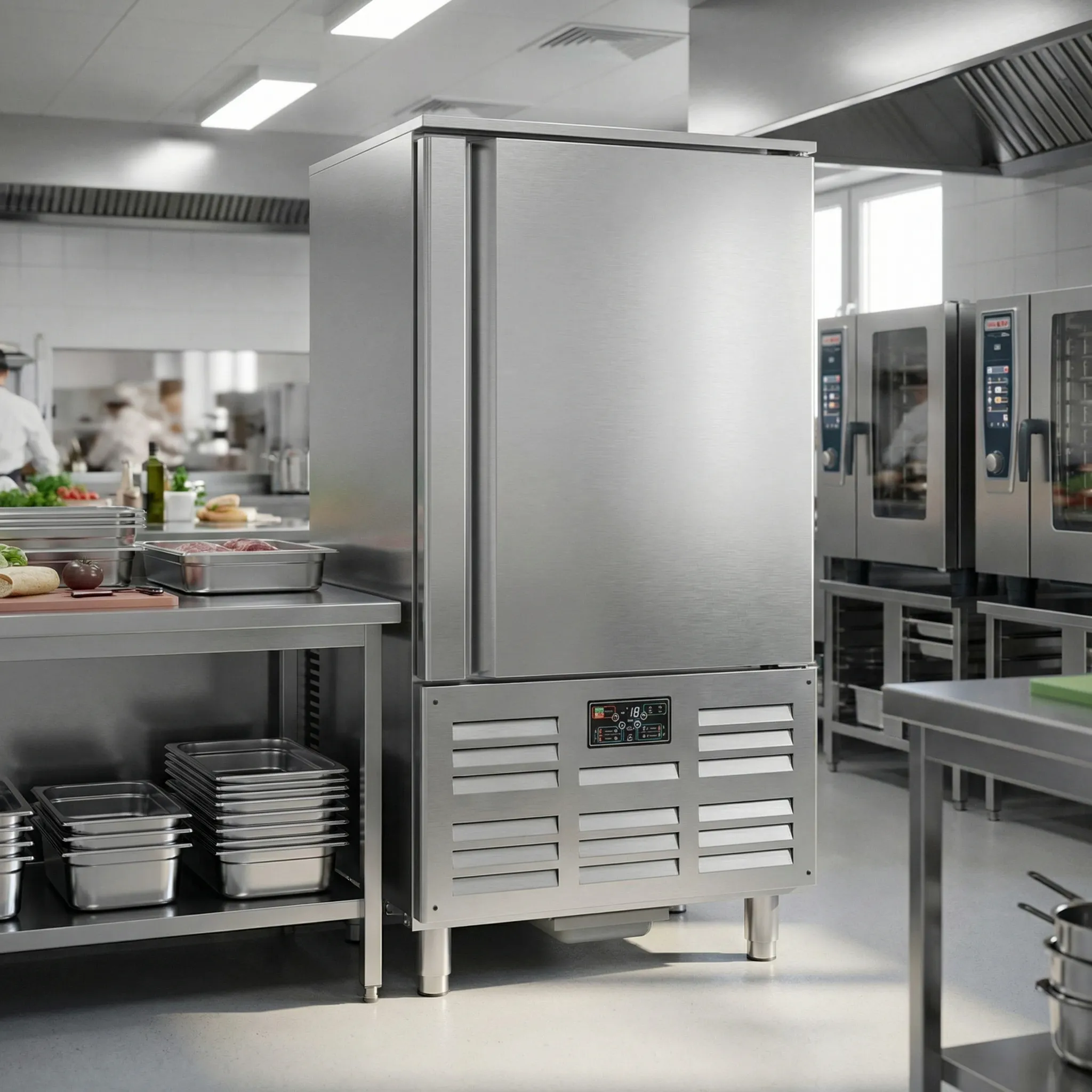
Fixed Blast Chiller – Stainless Steel 304 – 10 Levels
- AISI 304 stainless steel construction and 2.2 kW power for a true production format in a professional kitchen
- 10-level version rated for 30 kg in chilling and 25 kg in freezing per cycle
- A relevant model for caterers and restaurants that need to absorb a higher volume
How do you size the volume without overbuying ?
Correct sizing starts from your real production peak, not from an average day. An industrial blast chiller must process the critical volume at the right time, otherwise it becomes too small exactly when it is essential.
Calculate the number of pans or trays to chill during the busiest window, then check the permissible load per cycle. A 10-level blast chiller may be enough for a regular caterer; a 15-level cabinet becomes more logical if you need to chill large batches without splitting cycles.
| Production situation | Often suitable format | Point to watch |
|---|---|---|
| Restaurant with heavy mise en place | 10 levels | Avoid stacking too densely: air must circulate. |
| Caterer with production peaks | 10 to 15 levels | Size for the busiest day, not the average. |
| Lab or central kitchen | 15 levels or trolley solution depending on throughput | Plan the space, power supply and loading method. |
Verdict : if your blockage comes from a single daily peak, a robust 10-level unit may be enough. If you run several heavy production batches back to back or the team loads the chiller almost continuously, the 15-level format reduces waiting and handling even further.
Fixed, mobile or trolley-based : which industrial format should you choose ?
The choice Maynly depends on your layout. A fixed blast chiller promotes stability and robustness; a mobile blast chiller helps with cleaning and repositioning the workstation; a trolley-based solution makes sense when handling becomes as important as refrigeration.
For a structured lab, the fixed format keeps the station clear and durable. For a kitchen that often reorganizes its zones, mobility can simplify maintenance. For very large volumes, also reread our dedicated analysis of the trolley blast chiller, because it follows a different flow logic.
Refrigeration engineer’s tip : keep clearance around the machine. A powerful blast chiller that is poorly ventilated or pushed into a hot corner loses efficiency, especially during repeated cycles.
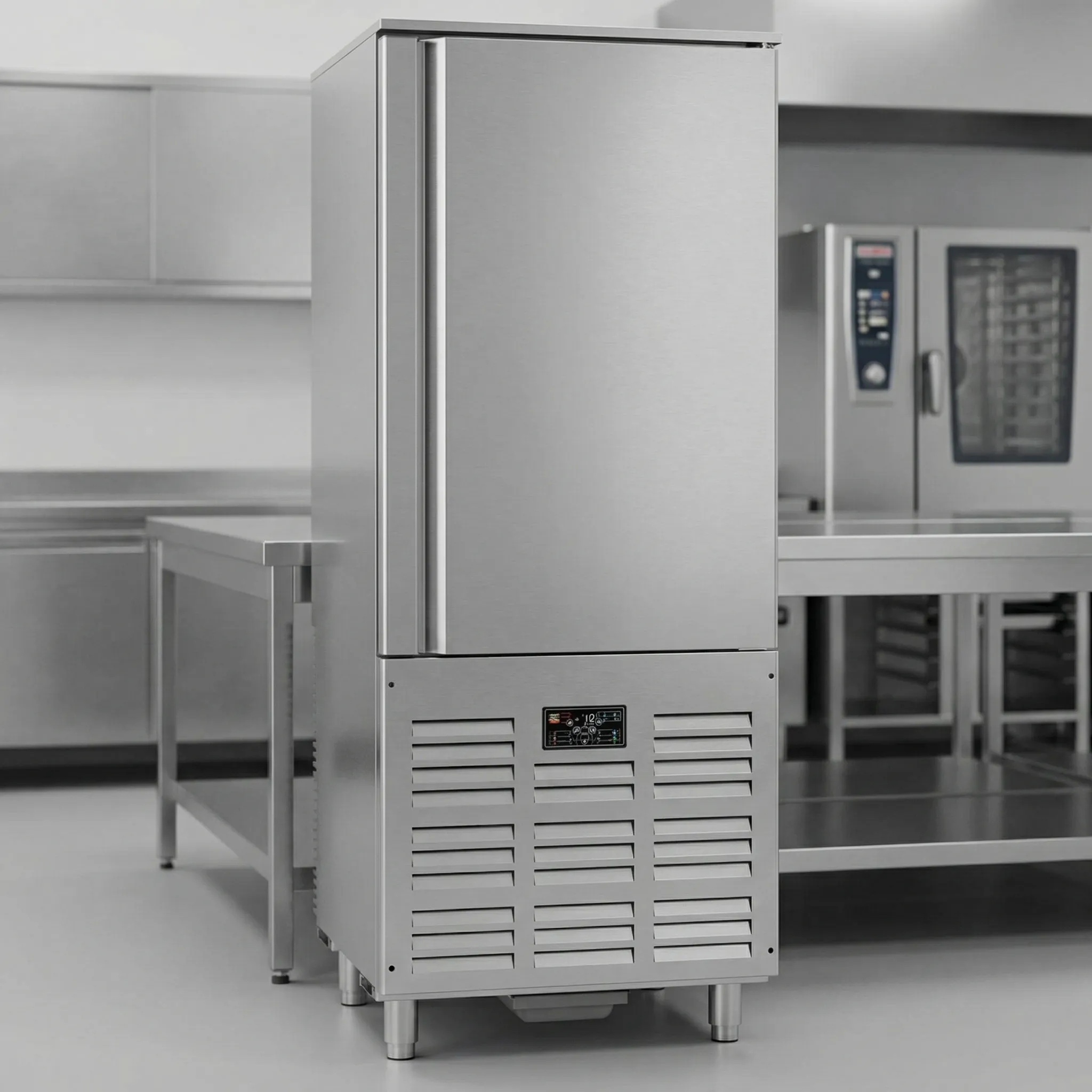
Fixed Blast Chiller – Stainless Steel 304 – 15 Levels
- Full AISI 304 stainless steel construction and 3.5 kW power for a true heavy-production format
- 15-level cabinet rated for 35 kg in chilling and 30 kg in freezing per cycle
- Fixed-feet version designed for labs that need very high capacity without compromising stability
Which HACCP criteria should you check before buying ?
Before buying, check that the machine supports a measurable, repeatable and clean chilling method. Power alone is not enough if the team cannot load correctly, control temperature or clean quickly.
Current standards primarily require a risk-control approach. The blast chiller must therefore help move preparations quickly out of the critical zone, with a core probe, efficient air circulation and surfaces that are easy to disinfect. For temperature benchmarks, our article on HACCP temperature in a blast chiller usefully complements this equipment choice.
- Core probe to monitor dense products.
- Professional stainless steel to withstand repeated cleaning.
- GN 1/1 and 600 x 400 compatibility if your production mixes kitchen and pastry work.
- Realistic capacity per cycle according to your hot volumes, not only according to the number of levels.
The mistakes that make an industrial blast chiller disappointing
The Mayn mistake is buying a large blast chiller without adapting the flow around it. An industrial machine performs if pans are correctly spaced, quantities are controlled and staff are trained to load quickly.
Also avoid undersized electrical supply, installation in an area that is too hot and cycles started with containers that are too deep. In practice, an industrial blast chiller must be designed as a production station, not as a simple, more powerful refrigerated cabinet.
Need to compare the formats suited to your throughput ? Find compact models, 10-level and 15-level units, and high-capacity solutions in our dedicated collection.
FAQ on industrial blast chillers
Does an industrial blast chiller replace a freezer ?
No. It is used to lower temperature quickly or to freeze according to the planned cycle, but long-term storage is then done in a suitable refrigerated cabinet or cold room.
Is a 10-level model enough for a caterer ?
Yes, if batches remain regular and peaks are under control. For repeated large events, a 15-level unit or a trolley solution becomes more comfortable.
Should AISI 304 stainless steel be preferred ?
Yes for intensive use. AISI 304 stainless steel better withstands frequent cleaning, humidity and the constraints of a food-production lab.
Is 600 x 400 compatibility important ?
It is if you work in pastry, bakery or catering. It avoids multiplying transfers between trays and pans.