
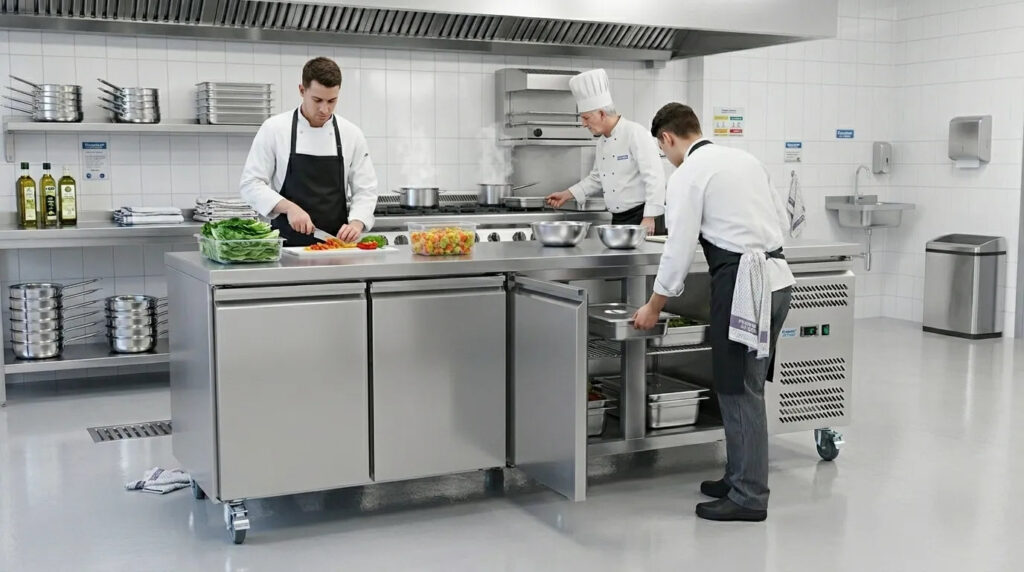
A 4-door refrigerated table becomes relevant when a kitchen needs to store more goods closer to the workstation without losing work surface. In practice, this format is Maynly used by establishments with high throughput, with several simultaneous preparations, a real HACCP constraint, and a need to streamline setup across the entire line.
So, it’s not just a “large refrigerated table.” It’s a layout choice: if under-counter volume is already lacking on a 2 or 3-door unit, a 4-door unit can save time, avoid back-and-forth trips to the cold room, and stabilize service.
When is a 4-door refrigerated table truly useful?
The right question is simple: do you have enough flow, containers, and cold references to make four bottom compartments profitable? If the answer is yes, the format quickly becomes logical.
In the field, this need is found in brasseries with busy lunch services, central kitchens, catering laboratories, establishments with several cold stations, and kitchens where the cold room is far from the dispatch area.
- High usable volume to keep more products immediately at hand.
- Long worktop for plating, portioning, or assembling for multiple people.
- Fewer repeated openings on a distant cabinet during service.
- Cleaner organization between raw materials, ongoing preparations, and sensitive products.
Conversely, in a small snack kitchen or a very compact station, a 4-door unit can become oversized. The storage gain doesn’t always compensate for the linear footprint.
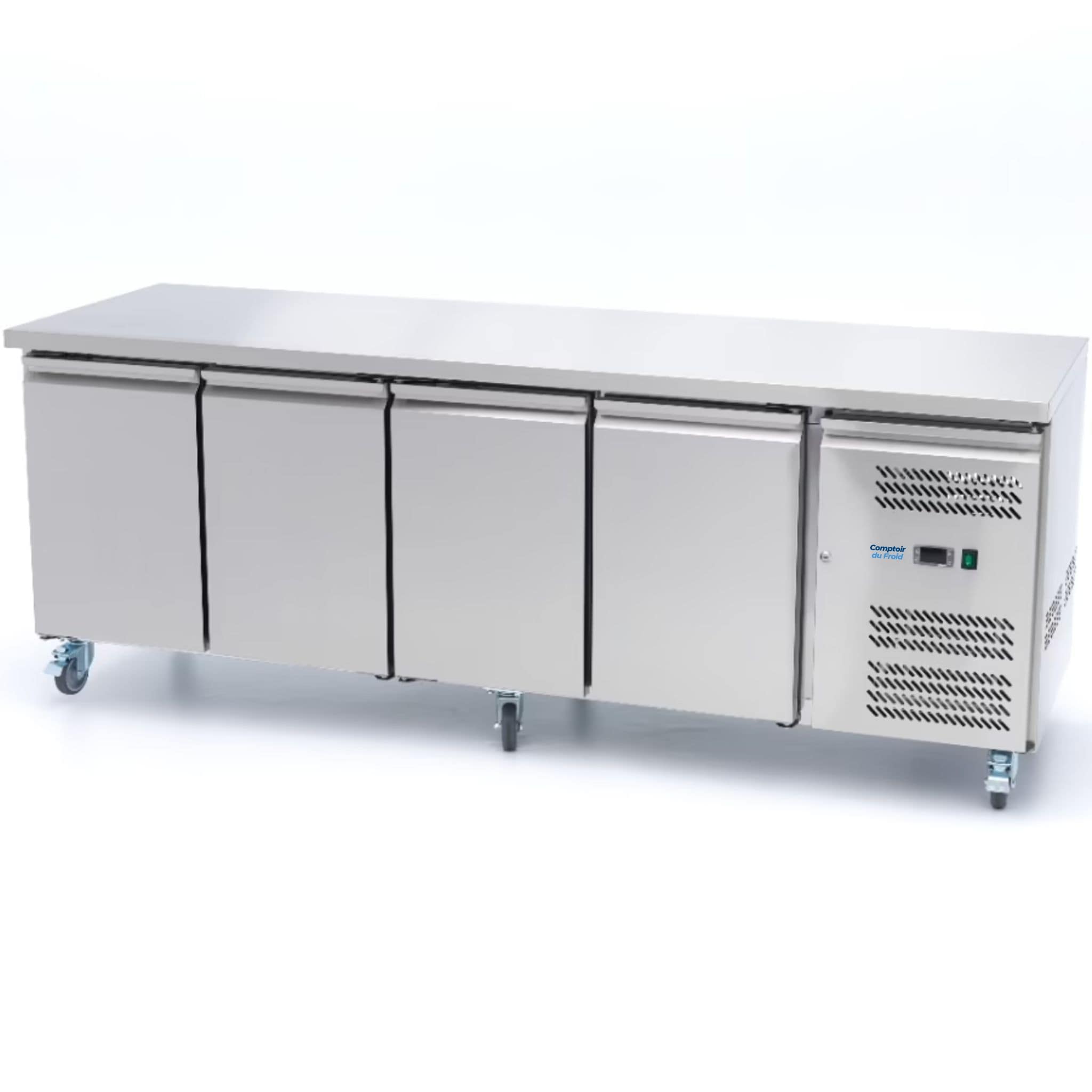
Large 4-Door Freezer Table (223 cm)
- Very long work surface for high-volume kitchens
- Four doors to distribute products and limit handling
- Consistent format when negative cold storage is already lacking volume
How to know if the 4-door format is better suited than a 3-door?
The short answer: choose 4 doors when your Mayn problem is the lack of usable length and embedded capacity on the preparation line. If your kitchen functions well with three lower storage modules, sticking with a 3-door unit avoids an overly heavy purchase.
The real trade-off is based on three criteria: the number of containers or foodstuffs to keep at the station, the available width against the wall, and the number of people working on the table simultaneously.
| Criterion | 3-Door Table | 4-Door Table |
|---|---|---|
| Service throughput | Good compromise for a small brigade or classic setup | Better suited for sustained services and multi-operator stations |
| Worktop length | Easier to integrate | More comfortable for plating, portioning, and assembling |
| Embedded capacity | Sufficient for an already optimized organization | Useful when trips to the cold room penalize service |
| Layout | More flexible in a medium-sized kitchen | Requires a true linear and circulation logic |
| Profitability | Very relevant if space is at a premium | Profitable if daily time savings offset the footprint |
Verdict: if your team already opens a cold cabinet too often during service or if the worktop lacks length, the 4-door is the best choice. If your Mayn constraint remains compactness, a 3-door will often be more rational.
To delve deeper into the subject, you can also read our article on the 3-door refrigerated table and our guide on the right refrigerated table format.
What technical points should be checked before purchasing?
Before purchasing, the priority is to confirm that the machine meets your actual use and not just the product sheet. A poorly installed 4-door unit can obstruct circulation, complicate cleaning, or offer underutilized volume.
1. Available length and clearances
Measure the usable width, but also door clearances, operator passage, and proximity to other hot equipment. A long table next to a dense cooking area can degrade user comfort.
2. Type of refrigeration and stability in service
In professional kitchens, temperature stability is as important as volume. Check the consistency between the planned load, opening frequency, and current HACCP standards.
3. GN format and setup logic
A 4-door table should facilitate your flow: gastronorm containers, preparations, sensitive products, dedicated stations. If the interior does not match your usual containers, the capacity gain remains theoretical.
Field advice: a 4-door unit is particularly profitable when it replaces both a too-short worktop and some openings to the cold room. If it eliminates neither travel nor flow disruptions, it’s close to being oversized.
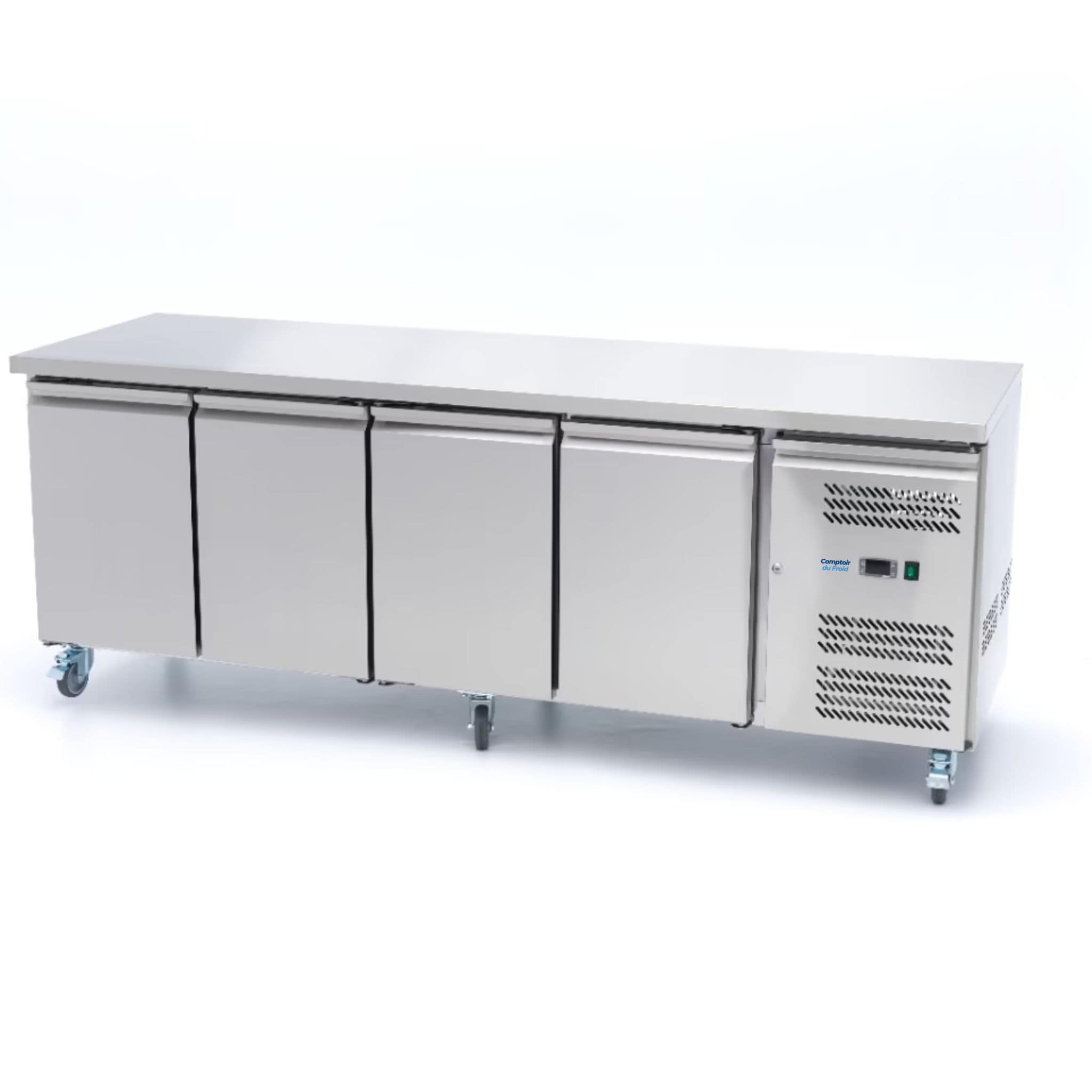
Large 4-Door Positive Refrigerated Counter (223cm, XXL)
- Premium alternative if you want more volume than a simple undercounter refrigerator
- Excellent for clearly separating reserve storage and immediate service
- Relevant format when the priority is cold capacity before the worktop
4-door refrigerated table, refrigerated counter, or negative table: what to prioritize?
The choice primarily depends on the function of the unit: prepare, store, or freeze within reach. A 4-door refrigerated table is designed to combine a worktop with low cold storage. A refrigerated counter prioritizes vertical volume more. A negative table, on the other hand, responds to a logic of frozen products and safety on a specific line.
In other words, the right decision is not just about the number of doors. It depends on the nature of the products, the rotation speed, and how your team works during peak hours.
| Equipment | Strength | Choose if… |
|---|---|---|
| 4-door refrigerated table | Large worktop + accessible low storage | You prepare a lot on the line and want to limit movement |
| 4-door refrigerated counter | More generous vertical capacity | You primarily lack cold volume rather than work surface |
| 4-door freezer table | Negative products immediately at hand | Your flow requires integrated frozen items on the preparation line |
Verdict: for an active preparation line, the 4-door refrigerated table remains the best answer. If your Mayn challenge is massive storage, the counter has the advantage. And if you work with negative temperatures at the workstation, the freezer table becomes more logical than an oversized positive table.
What mistakes to avoid with a 4-door refrigerated table?
The question to ask is clear: will the unit actually improve your service flow? If the answer is vague, it’s better to slow down the purchase and review the kitchen plan.
- Oversizing the line when a 3-door would be largely sufficient.
- Neglecting the layout and blocking passage or opening areas.
- Mixing uses without logical arrangement, which undermines HACCP readability.
- Choosing solely based on price without checking consistency with your actual pace.
In practice, the best 4-door table is not the largest: it’s the one that reduces unnecessary handling, keeps the cold chain stable, and integrates cleanly into your organization.
Looking for a low-profile cold unit adapted to your pace?
Explore our selection of positive refrigerated tables and professional counters to compare the right formats for your kitchen.
FAQ on the 4-door refrigerated table
Is a 4-door refrigerated table useful in a small kitchen?
Not always. It becomes relevant especially if throughput is high and the need for workstation storage is already clearly identified.
What is the difference between a 4-door table and a 4-door counter?
The table offers a worktop with low storage, while the counter focuses more on vertical storage volume.
Can a 4-door table be used for frozen products?
Only if it’s a negative model or a freezer table. A positive table is not designed for this use.
What is the Mayn advantage of a 4-door refrigerated table?
It combines work surface and cold volume directly on the line, which reduces movement and streamlines setup.