
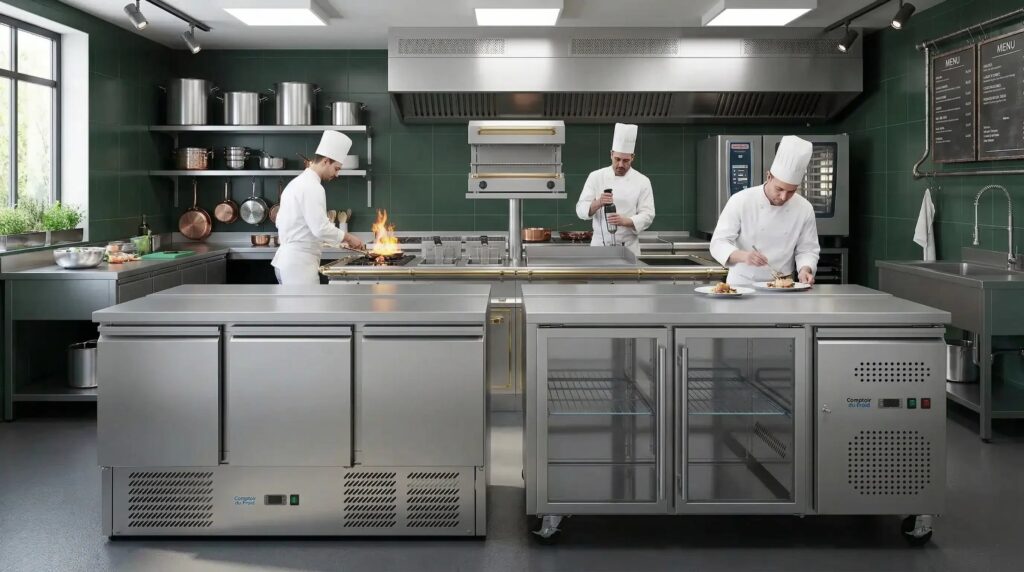
A 3-door refrigerated counter is often the best compromise when a professional kitchen needs a central work surface, immediate cold storage, and smooth workflow during service. In practice, this format becomes relevant as soon as two to three stations are working simultaneously, with a real need for accessible setup without multiple trips to a cold cabinet.
The right choice doesn’t just depend on the length of the unit. It primarily depends on your preparation volume, the type of containers used, your layout, and the pace of service.
When does a 3-door refrigerated counter become the right format?
The question is simple: at what point is a 3-door refrigerated counter more suitable than a 2-door one? The answer is clear: when a 2-door counter becomes too small for daily setup, but a 4-door one would be oversized or too bulky.
In a professional kitchen, this format is particularly relevant for establishments that need to keep cold bases, semi-prepared products, GN containers, and fast-moving ingredients close at hand. It offers a real improvement in working comfort, as storage remains under the work surface, as close as possible to the task at hand.
- Traditional restaurant: good solution for the pass, cold preparations, and garnishes.
- Snack bar or brasserie: very useful when several items are in circulation at the same time.
- Production kitchen: interesting for dividing zones by door or product family.
- Laboratory: relevant if setup needs to remain organized and quickly accessible.
If you’re still hesitating between several formats, you can also read our guide on choosing the right refrigerated counter format for your professional kitchen, which complements this reflection very well.
What criteria should you consider before buying?
To choose a 3-door refrigerated counter well, you must first answer a concrete question: what must it accommodate during your actual service? The answer must come before the technical specifications.
In the field, the most decisive criteria are usable capacity, GN format, counter depth, stainless steel quality, temperature stability, and opening ergonomics. A counter that is too small creates unnecessary handling; a counter that is too large disorganizes the layout.
Points to prioritize validation
Here are the elements that deserve serious consideration before purchase:
- Usable length: a 3-door counter must truly match your preparation area, not just fit in the room.
- GN 1/1 compatibility: essential for standardizing storage and speeding up replenishment.
- Type of refrigeration: forced-air cooling generally provides better homogeneity in intensive use.
- Access during service: check door swing and circulation space in front of the unit.
- Load on the counter: important if the counter serves as a true preparation station.
- Maintenance: seals, corners, grids, and drainage must remain easy to clean.
Field tip: the most common mistake is to choose a 3-door refrigerated counter based solely on gross capacity. In reality, you should primarily think in terms of service flow: frequency of opening, number of operators, and product families stored together.
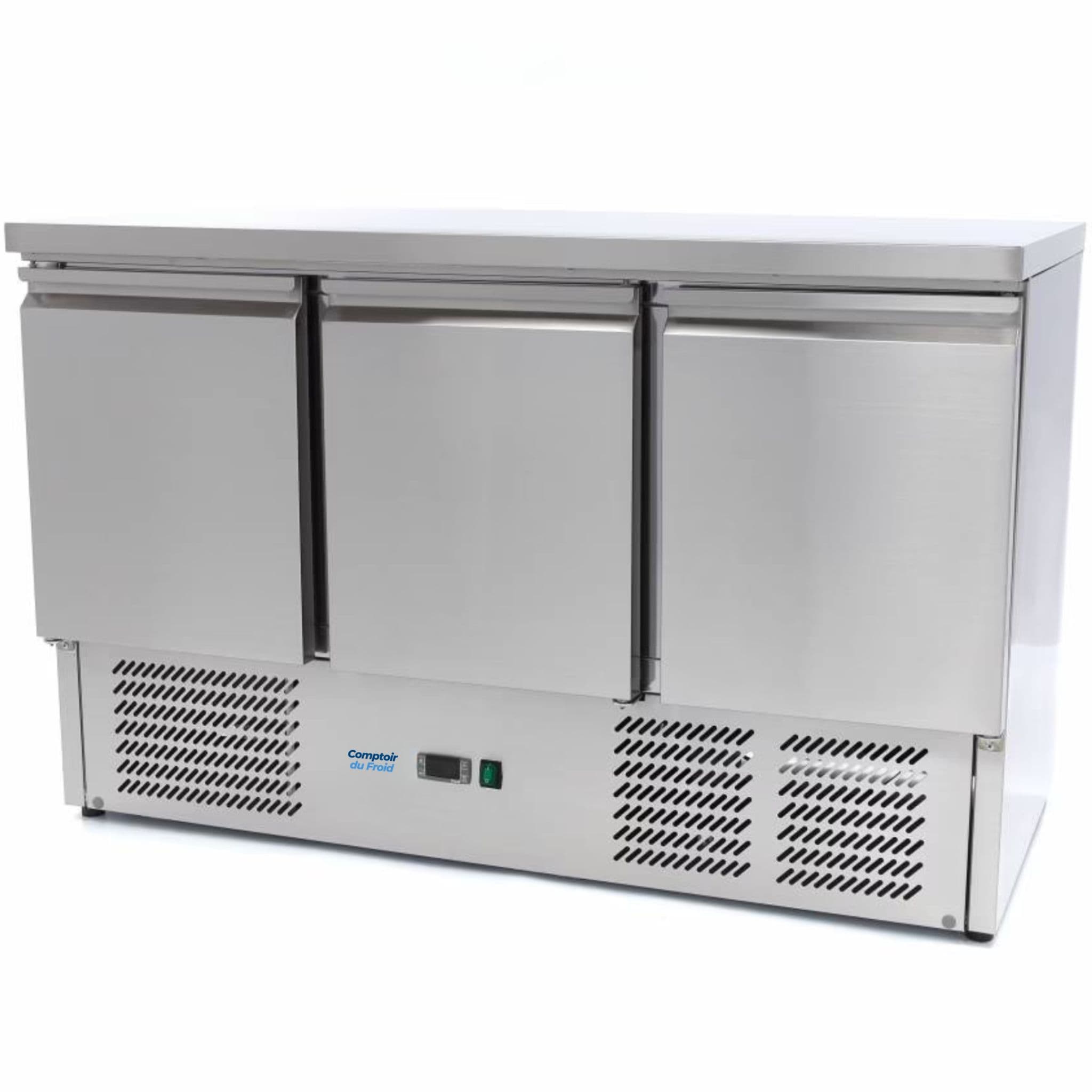
3-Door Refrigerated Base Unit 137cm (Stainless Steel Top)
- Consistent format for kitchens wanting a truly compact cold station.
- Immediate accessible storage during preparation and service.
- Practical stainless steel top for intensive daily use in catering.
3-door refrigerated counter, refrigerated worktop, or refrigerated upright cabinet: how to decide?
The real question isn’t just about choosing a cold unit. It’s about determining which unit best serves your organization. The quick answer: a 3-door counter is ideal if you need a refrigerated work surface; a refrigerated worktop is more compact; an upright cabinet prioritizes vertical capacity.
For a kitchen where preparation, plating, and storage occur in the same place, the 3-door counter often remains the most cost-effective solution. It avoids unnecessary separation of the work area and the cold storage area. Conversely, a refrigerated upright cabinet makes more sense if the primary goal is volume or multi-level storage.
| Equipment | Main advantage | Main limitation | For what use? |
|---|---|---|---|
| 3-door refrigerated counter | Combines work surface and immediate cold storage | Less volume than a vertical unit for equivalent footprint | Active preparation, line cooking, rapid setup |
| Refrigerated worktop | More compact format, easy to integrate | More limited capacity for sustained service | Small kitchens, supplementary, secondary stations |
| Refrigerated upright cabinet | Better vertical storage volume | Does not replace a real preparation surface | Service reserve, production, organized storage |
Verdict: if your team prepares directly at the cold station, the 3-door refrigerated counter is often the best compromise. If you Maynly lack reserve capacity, a refrigerated upright cabinet will do better. If you lack space, a refrigerated worktop may suffice.
To refine this arbitration, our article on choosing a refrigerated worktop for a professional kitchen can also help you compare layout constraints.
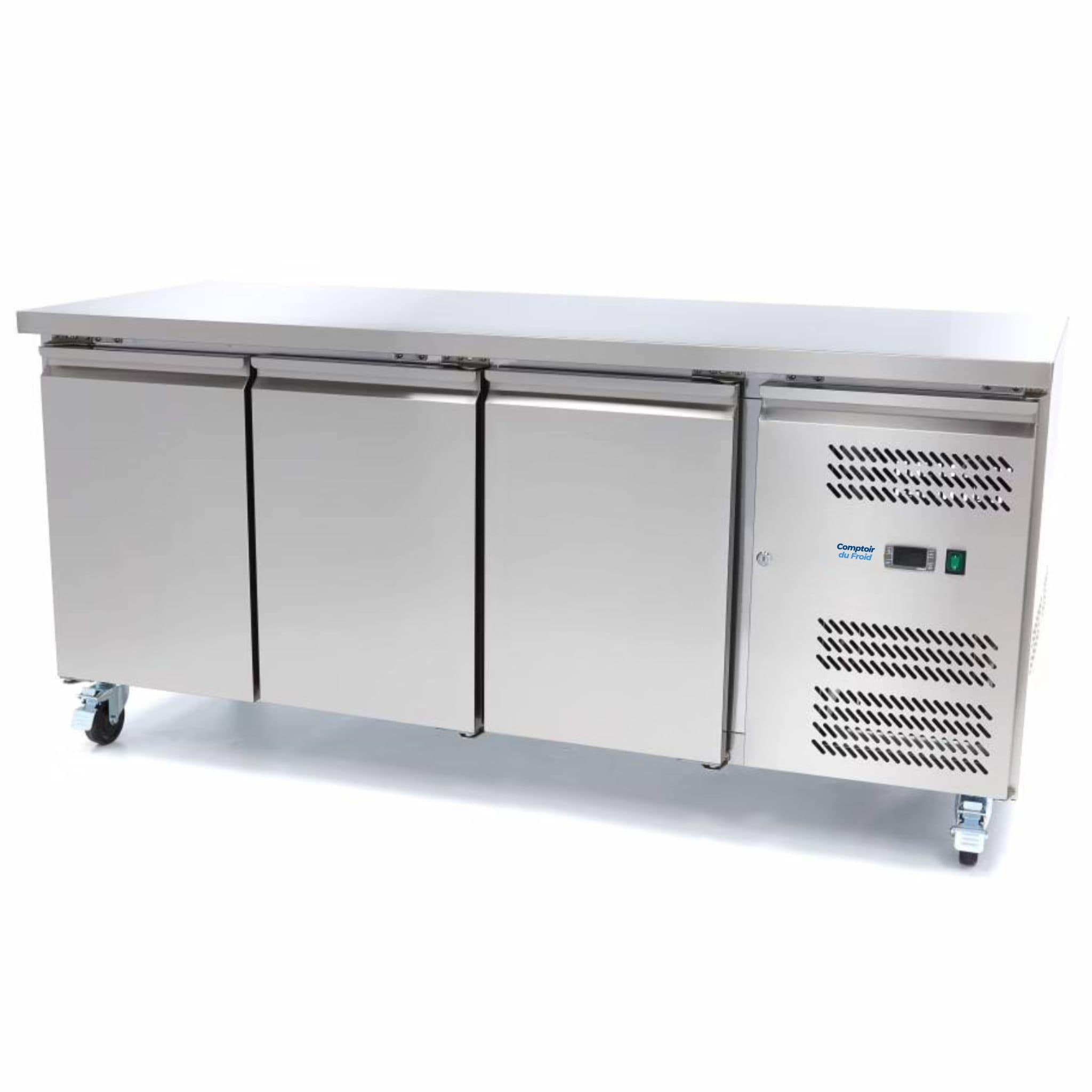
3-Door Positive Refrigerated Upright Cabinet 180cm (GN 1/1)
- Excellent choice if your priority shifts to storage volume.
- Practical vertical format for separating product families.
- Relevant alternative when the work surface already exists elsewhere.
What layout should be planned in a professional kitchen?
Before validating a 3-door refrigerated counter, an important layout question needs to be asked: where will it actually operate? The answer must take into account human traffic flow, circulation patterns, and proximity to hot or washing areas.
A well-placed counter reduces movement, limits long openings, and improves productivity. Recent market standards are also pushing towards more compact, better-zoned stations designed for repetitive tasks.
In practice, a successful layout generally adheres to the following principles:
- place the counter as close as possible to the plating or cold preparation area;
- avoid positioning it against a permanent heat source;
- allow enough clearance for door opening and GN handling;
- plan for easy cleaning around and under the unit;
- organize the interior by product family to limit unnecessary openings.
This logic not only improves service comfort but also temperature stability, which remains central for the cold chain and HACCP principles.
Should you invest in a 3-door refrigerated counter now?
The right question is: is the additional cost of a 3-door format justified? In many kitchens, yes, as long as the unit replaces both a work surface and part of the immediate cold storage.
The return on investment Maynly lies in three levers: less wasted time, less movement during service, and better organization of preparations. A well-sized counter also avoids the costly reflex of overloading a cabinet or multiplying poorly coordinated small units.
If you have high-volume service, a small but mobile team, or repetitive production, the 3-door refrigerated counter is often a more structuring purchase than it seems. It doesn’t just cool; it truly streamlines the workstation.
Need to compare the right models?
Discover our selection of positive refrigerated counters and upright cabinets to equip a professional kitchen with a format truly adapted to your service pace.
FAQ
Is a 3-door refrigerated counter sufficient for a traditional restaurant?
Yes, in many cases, especially if it serves as the Mayn preparation station with immediate cold storage.
What’s the difference between a 3-door refrigerated counter and a refrigerated worktop?
A 3-door counter generally offers more capacity and a more structured use for daily service.
Is the 3-door format suitable for a small kitchen?
Yes, provided the layout remains fluid and the length of the unit does not obstruct circulation.
Should I choose a 3-door counter or a refrigerated upright cabinet?
Choose the counter if you need a refrigerated work surface; choose the upright cabinet if your priority is vertical volume.