
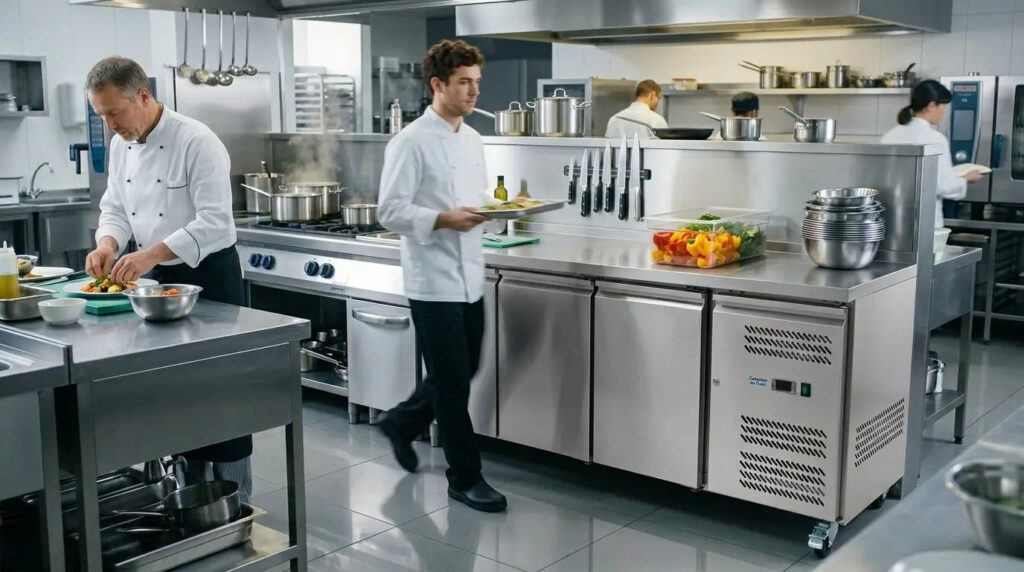
Yes, a used refrigerated counter might seem attractive in terms of price, but it’s rarely the best calculation if your kitchen relies on constant refrigeration during service. In the restaurant business, the real issue isn’t just the purchase price, but reliability, hygiene, and the cost of downtime when equipment breaks down too quickly.
In practice, used equipment is only defensible if the machine is recent, tested, traceable, and perfectly suited to your workflow. Otherwise, it’s often better to invest in a new, well-sized model, especially if your cold station operates every day.
Why are used refrigerated counters so appealing to professionals?
The answer is simple: the initial price seems more accessible. When you need to equip a kitchen, snack bar, or pizzeria without breaking the bank, second-hand items give the impression of quickly saving several hundred euros.
But this logic is only valid if the equipment still has a true reserve of reliability. A refrigerated counter works continuously, endures door openings, ambient heat, cleanings, and peak service hours. A worn-out model often costs more after the purchase than at the time of purchase.
- Lower initial budget, thus a reassuring purchase in the short term.
- Immediate availability on the local market or among professionals.
- False impression of a good deal when the condition of the refrigeration, seals, or unit is not truly checked.
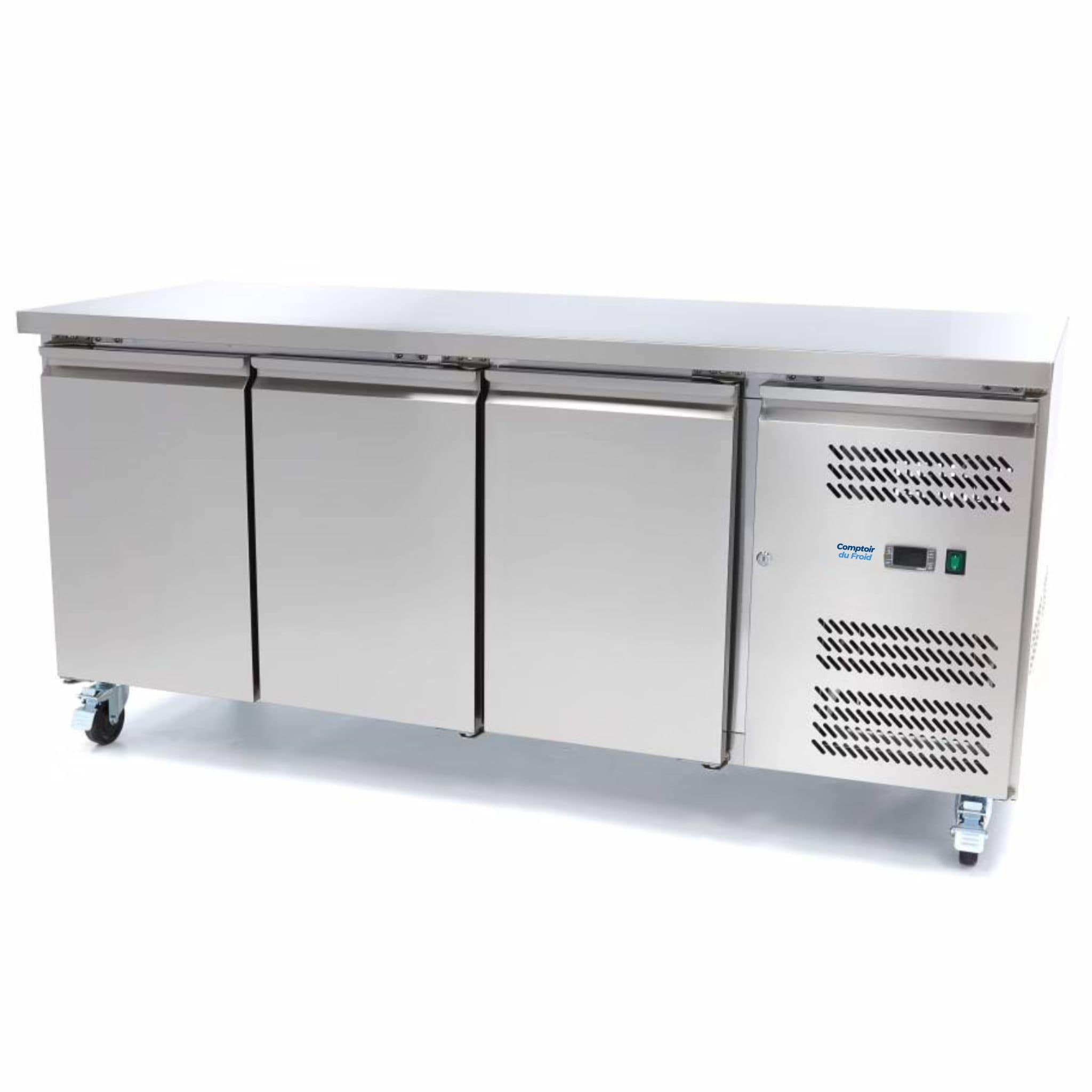
3-Door Positive Refrigerated Counter 180cm (GN 1/1)
- Balanced 3-door format to maintain real storage capacity under the worktop
- Practical GN 1/1 configuration for easy integration of pans and preparation flow in the kitchen
- New solution more reassuring if your cold station needs to last through all services without surprises
What are the real risks before buying a used refrigerated counter?
The key point is simple: you also buy the invisible history of the machine. If the counter has operated in a hot, poorly ventilated, or poorly maintained kitchen, its refrigeration unit may already be compromised, even if the stainless steel appears clean.
The risk is not limited to total breakdown. More frequently, the equipment still cools, but less quickly, less regularly, or with higher consumption. This is where the cold chain weakens and operational comfort declines.
The 5 points to absolutely check
Here are the most useful checks before making any decision.
- Actual temperature under load, not just an empty machine at the warehouse.
- Condition of seals, doors, and repeated closures.
- Maintenance history, refrigeration technician invoice, parts changed, age of the unit.
- Condition of the condenser and ventilation, often indicative of neglected use.
- Format compatibility, depth, width, GN capacity, and actual placement in your line.
Field advice: if the seller cannot prove a stable temperature, clear origin, and recent maintenance, consider the counter to be at high risk, even if the price seems attractive.
To determine the right size before buying, you can also read our guide on choosing between a 2-door or 3-door refrigerated counter.
When is buying used still defensible?
A used refrigerated counter can still be relevant if your needs are moderate, if you know the origin of the equipment, and if you accept a higher level of risk than with a new purchase. It can sometimes be defensible for a secondary station, a temporary opening, or a lightly loaded lab.
However, for a central cold line, sustained service, or a kitchen that cannot afford a breakdown, second-hand quickly loses its economic advantage.
| Situation | Used | New |
|---|---|---|
| Small, occasional throughput | Can be justified if the machine is tested and recent | Safer, but not always essential |
| Sustained daily service | High risk of breakdown and loss of efficiency | The most rational choice in the long run |
| Strict HACCP requirements | Traceability and stability sometimes insufficient | Better visibility into the actual condition of the equipment |
| Total cost over 2 or 3 years | Often increased by after-sales service, parts, and downtime | More transparent and often more cost-effective |
Verdict: if the refrigerated counter supports your Mayn prep, new is generally the best calculation. Used only makes sense if you truly understand the machine’s refrigeration condition and the station is not critical.
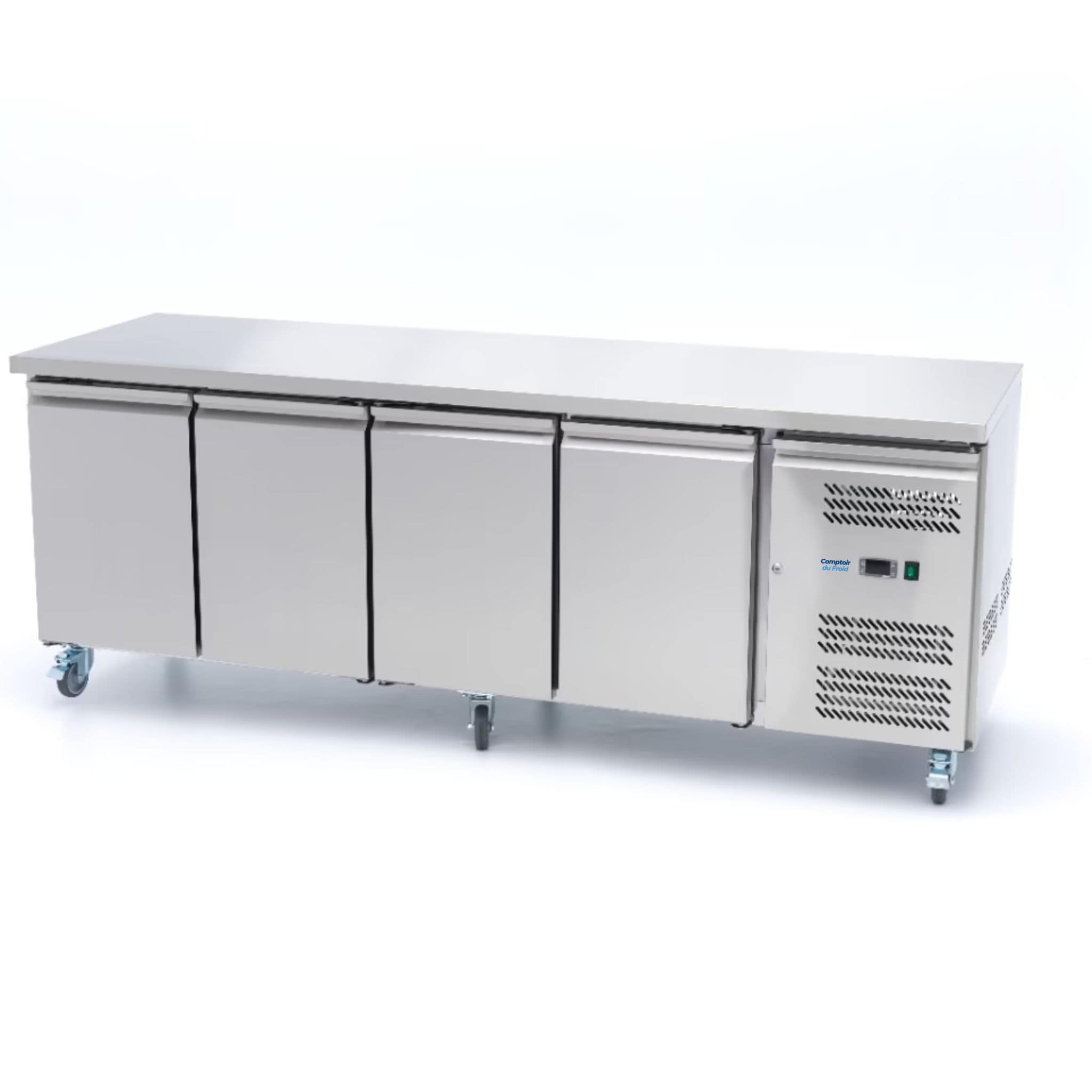
Large 4-Door Refrigerated Counter 223cm (XXL)
- Very large under-counter volume to relieve a team lacking cold storage at the station
- Useful 4-door format for better distribution of product families and limiting unnecessary openings
- Credible new alternative when an old used counter becomes too small or too uncertain
How to compare the advertised price to the true operating cost?
The right question isn’t “how much do I save today?”, but how much will this refrigerated counter cost me over 24 months. A cheaper used model can quickly lose all its appeal with a repair, a seal replacement, a drop in performance, or a disrupted day of service.
In practice, always add the following items to the advertised price:
- start-up and transport,
- refrigeration check,
- minor refurbishments,
- electricity consumption,
- cost of a breakdown during service.
If you are still hesitant about the overall sizing, our article on the professional refrigerated counter and its uses depending on the service helps avoid buying something too small or poorly placed.
What is the most coherent choice for your professional kitchen?
The answer Maynly depends on the equipment’s place in your workflow. If the refrigerated counter directly feeds preparation, plating, or service, you need a stable, clean, and easy-to-maintain appliance. Here, new retains a significant advantage.
If your need is more occasional or secondary, a serious used item can still be defensible, provided you check the actual cooling, seals, ventilation, and history. But as soon as your activity depends on the station, immediate savings often become an unnecessary gamble.
Need a more reliable refrigerated counter for your cold station?
Compare our professional models to choose a format consistent with your throughput, layout, and HACCP constraints.
FAQ on used refrigerated counters
Is a used refrigerated counter always a bad buy?
No, but it’s only worthwhile if its refrigeration condition, maintenance, and temperature stability are truly verified.
What is the Mayn risk with a used model?
The Mayn risk is a machine that still appears to work, but cools poorly under real conditions or becomes expensive in after-sales service.
Is a new 3-door counter better than a used 4-door?
If your station is strategic, a well-sized new 3-door counter is often safer than a worn 4-door counter that looks appealing on paper.
When should you give up on the idea of buying used?
As soon as the seller provides no serious test, no clear history, and no proof of stable temperature, it’s best to move on.


