
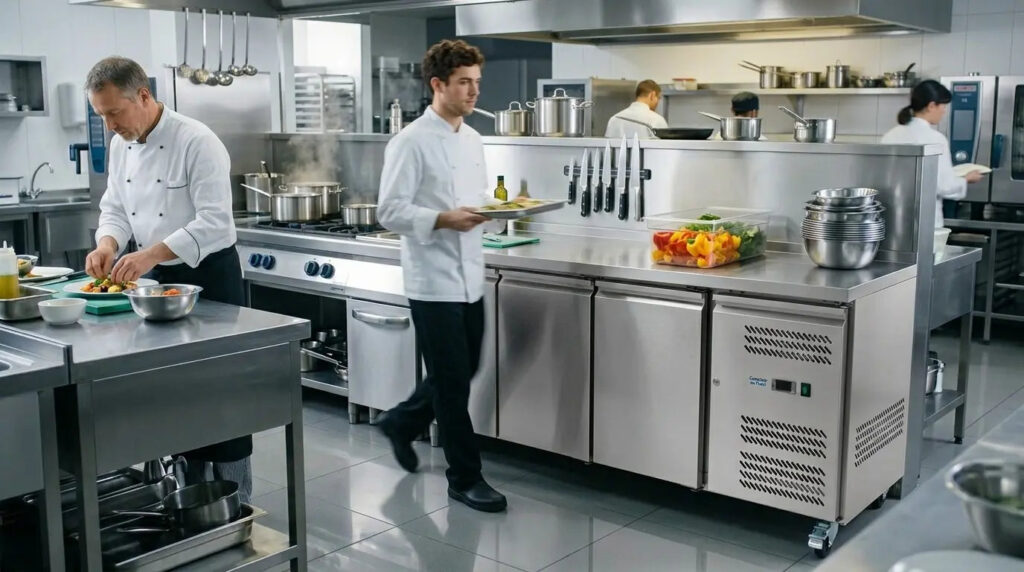
Between a 2-door refrigerated counter and a 3-door refrigerated counter, the right choice rarely depends on a simple difference in length. In a professional kitchen, the Mayn trade-off is between space, useful capacity, service speed, and working comfort. A model that is too compact can quickly become saturated during a rush. A model that is too long, on the other hand, can obstruct circulation and unnecessarily increase investment.
To make the right choice, you need to start from the practical needs: how many products need to be kept close at hand? How many operators work at the station? Do you have a narrow kitchen, a snack bar, a pizza station, or a continuous preparation line? It is this business logic that determines whether the 2-door format is sufficient or if the 3-door will be more profitable on a daily basis.
2-door or 3-door refrigerated counter: The real difference in a professional kitchen
On paper, the difference seems simple: one more door, therefore more storage. In practice, the difference is more strategic. The 2-door model is based on compactness and local fluidity, while the 3-door model becomes more relevant when a higher pace needs to be maintained with more mise en place available at the station.
| Criterion | 2-door refrigerated counter | 3-door refrigerated counter |
|---|---|---|
| Space Requirement | Compact, easier to integrate into a small kitchen | Longer, requires more thought in placement |
| Useful Capacity | Good for a snack station, a small team, or a secondary kitchen | More comfortable for a sustained preparation line |
| Ergonomics | Very good compromise between access and space-saving | Better comfort if multiple operators use the station |
| Profitability | Often easier to amortize if daily volume remains controlled | More relevant when under-counter storage becomes a real productivity lever |
| Typical Use | Snack bar, sandwich shop, bar, small brasserie, auxiliary cold station | High-volume restaurant, structured kitchen, continuous preparation |
Quick verdict: The 2-door is excellent when space is constrained and mise en place is controlled. The 3-door has an advantage when service becomes more intense, the number of containers increases, or several people work on the same line.
If you want to first frame the Mayn criteria for this type of equipment, you can also consult our complete guide to professional refrigerated counters.
When to choose a 2-door refrigerated counter?
The 2-door format is often the best choice when you are looking for a compact cold station, quick to access, and easy to make profitable. It works particularly well in kitchens where you want to keep sauces, garnishes, GN containers, or common preparations immediately at hand without extending the line.
- Small professional kitchen: you preserve circulation and other work areas.
- Snack bar / sandwich shop / pizzeria: you keep essentials close at hand during service.
- Auxiliary station: you add proximity refrigeration without creating too bulky a unit.
- Controlled budget: you invest only at the useful level, without oversizing.
This format is therefore consistent if your daily volume is compatible with a compact layout. However, it quickly becomes limiting if the team is constantly opening doors or if the mise en place is already overflowing at each service.
Practical advice: many searches for “2-door refrigerated counter” actually refer to refrigerated bases or 2-door positive refrigerated tables. If you are looking for a low under-counter unit, the actual use of the station should guide the choice, not just the commercial designation.
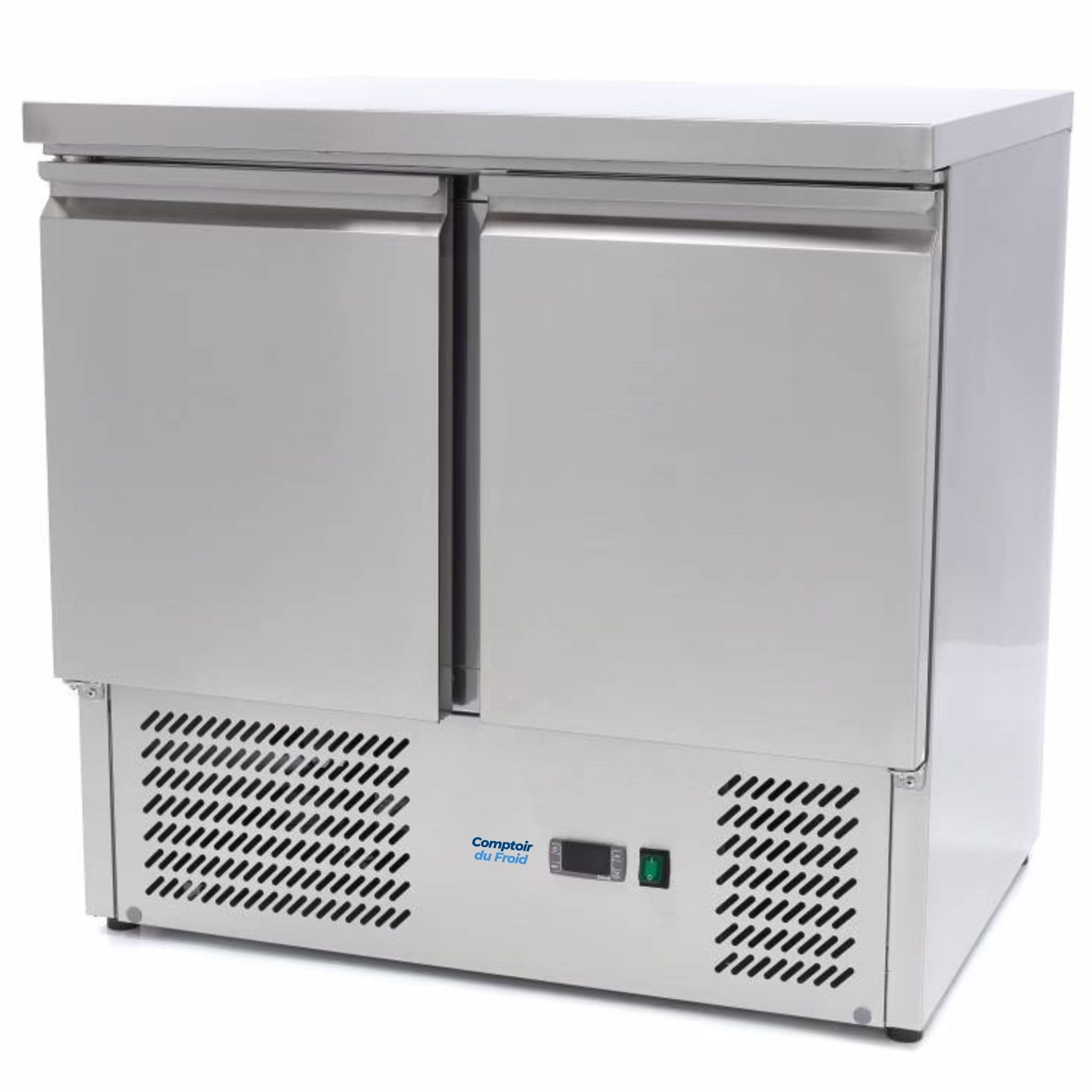
2-Door Positive Refrigerated Base 90cm – Stainless Steel
- Very compact format for snack bars, bars, or secondary kitchens
- Quick access to products during service
- Relevant solution if every centimeter counts
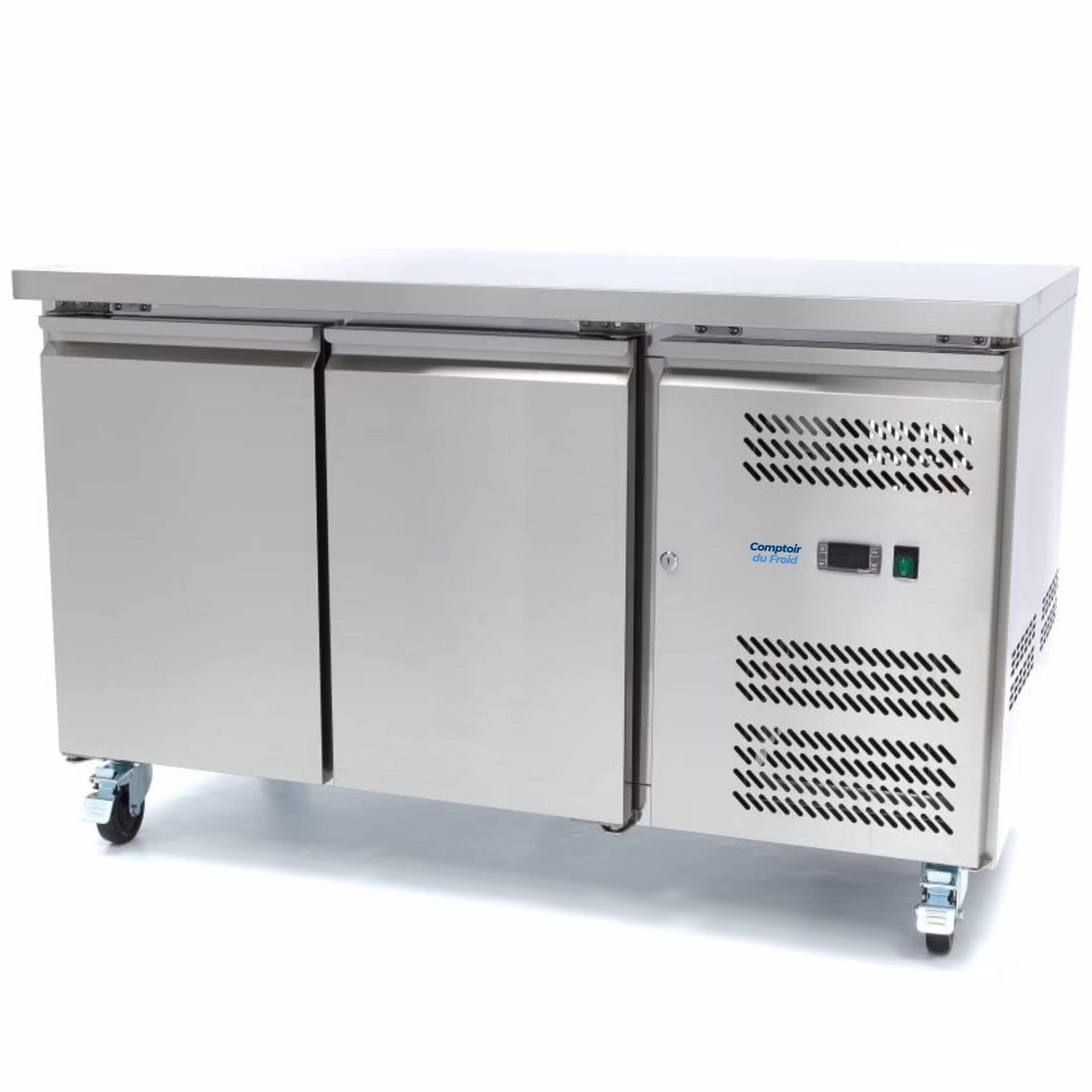
2-Door Positive Refrigerated Table 136cm (GN 1/1)
- Excellent compromise between compactness and useful capacity
- GN 1/1 compatible for smoother organization
- Very suitable for regular cold preparation stations
When does the 3-door refrigerated counter become more relevant?
The 3-door clearly has an advantage when the kitchen operates with more volume, more containers, and more repeated openings. It is often the right choice for a team that wants to avoid unit saturation during peak service, or for a preparation line where several items need to be constantly accessible.
In a high-volume restaurant, a busy pizza station, or a kitchen with continuous production, the 3-door provides a level of comfort that the 2-door cannot always offer: more product separation, more organizational flexibility, and fewer constant trade-offs in arrangement.
- More under-counter capacity without immediately needing to add another cold reserve.
- Better service continuity when the team frequently opens the doors.
- Clearer organization to separate sauces, garnishes, sensitive products, or daily preparations.
- More comfort for the team on a longer work line.
If your primary need is continuous capacity at the station, it makes sense to go for a more generous model. To delve deeper into this scenario, you can also read our article dedicated to the 3-door refrigerated table and the right format for your kitchen.
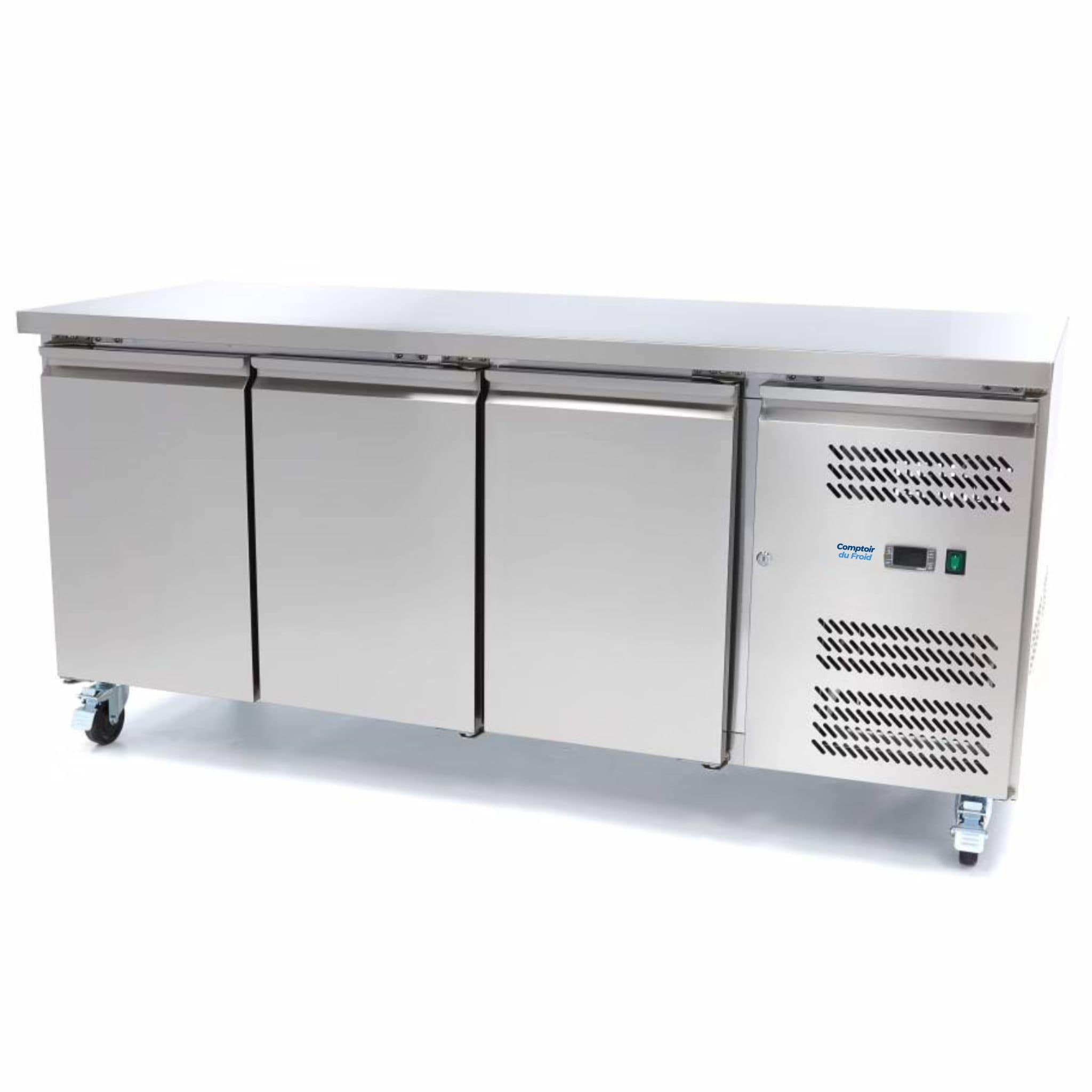
3-Door Positive Refrigerated Counter 180 cm (GN 1/1)
- 3-door format suitable for a more sustained preparation line
- Stainless steel worktop usable daily
- Better cold reserve at the station for busier kitchens
The 5 criteria that should truly decide between 2 doors and 3 doors
1. Available space in the kitchen
Always start with the actual layout. A badly placed 3-door can obstruct openings, break up circulation, or complicate cleaning. If the kitchen is narrow, the 2-door maintains a clear advantage.
2. Volume of products to keep at the station
If you frequently restock or already lack space in containers, the 3-door will be more suitable. If your mise en place remains short and rational, the 2-door may be largely sufficient.
3. Number of operators on the line
A station used by only one person can work very well with 2 doors. If several team members are working on the same unit, the 3-door provides more comfort of use.
4. Type of service
In snack bars, fast food, or secondary kitchens, compactness often takes precedence. In more sustained catering, continuous production, or a central preparation station, capacity becomes more strategic.
5. Investment logic
The right purchase is not the one that seems most complete, but the one that avoids both under-sizing and over-equipping. A saturated 2-door quickly becomes a hindrance. An overly ambitious 3-door can tie up budget and space without real operational gain.
Should you choose a single format or also compare similar equipment?
In many kitchens, the right answer is not limited to “2 or 3 doors.” You also need to verify if you are truly looking for a refrigerated counter, a refrigerated table, or a compact base. These formats often overlap in practice, but not always in their operational logic.
In practice, the best method is to start from your actual station:
- if you Maynly want to save space, the 2-door is often the most rational solution;
- if you want to accommodate more mise en place at the same station, the 3-door will be more suitable;
- if you are hesitant between several low units, also compare refrigerated bases and tables with similar GN formats.
Need to compare the right formats for your kitchen?
Find our selection of professional refrigerated counters and tables to choose the right compromise between compactness, capacity, and service fluidity.
FAQ on 2-door or 3-door refrigerated counters
Is a 2-door refrigerated counter sufficient for a restaurant?
Yes, if it’s for a small team, a snack station, or a secondary kitchen with controlled mise en place. As soon as the volume at the station greatly increases, the 3-door often becomes more comfortable.
When does the 3-door become more profitable than the 2-door?
The 3-door becomes more profitable when it avoids constant restocking, streamlines the work of multiple operators, and supports a denser service without saturating the cold station.
What is the difference between a refrigerated counter, refrigerated table, and refrigerated base?
In practice, their uses often overlap. The difference Maynly comes from the format, working height, GN compatibility, and how the unit integrates into your production line.
Should you choose the 2-door simply because it takes up less space?
No. You must primarily check if its capacity remains consistent with your pace, mise en place, and daily number of openings. Compactness is an advantage, but not if it causes saturation during service.