

A 4-door refrigerated counter becomes relevant when a professional kitchen lacks immediate under-counter storage volume, without wanting to multiply the number of cabinets near the workstation. In practice, it’s often the right size for brigades that produce a lot, work at several stations simultaneously, and want to keep raw materials as close as possible to the mise en place.
This format isn’t automatically the best everywhere. You Maynly need to check the available length, the number of truly useful pans or grids, the service pace, and the operational benefit of a large refrigerated worktop instead of several separate units.
When does a 4-door refrigerated counter truly become useful?
The real question is simple: do you need more cold volume directly on the preparation line? If the answer is yes, a 4-door model often becomes more logical than a 2- or 3-door model pushed to its limit.
In the field, this format is especially suitable for kitchens that combine several constraints: high ingredient turnover, a large number of GN pans, rapid plating needs, and a lack of time to retrieve items from the cold room during service.
- Large brigade: several operators use the same unit at the same time.
- Voluminous mise en place: sauces, garnishes, bases, fresh and semi-finished products must remain accessible.
- Busy service: limiting repeated openings of more distant cabinets improves flow.
- Linear station: a long cold stainless steel surface serves as both storage and workspace.
If you are still in the overall arbitration phase for this type of equipment, also read our complete guide to professional refrigerated counters. And if you are hesitating between more compact formats, our 2-door or 3-door comparison will help you define the right threshold before moving to a 4-door model.
What benefits can you expect from a 4-door model in a professional kitchen?
The Mayn benefit is direct: more capacity without disrupting workflow. A large refrigerated counter allows more products to be grouped in the same place, with a clearer overview of service stock.
In hospitality kitchens, this generally improves three points: speed, organization, and the stability of the cold chain. Fewer back-and-forth trips also mean fewer rhythm disruptions during peak hours.
The most tangible advantages
A 4-door unit isn’t just about “putting more things in.” It’s about better structuring the workstation.
- Zone distribution: one door per product family, per station, or per service time.
- Better visibility: avoids overcrowding compartments that are too narrow.
- Fewer manipulations: products remain closer to the task at hand.
- XL worktop: cutting, plating, or assembling on a continuous surface.
Field tip: a 4-door refrigerated counter truly becomes cost-effective when it replaces both an undersized unit and some trips to the cold storage. If its volume remains underutilized, you are primarily paying for unnecessary linear meters.
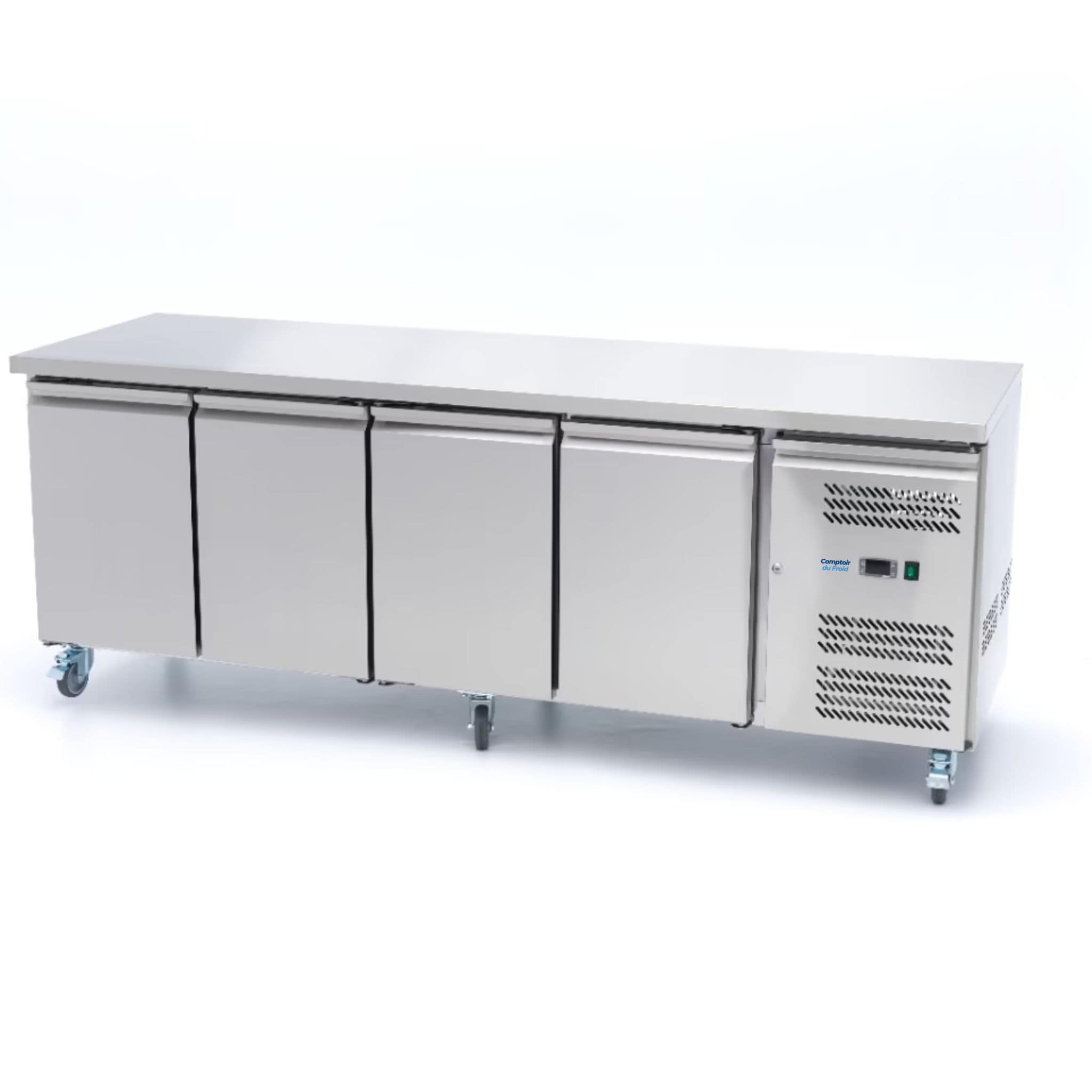
Large 4-Door Refrigerated Counter 223 cm (XXL)
- Large usable volume for brigades with extensive mise en place
- Long continuous stainless steel worktop for assembling, portioning, and plating
- Coherent format for centralizing several product families
How do you know if a 4-door unit isn’t too big for your station?
The right question isn’t “bigger = better?” but will the unit be intelligently filled without hindering circulation? A 4-door counter becomes a poor choice if its length blocks workflow or if the team never truly utilizes its capacity.
Before purchase, you need to measure the complete environment: clearance in front of the doors, proximity to hot zones, delivery access, outlet locations, and storage logic during service.
| Format | When it’s suitable | Main limitation |
|---|---|---|
| 2 doors | Small kitchen, snack bar, compact station, small team | Volume quickly saturated during busy service |
| 3 doors | Restaurant with regular production and need for a good compromise | May become insufficient for multiple simultaneous stations |
| 4 doors | Structured brigade, large mise en place, continuous under-counter storage needs | Requires a large footprint and a genuine operational need |
Verdict: If you primarily lack immediate service volume, the 4-door is often the best choice. If your Mayn constraint is space, a well-placed 3-door often remains the best compromise.
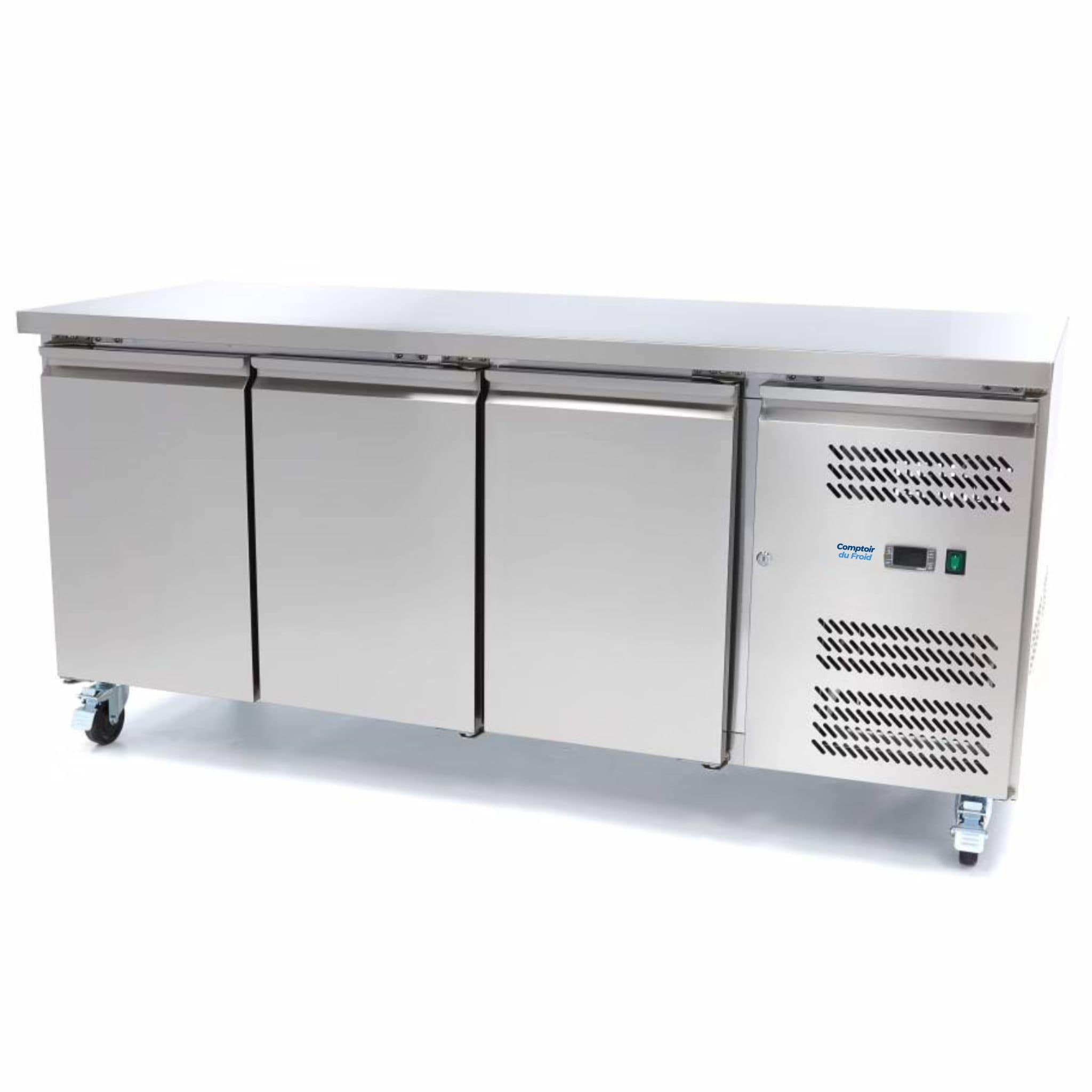
3-Door Positive Refrigerated Counter 180 cm (GN 1/1)
- Excellent compromise if a 4-door unit would be too long for the line
- Clear organization for a kitchen with sustained pace but constrained space
- Serious solution for staying close to the task without over-sizing
What technical criteria should you check before choosing your 4-door refrigerated counter?
Before validating a model, you need to answer a very practical question: is this unit suitable for your actual production routine? A good volume is not enough if the refrigeration, ergonomics, or GN compatibility are not up to par.
Recent market standards are pushing towards more performant units, but the decisive points remain classic.
- Actual usable capacity: check the number of levels and GN 1/1 or GN 2/1 compatibility depending on your habits.
- Type of refrigeration: for an intensive professional kitchen, ventilated refrigeration helps maintain a more uniform temperature.
- Worktop: thickness, resistance, ease of cleaning, and daily use.
- Cleaning and hygiene: accessible corners, easy-to-maintain seals, simple drain control.
- Installation: total width, depth, door opening, and staff circulation.
- Service load: number of covers, frequency of opening, and duration of peak hours.
From an HACCP perspective, the most common mistake is to overload the unit without a rotation logic. Even with a large refrigerated counter, strict organization of products, closed containers, and consistent zones must be maintained to limit cross-contamination.
Should you prefer a 4-door refrigerated counter over a refrigerated cabinet?
The question often arises: can a large counter replace a positive refrigerated cabinet? The answer is generally no. The two pieces of equipment do not have the same role.
The 4-door refrigerated counter is primarily a service and preparation tool. The refrigerated cabinet, on the other hand, is more relevant for larger vertical storage or storage further from the workstation. In practice, the counter brings refrigeration closer to the task, not to absorb the entire reserve.
The best setup for many kitchens combines:
- a cabinet for daily or half-day stock;
- a 4-door counter for ongoing mise en place and service;
- a simple restocking logic to avoid doors being open too long.
Looking for a true line-item piece of furniture to keep up the pace?
Discover our selection of positive refrigerated counters and tables to equip a fluid, clean, and profitable professional kitchen.
FAQ
Is a 4-door refrigerated counter useful for a small restaurant?
Not always. If your mise en place remains limited and the kitchen lacks space, a 2 or 3-door unit is often more coherent.
What’s the difference between a 4-door refrigerated counter and a positive cabinet?
The counter is primarily for under-counter service storage, while the positive cabinet is more designed for vertical storage.
Does a 4-door unit necessarily consume a lot more energy?
It can consume more than a compact model, but the impact Maynly depends on the quality of the unit, the type of refrigeration used, and its installation.
Which profession benefits most from a 4-door refrigerated counter?
Kitchens with high minute production, multiple active stations, and extensive mise en place, such as busy traditional restaurants, brasseries, or certain preparation labs.