
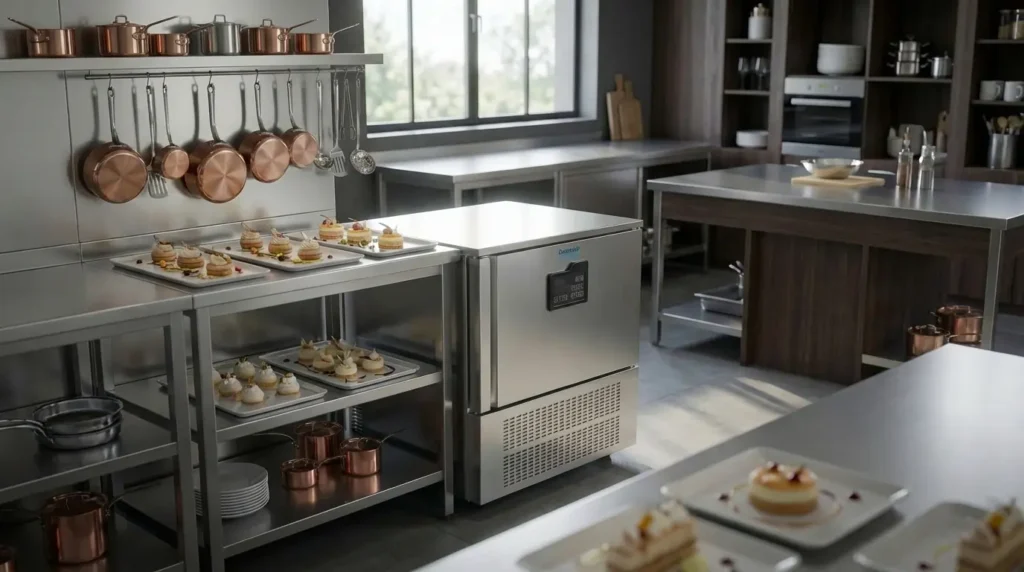
A 3-level blast chiller is sufficient when a professional kitchen wants to secure small batches, without taking up too much space or oversizing its equipment. It is a relevant format for a compact restaurant, a local pastry shop or a laboratory which cools regularly but in controlled volumes. On the other hand, it quickly becomes limited if several GN containers have to come out at the same time after each service.
What is a 3-level blast chiller really used for?
The right question is simple: do you need to cool few preparations, but often ? If so, the 3-level format is often more rational than a larger cell, because it reduces space requirements while providing a real rapid cooling cycle.
In the field, this format is Maynly aimed at positions where we work in small batches: sauces, creams, fillings, catering preparations, pastry inserts, cooked portions or placement trays. It does not replace a heavy production cell, but it avoids cooling in the open air or loading a cold cabinet too early.
- Compact restaurant: cooling of preparations after firing, without blocking a large kitchen area.
- Artisanal pastry: cooling of creams, inserts and plates 60 x 40 depending on machine compatibility.
- Low volume catering: securing short batches before storage or transport in cold transport.
- Snack or small central kitchen: better HACCP control without investing in a 5, 7 or 10 level format.
For kitchens where the Mayn issue is rather the lack of space, the article on the small blast chiller complements this layout logic well.
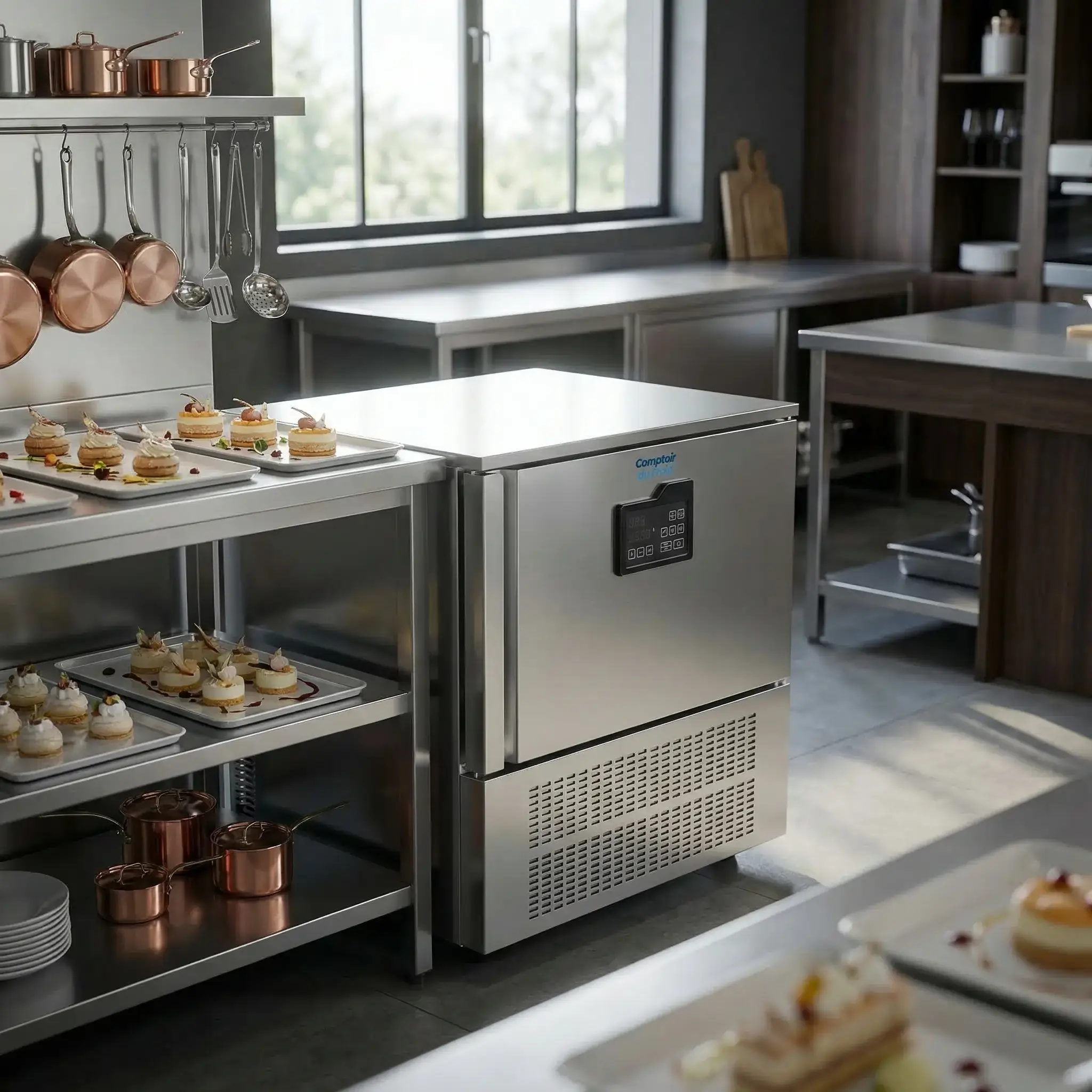
Stainless Steel Rapid Chiller – 3 levels
- Mixed GN 1/1 compatibility and 60 x 40 plates to serve both cooking and baking
- AISI 304 stainless steel construction with core probe for more durable and better controlled professional use
- Compact 3-level version, given for 10 kg in cooling and 5 kg in freezing per cycle
How do you know if 3 levels are enough for your cadence?
The answer depends less on the number of place settings than on your hot volume to cool per cycle. A 3-level cell is suitable if you can split production without creating a long wait between two batches.
The good reflex is to list the preparations that come out hot, their actual container and the time at which they must be cooled. If all the bins arrive at the same time, a small format quickly becomes a bottleneck. If production is spread out, it can on the contrary be perfectly efficient.
| Production situation | 3-level format | Larger format to consider |
|---|---|---|
| Small regular batches | Very suitable: short cycles, compact layout | Not necessary unless rapid growth |
| Several GN 1/1 containers after each service | Possible, but subject to strict planning | 5 or 7 levels to avoid waiting |
| Grouped catering production | Often too tight if everything comes out at the same time | 7, 10 levels or mobile model depending on flow |
| Pastry with 60 x 40 plates | Interesting if compatibility is confirmed | 5 levels if the batches come together quickly |
Verdict: choose 3 levels if your priority is reliable HACCP cooling on small volumes. If your real constraint is to absorb a big peak in production, the space gain will not compensate for the loss of throughput.
What limits should you anticipate before buying?
The Mayn limit of a 3-level cell is the simultaneous capacity. It can be excellent on a compact workstation, but it does not forgive poorly sequenced production.
Before purchasing, especially check the useful depth, GN or 60 x 40 compatibility, the presence of a core probe, ease of cleaning and ventilation location. A blast chiller remains food safety equipment: it must be installed in an environment where air circulates correctly and where the bins can enter without hazardous handling.
Refrigeration advice: do not size only on the number of levels. Dimension on the worst time of the day: exit from cooking, end of service, pastry production or catering preparation. This is where the cell must really play its role.
If you are hesitant with a larger model, the guide dedicated to the 5-level chiller helps you understand when upgrading to a larger size becomes profitable.
The right choice for a compact kitchen, but not for all productions
A 3-level blast chiller is a coherent choice when the objective is to professionalize cooling without disrupting the layout. It provides a real HACCP response to small kitchens that want to move away from DIY, but it requires a clear organization of cycles.
It is not the best choice for a kitchen that produces in mass, for a caterer who loads several trolleys or for a laboratory which must cool numerous plates continuously. In these cases, it is better to accept a larger format from the start rather than multiplying the waits between two cycles.
Need to compare cell formats?
Find professional blast chillers suitable for small kitchens as well as more intensive laboratories.
3 Level Chiller FAQ
Is a 3-level blast chiller suitable for a restaurant?
Yes, if the restaurant works in regular small batches. For a large group production, a 5 or more level format will often be more comfortable.
Can we use a 3-level cell in pastry making?
Yes, provided you check compatibility with the plates used, in particular the 60 x 40 format. This is relevant for creams, inserts and small series.
Is the 3 level format sufficient to comply with HACCP?
It may be sufficient if the volumes per cycle remain consistent. Compliance depends Maynly on cooling speed, temperature monitoring and batch organization.
When should you switch to a 5-level cell?
Switch to 5 levels if several bins arrive at the same time, if the cycles follow one another without pause or if the 3 level cell is already creating a wait in production.