
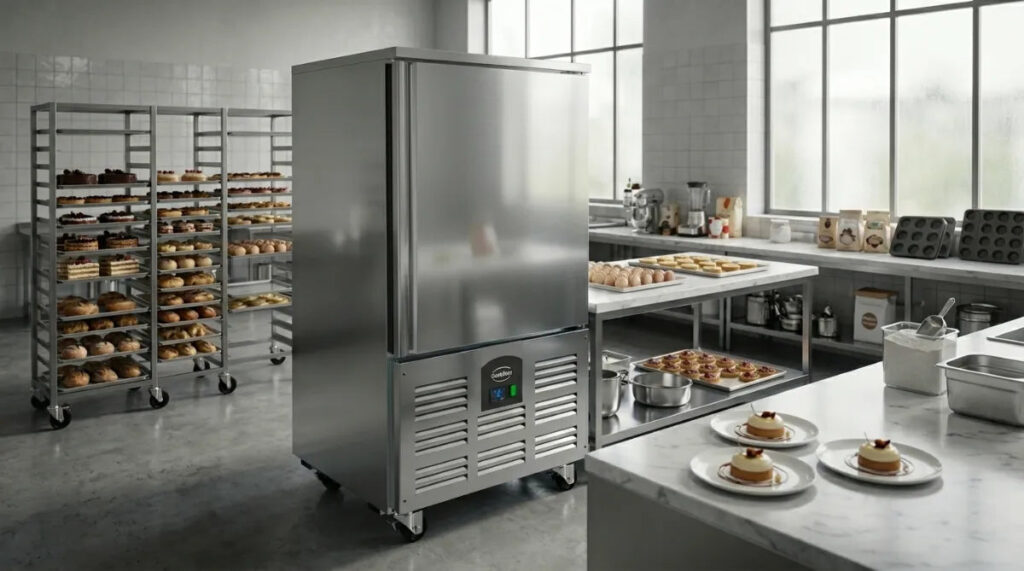
A 10-level blast chiller becomes relevant when a professional kitchen needs to handle several successive productions without disrupting service or falling behind on HACCP obligations. This format is not about “being generous” but about securing a significant volume of GN 1/1 containers or 600 x 400 trays during consecutive chilling phases.
In practice, the right choice depends less on the number 10 than on your pace, the type of production, and how you load the machine. If your teams are already juggling several batches, a 10-level unit can quickly become more cost-effective than a shorter model that gets saturated by mid-day.
When is a 10-level blast chiller truly justified?
The real question is simple: do you have enough volume to process to fill the machine without underutilizing it? A 10-level unit makes sense as soon as a restaurant, catering laboratory, pastry shop, or central kitchen needs to chill several preparations in parallel, while maintaining a margin for peak periods.
In the field, this format becomes coherent when the cold station works with anticipated productions, planned reheating, or volumes that quickly exceed the scope of a compact unit. It’s also a good benchmark when you want to avoid overly tight rotations that complicate organization at the end of service.
- you prepare several GN 1/1 containers or 600 x 400 trays in the same sequence,
- you need to chill quickly without tying up the entire team around a single small machine,
- you are looking for a more stable capacity for institutional catering, catering, or pastry,
- you want to maintain an HACCP margin during busy days.
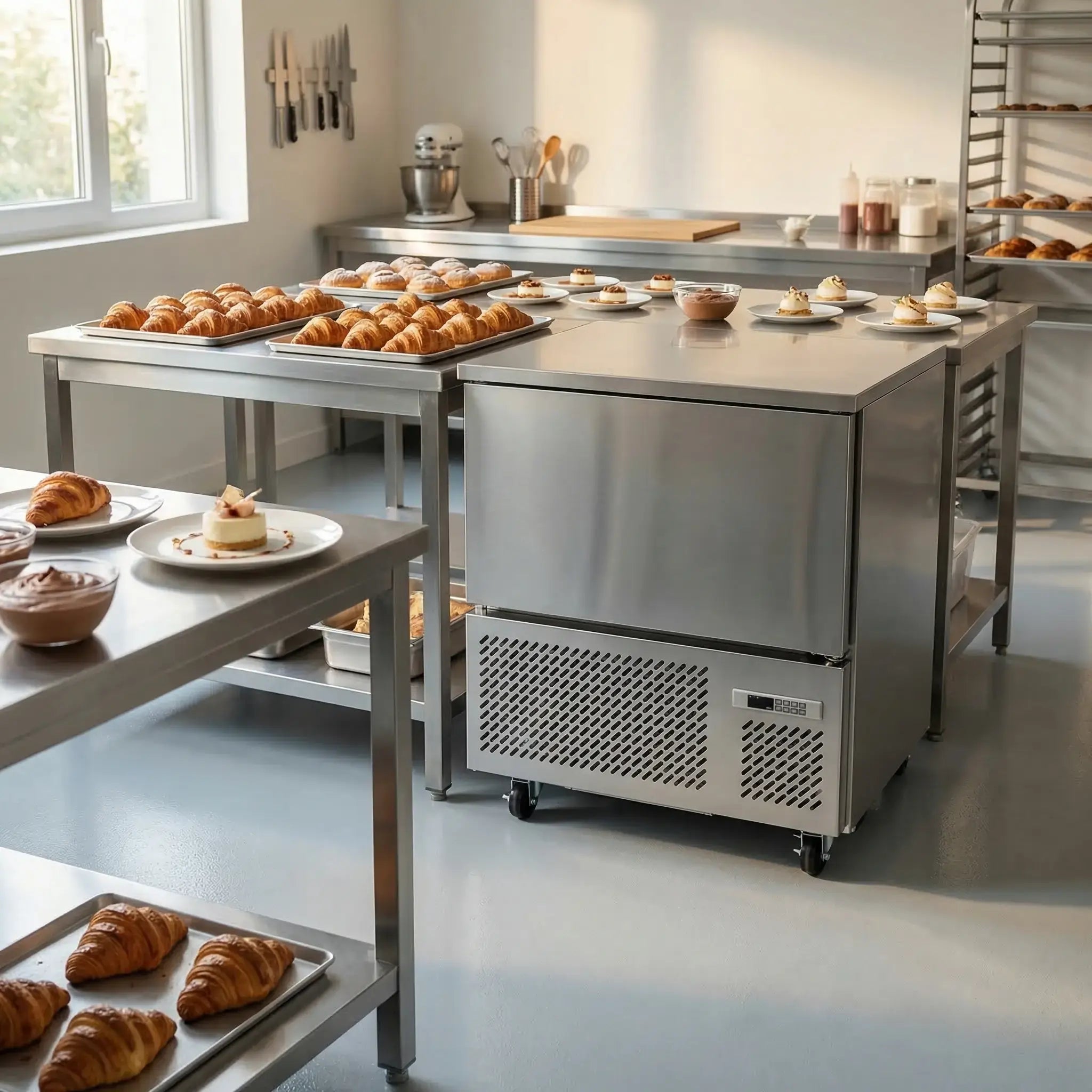
Stainless Steel Blast Chiller – 10 levels
- GN 1/1 and 60 x 40 compatibility designed to handle large volumes on a single machine
- AISI 304 Stainless Steel construction with core probe for finer control of HACCP cycles
- Expert 10-level format, rated for 40 kg for chilling and 28 kg for freezing per cycle
How do you know if 10 levels are better than a 5-level unit?
The short answer is: 10 levels are more suitable when your Mayn problem is pace, not just the lack of one or two shelves. If your production is already strained with a 5-level unit, upgrading to 10 levels avoids multiplying cycles and delaying subsequent setup.
Conversely, if your kitchen operates with smaller volumes or in a very confined space, a more compact unit may remain more rational. This is the tipping point between useful capacity and an oversized machine.
| Decision point | 5-level unit | 10-level unit |
|---|---|---|
| Volume per cycle | Suitable for a small team or short productions | More comfortable for several successive productions and large services |
| Daily pace | Good if loads remain regular and moderate | More comfortable when peaks are frequent |
| Footprint | Easier to fit in a compact kitchen | Requires a true layout plan and a more structured workflow |
| HACCP margin | Can become tight if containers accumulate | More secure when volumes increase quickly |
Verdict: if you primarily lack flexibility during busy days, the 10-level unit offers real relief. If your Mayn concern is space saving, stick to a shorter format.
To compare with a smaller size already considered for purchase, you can also read our article on the 5-level blast chiller.
Practical advice: a 10-level unit is most beneficial if your teams load the unit uniformly and anticipate exits. A large capacity that is poorly organized will not compensate for poor container flow.
What technical criteria should be checked before buying?
Before validating the format, you need to check its actual compatibility with your production. A 10-level unit can look excellent on paper but disappoint if the kitchen does not have the right layout, the right standard of containers, or the right power available.
The Mayn points to look at are GN 1/1 or 600 x 400 compatibility, the advertised chilling capacity per cycle, the presence of a core probe, the quality of construction, and whether it’s mobile or fixed depending on your station. For this type of equipment, durability and cleaning are as important as volume.
The most useful purchasing benchmarks
- support format: check that the unit accepts your containers or trays without modification,
- actual load: think not only in terms of the number of levels, but in kilos processed per cycle,
- layout: plan for circulation space, door opening, and handling,
- hygiene: prioritize AISI 304 Stainless Steel and easy-to-clean components,
- control: a core probe helps secure the protocol rather than working “by guesswork”.
If your priority is primarily to secure good temperature reduction benchmarks, our article on HACCP temperature in blast chillers complements this topic well.
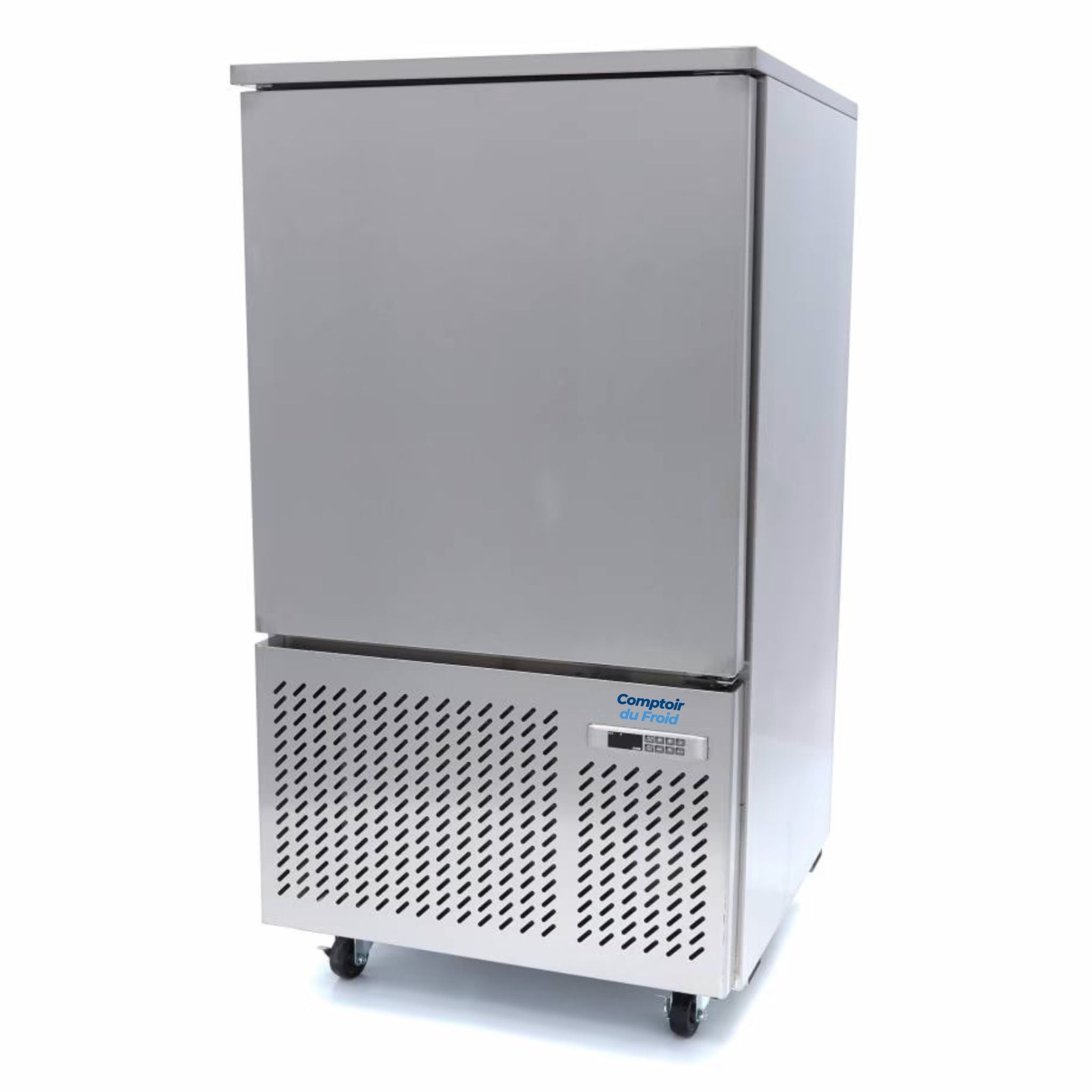
Fixed Blast Chiller – Inox 304 – 10 levels
- AISI 304 Stainless Steel construction and 2.2 kW power for a true production format in a professional kitchen
- 10-level version rated for 30 kg for chilling and 25 kg for freezing per cycle
- Relevant model for caterers and restaurants that need to absorb a larger volume
Which businesses is this format best suited for?
A 10-level unit primarily caters to businesses where volume must be absorbed without breaking regularity. It is often the right format for caterers, restaurants with extensive mise en place, pastry laboratories, and certain multi-service organizations.
It is less relevant for small businesses that produce little, or that have neither the space nor the sufficient rotation to fill such a format. The right purchase is not the largest, but the one that matches your actual pace.
- caterers: interesting if cycles are continuous and volumes increase quickly,
- restaurants with extensive anticipation: useful for smoothing out preparation and maintaining throughput,
- pastry shops: relevant when trays and containers multiply during the same production period,
- small snack kitchens: often oversized if the activity remains simple and short.
Looking for the right unit for your actual volume?
Browse our selection of professional blast chillers to compare formats, capacities, and useful configurations for professional kitchens.
FAQ about the 10-level blast chiller
Is a 10-level unit necessarily reserved for large kitchens?
No. It is Maynly suitable for structures that have regular peaks or several productions to chill in the same sequence.
Can a 10-level unit be used in pastry?
Yes, especially if the model accepts 600 x 400 trays and if the laboratory works on several close batches.
Is the number of levels sufficient for selection?
No. You also need to look at the actual load per cycle, the layout, the core probe, and compatibility with your supports.
Does a 10-level unit always take up the space of a full cabinet?
Not necessarily, but it requires careful consideration of space and circulation around the station before purchase.