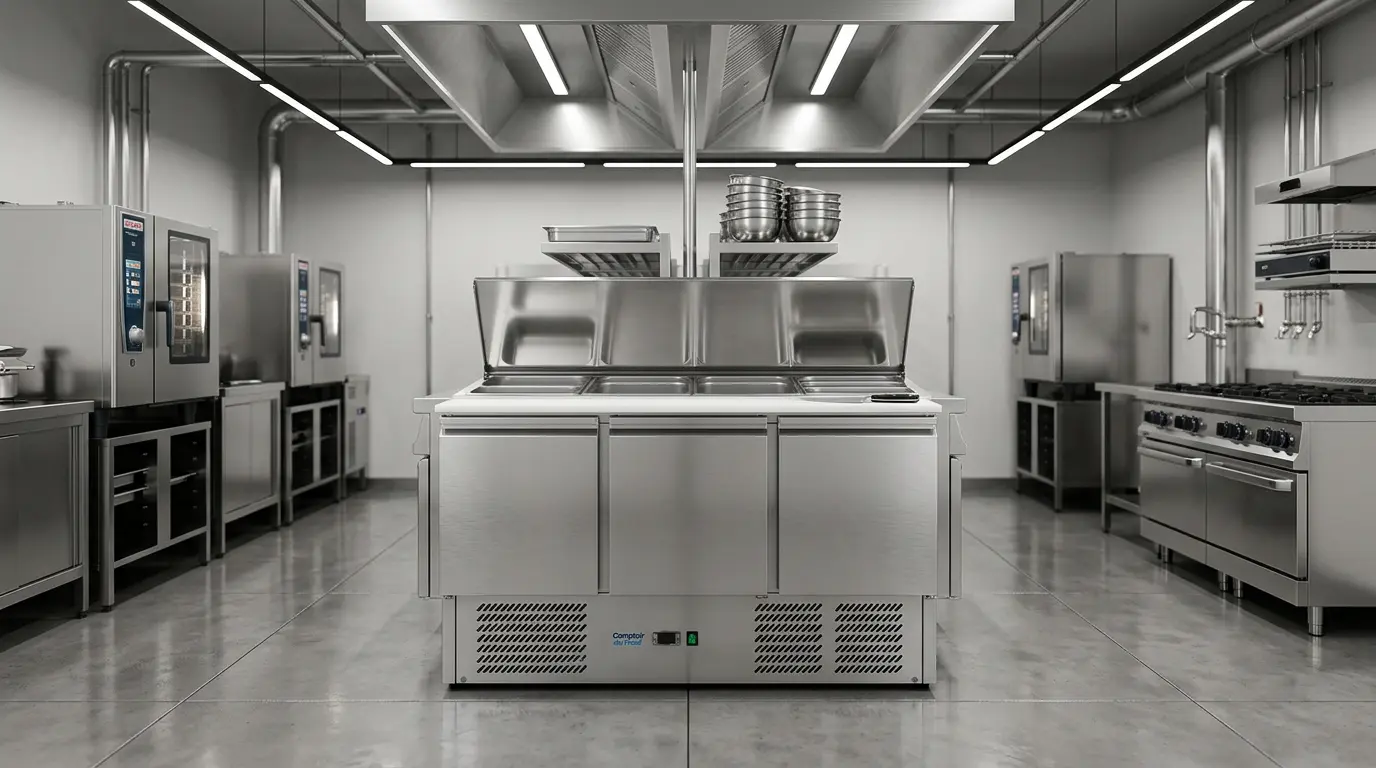
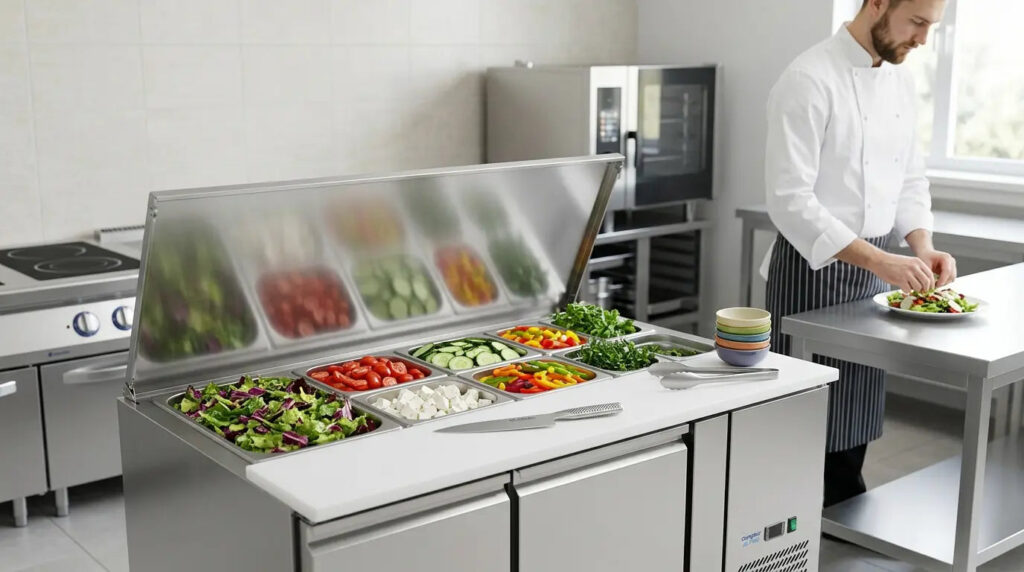
In fast food, snack bars, sandwich shops, or prep kitchens, the refrigerated saladette is as strategic a workstation as cold storage equipment. It allows ingredients to be kept at the right temperature, speeds up plating, and streamlines service without sacrificing hygiene. When chosen well, it improves productivity, limits waste, and secures your daily operations.
The real challenge, therefore, is not just finding an “inexpensive” saladette, but selecting a model that aligns with your production volume, layout, and work method. If you’re still hesitating between different types of refrigerated units, our professional refrigerated counter guide can also help you distinguish between storage and preparation uses. For pizza concepts, we’ve also detailed the key points in our refrigerated pizza prep table guide.
What exactly is a refrigerated saladette used for?
A refrigerated saladette is a professional low-level unit designed to prepare, temporarily store, and keep cold ingredients within reach during service. It is often found in the following environments:
- sandwich shops and snack bars;
- salad, poke bowl, or wrap restaurants;
- pizzerias for toppings;
- communal kitchens for mise en place;
- bars and hotels for cold preparations.
Its Mayn advantage is to combine a work surface + refrigerated storage + quick access to ingredients in a single station. The result: fewer movements, fewer door openings on other refrigeration units, and a more consistent production rate during peak hours.
Why this equipment is profitable in a professional kitchen
A good saladette is not only practical: it has a direct impact on profitability. By centralizing fresh ingredients at the preparation station, you reduce the assembly time for each order. During busy services, this gain quickly becomes significant.
- Improved flow: bins are visible and immediately accessible.
- Better preservation: sensitive ingredients remain within an appropriate temperature range.
- Less waste: organization by bins and zones reduces forgotten items and spoilage.
- Enhanced hygiene: clearer separation between storage, preparation, and service.
For a hospitality establishment, the objective is simple: maintain service pace while remaining clean, compliant, and consistent.
Essential criteria for choosing a refrigerated saladette
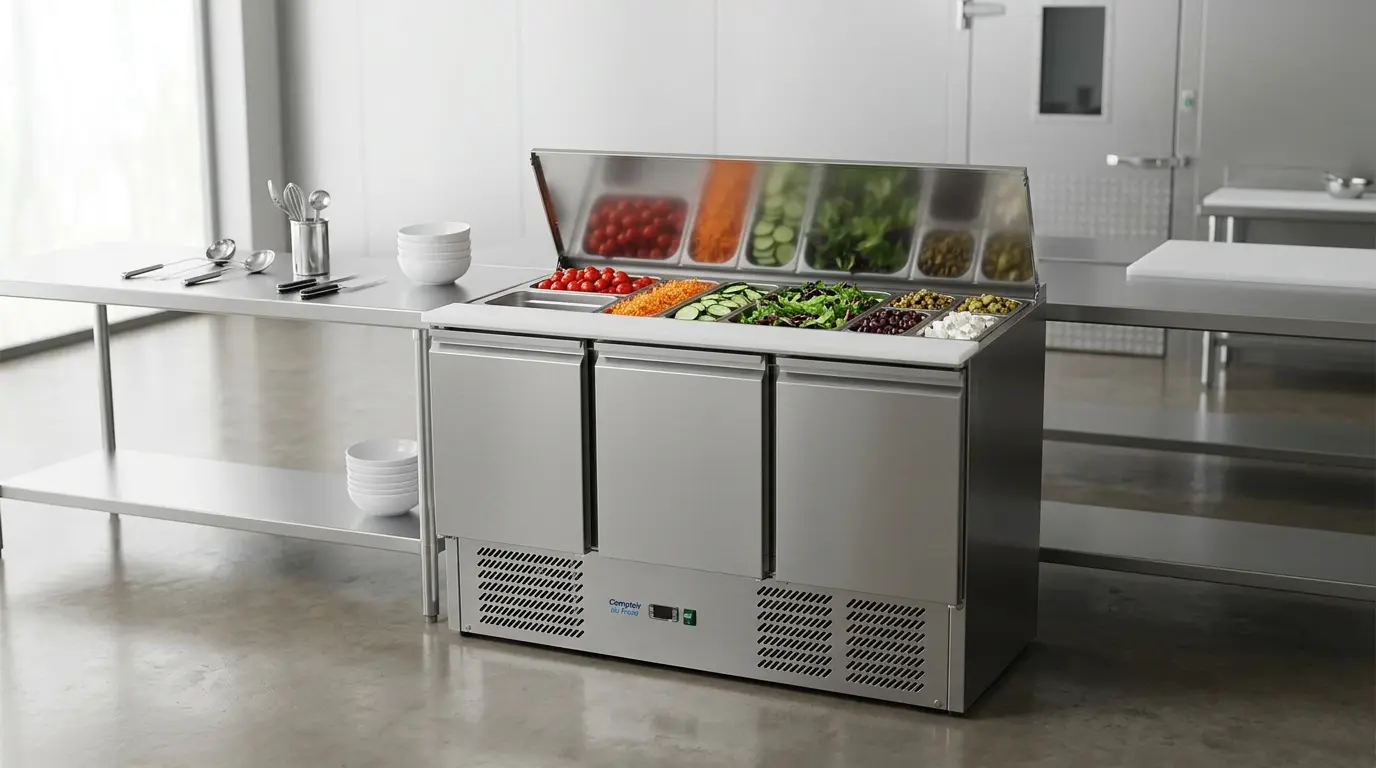
To make the right choice, focus on 4 points: the number of doors, the GN configuration, the work surface, and ease of cleaning. A 2-door model is often sufficient for a snack bar or small sandwich shop. A 3-door model becomes more appropriate when the menu expands, throughput increases, or multiple ingredient families need to be ready simultaneously.
GN compatibility remains essential: the right station is one where the containers follow your assembly logic, without unnecessary movements. Finally, stainless steel remains the most logical choice for its robustness, ease of cleaning, and durability.
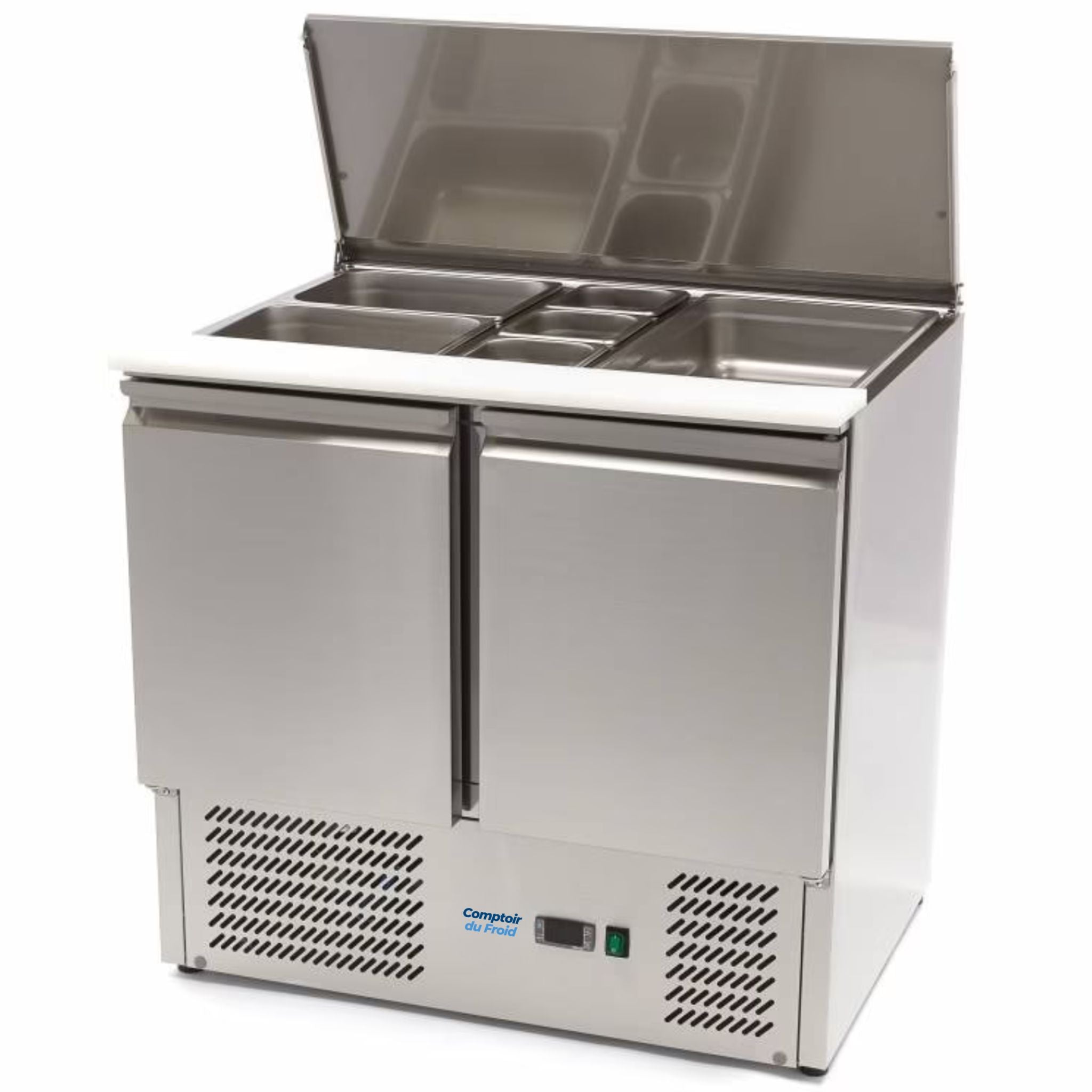
Stainless Steel Refrigerated Saladette 2 Doors 90cm (Stainless Steel Lid)
- Compact format ideal for snack bars, sandwich shops, and small prep areas
- Practical stainless steel top for quick order assembly
- Good balance between footprint, cold storage, and budget
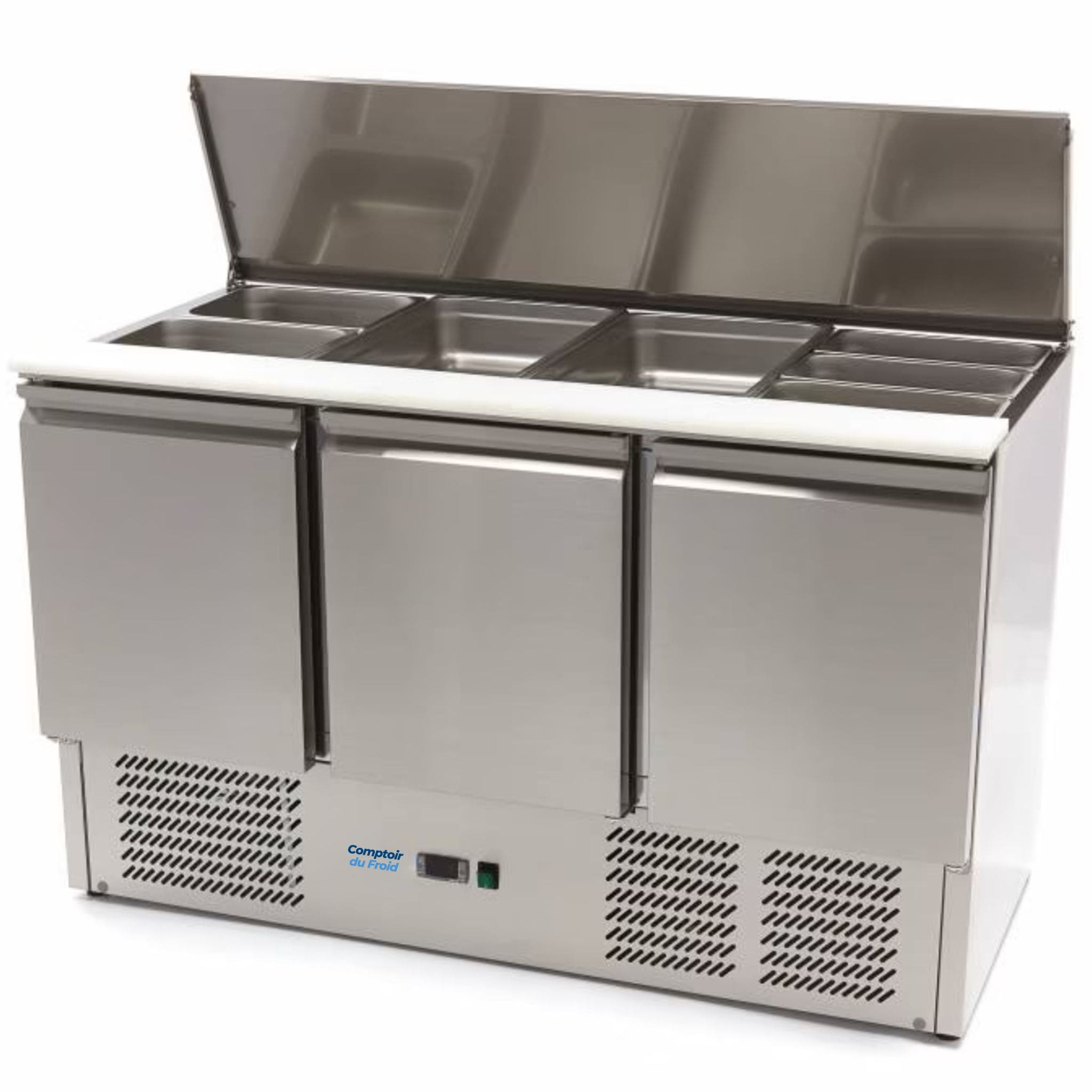
Stainless Steel Refrigerated Saladette 3 Doors 137cm (Stainless Steel Lid)
- Superior capacity to handle sustained service
- More comfort for organizing multiple ingredient families
- Excellent choice for pizzerias, fast food, or denser production
What size to choose based on your establishment?
Here’s a quick guide to sizing your needs:
| Type of activity | Recommended format | Why |
|---|---|---|
| Snack / small sandwich shop | 2 doors | Space-saving, quick access, controlled investment |
| Pizzeria / busy fast food | 3 doors | More storage, more comfort during rush hour |
| Production kitchen / communal catering | 3 doors or specialized station | Increased ingredient variety and better service continuity |
The right sizing depends less on the theoretical number of covers than on the density of service over a short period. If you work with very pronounced peaks, it’s better to avoid an undersized model.
2-door or 3-door saladette: which to choose?
The choice between 2 and 3 doors is often the real decision point. A 2-door model is often sufficient if you have few items, limited space, and a manageable service. A 3-door model becomes more relevant if the menu expands, if multiple operators work at the station, or if your services are very dense.
Common mistakes to avoid
Many failed purchases result from an incorrect assessment of needs. Here are the most common mistakes:
- Undersizing the unit by only looking at available space.
- Confusing storage and preparation: a refrigerated cabinet does not offer the same ease of use.
- Neglecting GN containers and the actual organization of the station.
- Choosing solely based on price without considering service pace.
- Forgetting daily cleaning in an HACCP environment.
A profitable saladette is a model that aligns with your work process, not just a technical specification sheet.
Our advice for a good purchase
If you are launching or optimizing a point of sale, start by estimating:
- the number of ingredients actually used simultaneously;
- the length of your preparation line;
- the number of operators at the station;
- the intensity of peak hours.
Then, choose a model that gives you a comfort margin. In professional kitchens, a slightly oversized unit is often more profitable than a station that is saturated after a few weeks.
Need a saladette that matches your throughput?
Compare our saladettes and preparation tables to choose the right format according to your space, your menu, and your service rhythm.
FAQ: refrigerated saladette
What is the difference between a saladette and a refrigerated counter?
A saladette is designed for preparation with direct access to ingredients, whereas a refrigerated counter is often more focused on cold storage under a worktop.
Is a 2-door saladette sufficient for a snack bar?
Yes, in many snack bars and sandwich shops, a 2-door model is sufficient if the number of ingredients remains manageable and the throughput is not too high.
Why choose a stainless steel saladette?
Stainless steel is robust, easy to clean, hygienic, and well-suited for intensive use in a hospitality environment.
How do I know if I need to upgrade to a 3-door model?
If you lack storage space, if your menu is expanding, or if your services are very dense, a 3-door model offers better operational comfort.