
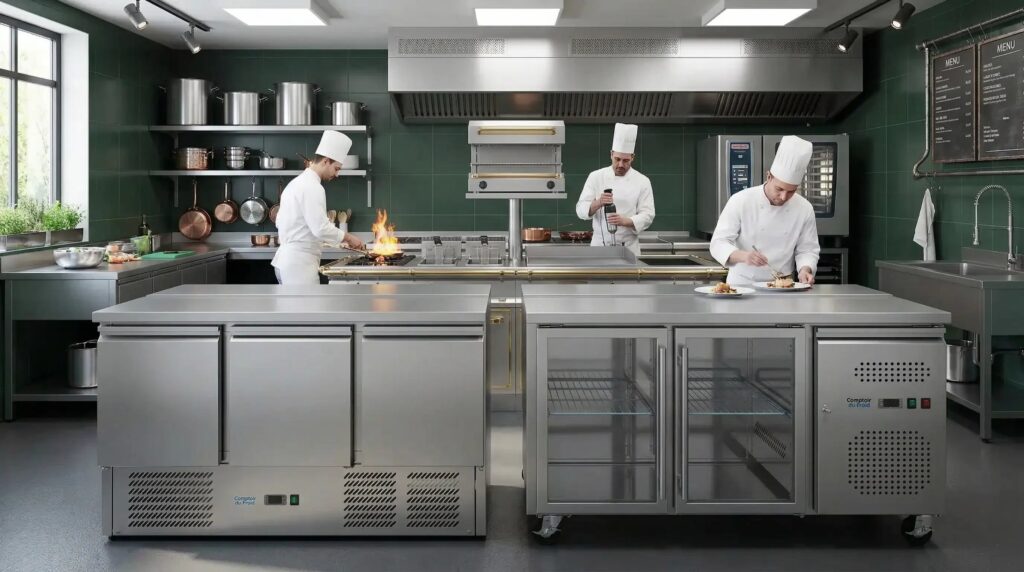
A negative refrigerated table is the right solution when you need to store frozen products as close as possible to the production station while maintaining an immediately usable stainless steel worktop. In a professional kitchen, it saves steps, secures the negative cold chain, and speeds up service where every door opening counts.
In practice, the right choice depends primarily on your throughput, the volume to be kept in reserve, the GN format used, and the actual space available in the kitchen line. It’s less of a “catalog” purchase and more of a trade-off between capacity, speed of access, and endurance in service.
What is a negative refrigerated table really used for in a professional kitchen?
A negative refrigerated table is used to store frozen products under a worktop, without having to make multiple trips to a distant cabinet or chest freezer. The short answer: it combines negative storage + preparation surface in a single piece of equipment.
In the field, this format is particularly useful in kitchens where setup must remain fluid: snack bars, fast food, institutional catering, preparation laboratories, or finishing stations. Where a negative cabinet offers more vertical volume, the negative table provides a real advantage in terms of layout, especially when the service flow requires quick access to frozen trays, boxes, or sheets.
If you’re still hesitating with a positive model, our article on the right refrigerated table format for a professional kitchen can clarify general use before deciding on a negative one.
- Reduced travel between storage area and worktop
- Improved service continuity during peak hours
- Cleaner organization of the most frequently used frozen items
- Space saving in compact or very linear kitchens
What criteria make the difference when choosing?
The right criteria are simple: you need to size the equipment according to the volume actually handled, the frequency of opening, and the logic of service. The direct answer: a negative table is not chosen solely by length, but by operational use.
Recent market standards recommend prioritizing GN compatibility, type of cold, stainless steel quality, temperature stability, and door ergonomics. A table that is too small forces overstocking in another appliance; a table that is too large consumes more space and energy than necessary.
Points to validate before purchase
Here are the most important criteria to avoid sizing errors:
- Number of doors: 2 doors for a compact station, 3 doors for an intermediate brigade, 4 doors for high throughput.
- Interior format: check GN 1/1 compatibility or the containers used in your service.
- Type of cold: ventilated cold is often more suitable for repeated openings and faster return to set point.
- Power and recovery: essential if the appliance operates in a hot environment or sustained service.
- Worktop: thickness, finish, and resistance are as important as the refrigeration part.
- Maintenance: access to the unit, gaskets, internal corners, and drainage must remain easy to clean.
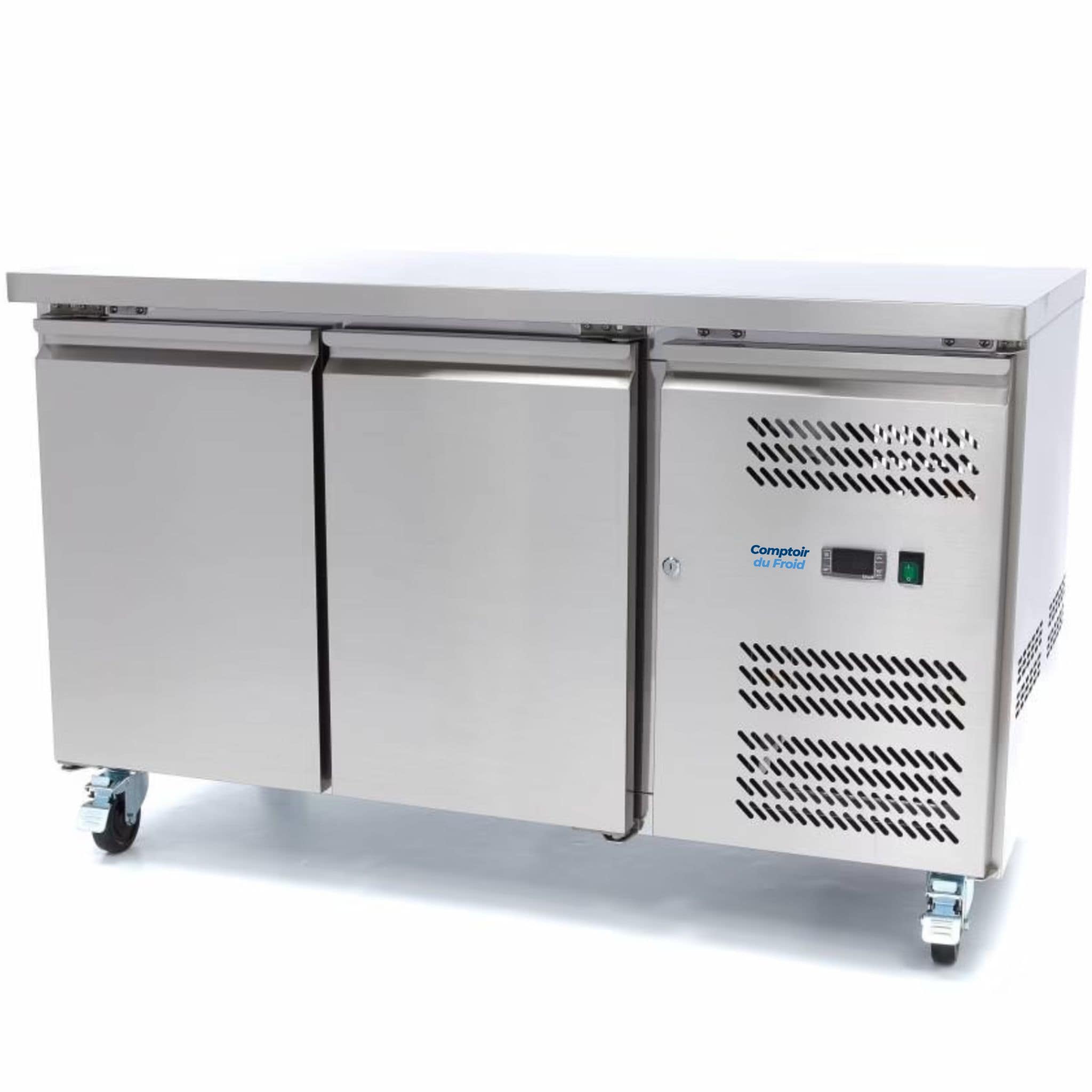
2-Door 136 cm GN 1/1 Freezer Table
- Compact format ideal for tight preparation stations
- Robust stainless steel top for intensive daily use
- Quick access to the most frequently used frozen items during service
Which format to choose between 2, 3, and 4 doors?
The right format depends primarily on the throughput and the number of items you want to keep at the station. The short answer: 2 doors for compact efficiency, 3 doors for balance, 4 doors for service power.
In practice, many mistakes come from a poor trade-off between capacity and circulation. A table that is too long hinders movement, while an undersized table forces teams to open other appliances in parallel, which breaks the rhythm of service.
| Format | For what use? | Strengths | Watch out for |
|---|---|---|---|
| 2 doors | Snack bar, bar, small restaurant, auxiliary station | Compact, quick access, easy installation | More limited volume for large services |
| 3 doors | Brasserie, versatile kitchen, regular service | Very good compromise between capacity / footprint | Requires real linear space |
| 4 doors | Sustained production, institutional catering, extensive setup | Large volume, clearer separation of items | Higher investment and floor space |
Verdict: if your kitchen is compact or if the table is Maynly used to support a specific station, the 2-door format remains the best compromise. For a brigade that works quickly with several families of frozen products, the 4-door becomes relevant as soon as service is busy and repetitive.
To refine your choice on the most common dimensions, you can also consult our guide on the 2-door refrigerated table in a professional kitchen, useful for comparing actual footprint and station ergonomics.
Field tip: a high-performance negative table does not replace a well-designed Mayn storage. It should accommodate fast-moving items, not become a perpetually saturated “buffer” freezer. This is often the most common mistake in busy kitchens.
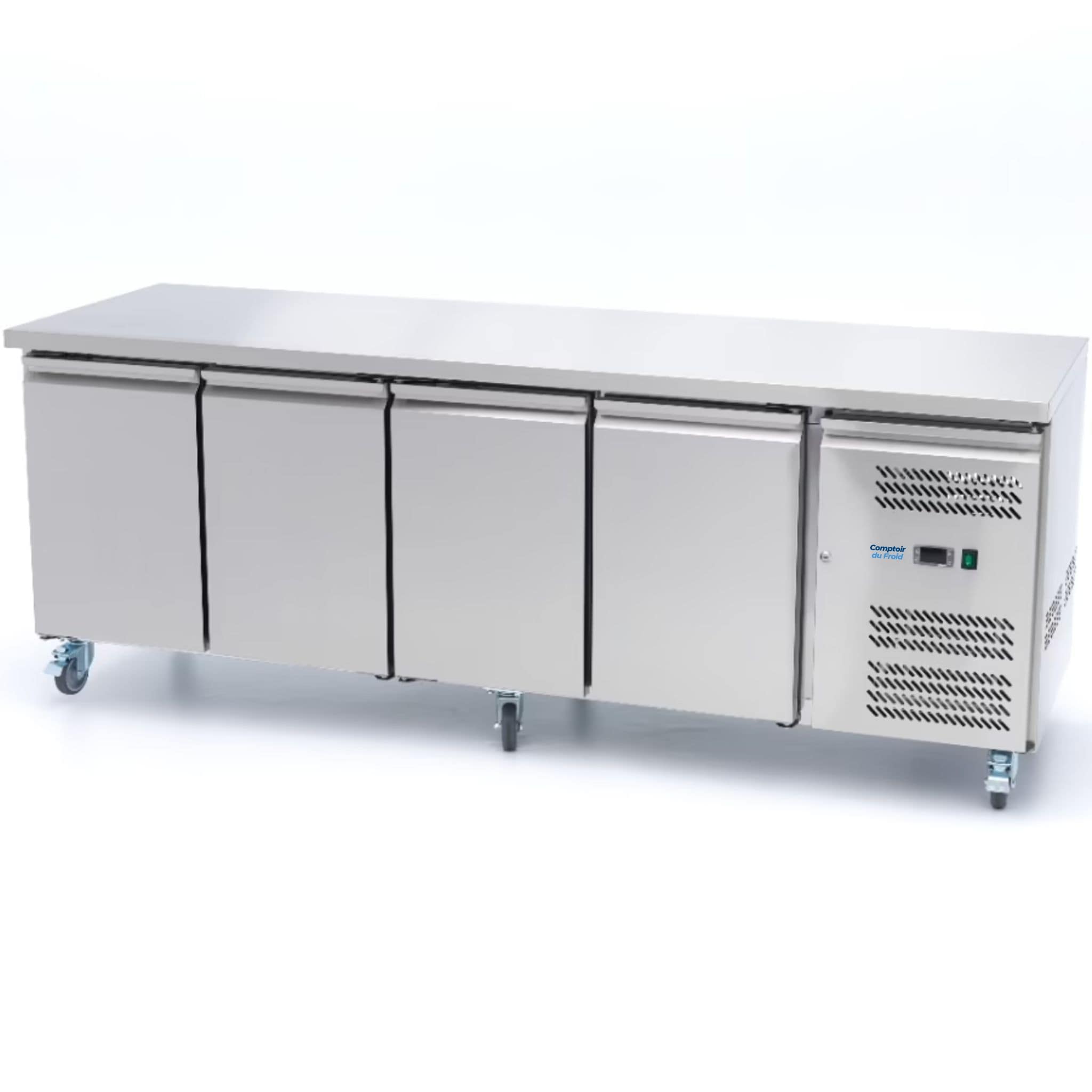
Large 4-Door 223 cm Freezer Table
- Very large capacity for clear separation of items
- Designed for sustained service and large setups
- Extra-large stainless steel top useful for intensive preparation stations
How to ensure performance and HACCP daily?
To remain efficient, a negative refrigerated table must maintain temperature despite repeated openings and service intensity. The simple answer: you need a well-sized appliance, properly ventilated around the unit, and integrated into a serious maintenance routine.
In practice, the negative cold chain relies on very concrete details: clean gaskets, non-excessive loading, unobstructed air circulation, maintained condenser, and placement away from heat sources. A poorly ventilated or overloaded negative table recovers more slowly and puts more strain on its compressor.
Current standards primarily require demonstrating serious control over storage. For a kitchen manager, this means clear instructions, regular temperature checks, and a rotation logic that avoids unnecessary openings.
- Do not overload compartments beyond useful air circulation
- Maintain clearance around the unit to facilitate heat dissipation
- Regularly check the condition of the gaskets and the door closing level
- Clean the condenser according to actual usage frequency
Need a negative model truly adapted to your pace?
Compare the different freezer table formats to choose the capacity and footprint consistent with your professional kitchen.
FAQ
What is the difference between a positive and negative refrigerated table?
A positive one stores fresh products, while a negative one keeps frozen products at a negative storage temperature.
Is a negative refrigerated table sufficient as primary storage?
No, it primarily serves as close-to-hand storage at the workstation. The Mayn volume is often handled by a cabinet or other dedicated equipment.
Is ventilated cold preferable for this type of equipment?
Yes, in most professional kitchens, it helps to recover temperature better after repeated openings.
How many doors should I choose?
Two doors are suitable for compact stations, three doors offer a good balance, and four doors are more suitable for high throughput.