
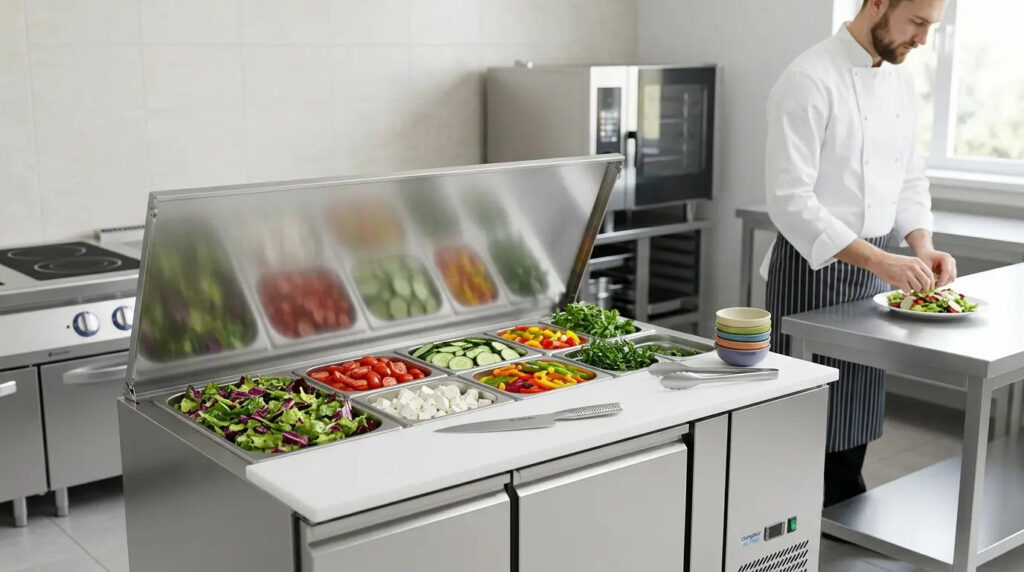
A 3-door refrigerated saladette becomes the right choice when a prep station needs to sustain high service volumes, keep more ingredients within reach, and avoid trips to a cold storage unit. In practice, it Maynly provides more usable linear space, more cold storage, and better fluidity for fast-paced teams.
This format is not necessarily the most compact or the cheapest, but it is often the most profitable when a salad, snack, pizza, or cold assembly station starts to get overloaded. The challenge isn’t just capacity: it’s the production rhythm.
When is a 3-door refrigerated saladette truly relevant?
The real question is simple: do you have a station that lacks working width and cold storage during service? If so, the 3-door version quickly outperforms a shorter model.
In practice, this format becomes relevant when several GN containers remain open simultaneously, when multiple operators work on the same line, or when the menu requires many ready-to-assemble items. The machine then serves not only for storage but also to support the pace.
- High-volume snacking: sandwiches, poké bowls, composed salads, wraps.
- Pizzeria: needs a stable work surface, quick access to ingredients, and good cold storage.
- Premium fast food: minute assembly with continuous container rotation.
- Caterer or prep kitchen: clean segmentation of products and comfortable long-term work.
If your team is constantly opening a walk-in cooler or a storage cabinet to resupply the station, it’s often a sign that the prep station is undersized.
What are the concrete advantages compared to a 2-door saladette?
The short answer: you get breathing room during rush hour. The 3-door offers more usable under-counter space and a more comfortable linear arrangement to organize setup without jamming workflows.
The difference is less theoretical than it seems. When the station is busy, a few extra centimeters improve the quality of execution: fewer cross-overs, fewer prolonged openings, fewer storage errors, and better maintenance of the cold chain.
| Criterion | 2-Door Saladette | 3-Door Saladette |
|---|---|---|
| Service Output | Suitable for a compact station or short menu | Better equipped for sustained and multi-item service |
| Under-counter Cold Storage | Adequate for a small team | More comfortable for limiting refills |
| Preparation Comfort | Good for small setups | Better for spreading out ingredients, actions, and containers |
| Footprint | Easier to fit | Requires a dedicated space in the line |
| Profitability | Very good if the station’s demand is moderate | Superior if the pace justifies the volume |
Verdict: If your station serves quickly, handles many items, and already feels cramped, the 3-door refrigerated saladette is often the best compromise. If you work in a very constrained space or with a short menu, the 2-door model remains more appropriate.
Expert tip: In the hospitality industry, the most common mistake is to choose a saladette’s size based on available space rather than the actual number of ingredients opened during service. It’s better to think in terms of production flow than just linear meters.
What to check before buying this format?
Before buying, you need to answer a clear question: does the station need more capacity, more comfort, or both? This check prevents oversizing the equipment.
For a relevant purchase, primarily check criteria that impact daily operations:
- Available length on the line, including circulation space.
- Number of containers and items to keep in direct access during service.
- Type of refrigeration and temperature stability despite repeated openings.
- GN compatibility and usable depth of the prep surface.
- Ease of cleaning, seals, internal corners, and technical accessibility.
- Actual load level: single station, two operators, lunch peak, continuous service.
For a broader view of prep formats, you can also read our guide on choosing a professional refrigerated saladette. If your need is more pizza-oriented, our article on the refrigerated pizza prep table helps decide between a classic assembly station and a specialized station.
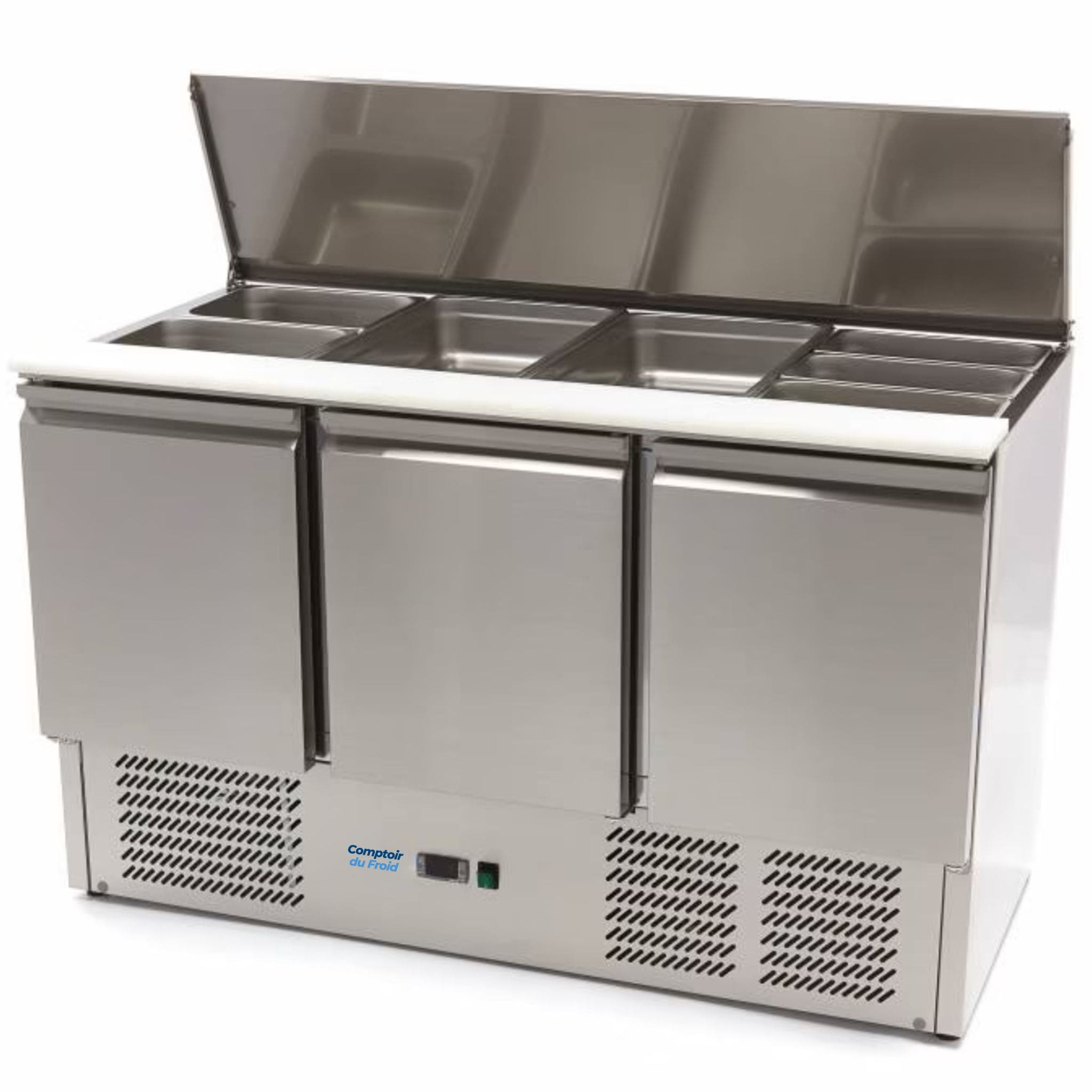
3-Door Stainless Steel Refrigerated Saladette 137 cm
- Excellent compromise between cold storage and managed footprint
- Practical stainless steel lid to secure ingredients when not in use
- Ideal format for snack bars, sandwich shops, and continuous cold prep
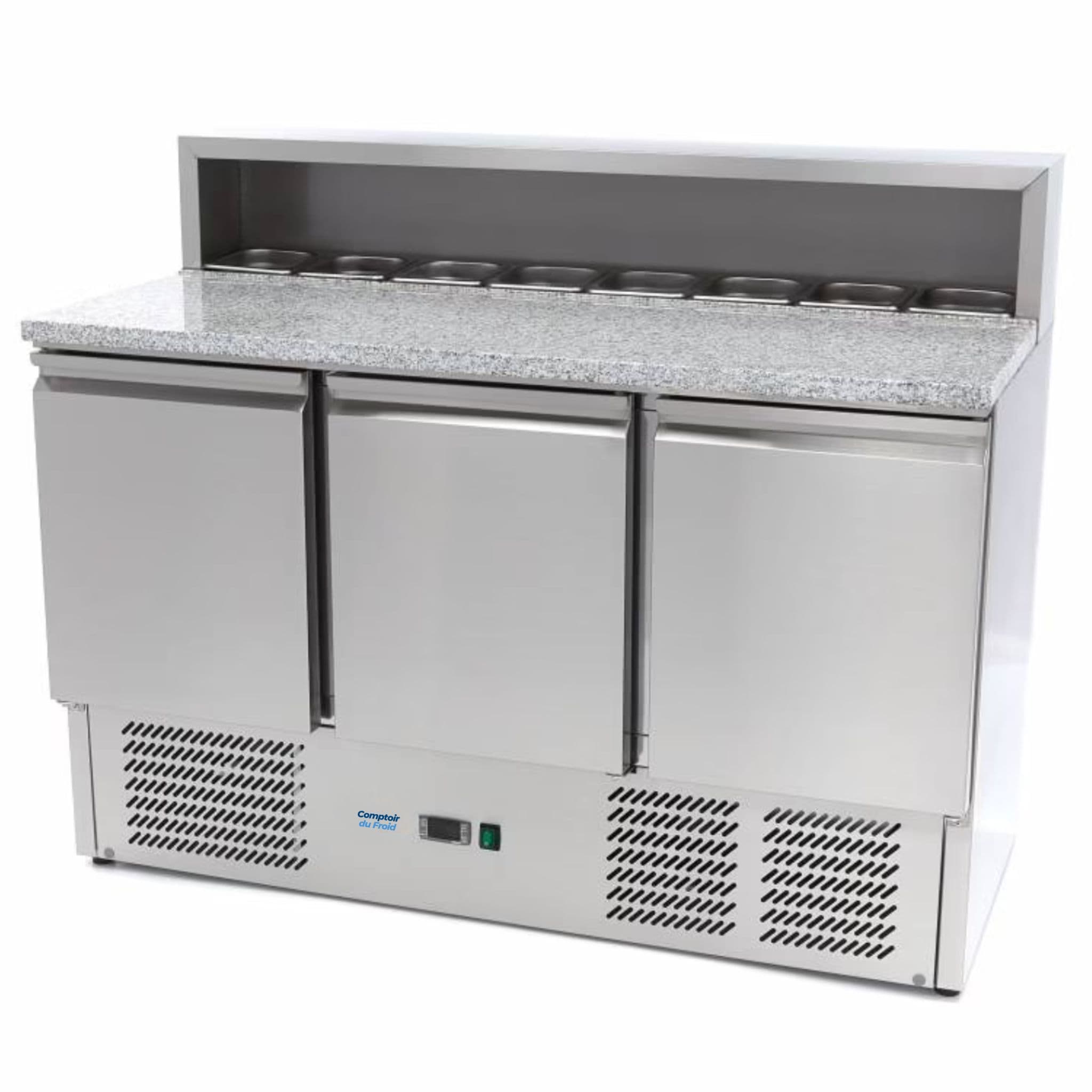
3-Door Pizza Saladette 137 cm with Granite Top
- Granite top designed for comfortable shaping and assembly
- Excellent choice for intensive pizza or snacking setups
- Combines prep, cold storage, and a robust work station
Why does this format also improve hygiene and organization?
The direct answer is: a better-sized station reduces unnecessary handling. Fewer urgent refills, fewer open doors, fewer last-minute displaced containers: all of this helps keep the station cleaner and more stable.
In an HACCP logic, a well-organized station simplifies product family separation, rotation, and visual control. It’s not just a matter of comfort: it’s also a lever for more consistent operation, especially when service is fast-paced.
The 3-door saladette thus becomes interesting when your goal is not just to keep more things cold, but to maintain a fluid, clear, and profitable prep station.
Need to equip a real cold prep station?
Explore our selection of saladettes and prep tables designed for the hospitality industry, with formats adapted for small stations as well as more demanding production lines.
FAQ
Is a 3-door refrigerated saladette useful in a small snack bar?
Yes, if the snack bar handles many items and lacks cold storage at the station. Otherwise, a 2-door model might suffice.
What is the difference between a 3-door saladette and a classic refrigerated table?
A saladette is designed for preparation with accessible containers on top, while a refrigerated table serves more as a versatile under-counter cold unit.
Does the 3-door format necessarily consume much more energy?
Not disproportionately. The real issue is primarily the suitability between usable volume, pace, and openings during service.
Should I choose a special pizza version?
Yes, if your business relies on dough rolling, topping, and a dedicated work surface. For a more versatile cold station, a standard saladette is often more suitable.