
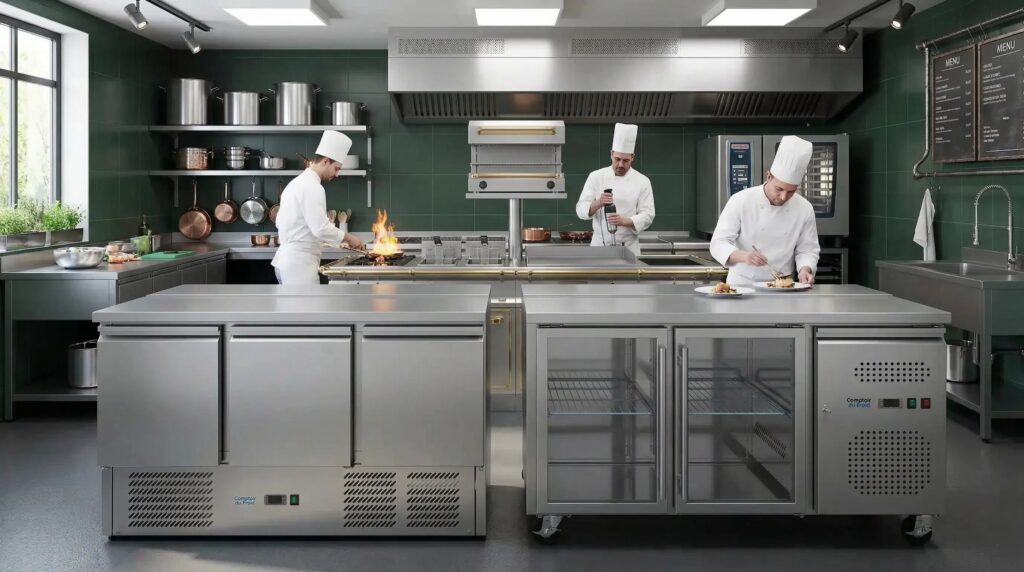
A refrigerated drawer unit is particularly relevant when speed of action, storage by containers, and workstation ergonomics are as important as the refrigeration itself. In a professional kitchen, it allows products to be kept close at hand, limits long opening times, and streamlines setup during peak hours.
It’s not just an aesthetic variation of a classic refrigerated table. The drawer format aligns with a logic of cadenced preparation, sorting by product family, and working comfort for positions where every second counts.
Why choose a refrigerated drawer unit rather than a door model?
The real question is simple: how does the drawer change daily operations? The answer is that it primarily changes the way work is done. In a plating, snacking, or cold preparation station, drawers provide faster and more segmented access to ingredients.
Instead of opening a large door and then searching within a single volume, the team opens the right level, grabs the right container, and closes it immediately. This helps maintain the cold chain better, reduces hesitation, and ensures a cleaner organization during service.
- better ergonomics for high-paced stations;
- clearer storage by product families, GN containers, or pre-cut items;
- less wasted time during plating or replenishment;
- more targeted openings, thus less thermal disruption.
If you’re still undecided on the overall furniture format, you can also compare it with our article on choosing the right refrigerated table for your professional kitchen.
In which professions is the refrigerated drawer unit most useful?
The direct answer: it is especially useful where the setup needs to remain clear, segmented, and immediately accessible. This is often the case in quality fast food, sandwich shops, burger joints, snack bars, brasseries with distinct cold stations, or on preparation lines where a lot of work is done with GN containers.
In practice, the drawer is very suitable when several operators share the same unit and need to quickly find an ingredient without breaking the service rhythm. While a door model offers a large, more basic volume, the drawer improves the logic of the workstation.
Cases where the drawer becomes really interesting
The drawer gains value when you need to serve quickly without disorganizing your workspace.
| Context | Drawer unit | Door unit |
|---|---|---|
| Snack / instant assembly | Quick ingredient-by-ingredient access | Less practical if opened frequently |
| Setup with GN containers | Very suitable for compartmentalized storage | Larger volume but less segmented |
| Mass storage | Less relevant | Often more cost-effective |
| Multi-operator station | Better visibility of contents | Slower searching within the unit |
Verdict: if your Mayn challenge is preparation speed and workstation clarity, the drawer is often more intelligent than a simple door. If your priority is primarily raw storage volume, a door model is often more logical.
What criteria should you check before buying a refrigerated drawer unit?
Before buying, you must first answer this question: should the unit support a preparation station or serve as auxiliary storage? This point determines almost everything else.
For serious use in hospitality, prioritize checking GN compatibility, the robustness of the slides, the stability of the worktop, ease of cleaning, and the consistency between useful capacity and actual service flow. A beautiful stainless steel facade does not compensate for a unit poorly adapted to the team’s rhythm.
- actual capacity of drawers and accepted container sizes;
- quality of rails and performance under repeated load;
- working temperature according to stored products and opening frequency;
- ease of maintenance of gaskets, corners, handles, and guides;
- height and depth compatible with your preparation line.
For compact kitchens or more versatile stations, our guide on choosing your refrigerated trolley for a professional kitchen can also help decide between flexibility, footprint, and capacity.
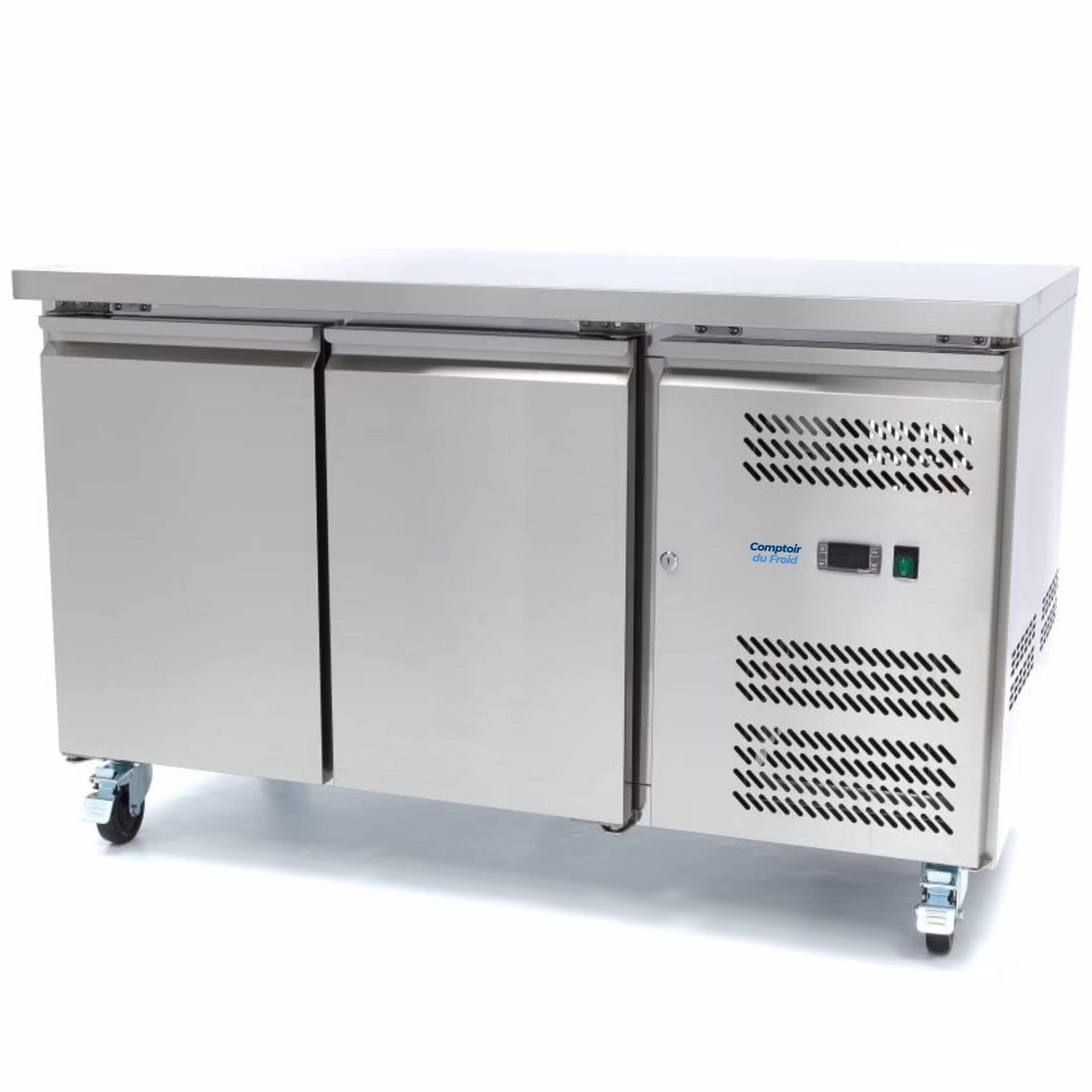
2-Door Positive Refrigerated Table 136 cm (GN 1/1)
- Balanced format for a compact preparation line
- Robust stainless steel top for a true workstation
- Good base if you’re looking for a simple alternative to drawers
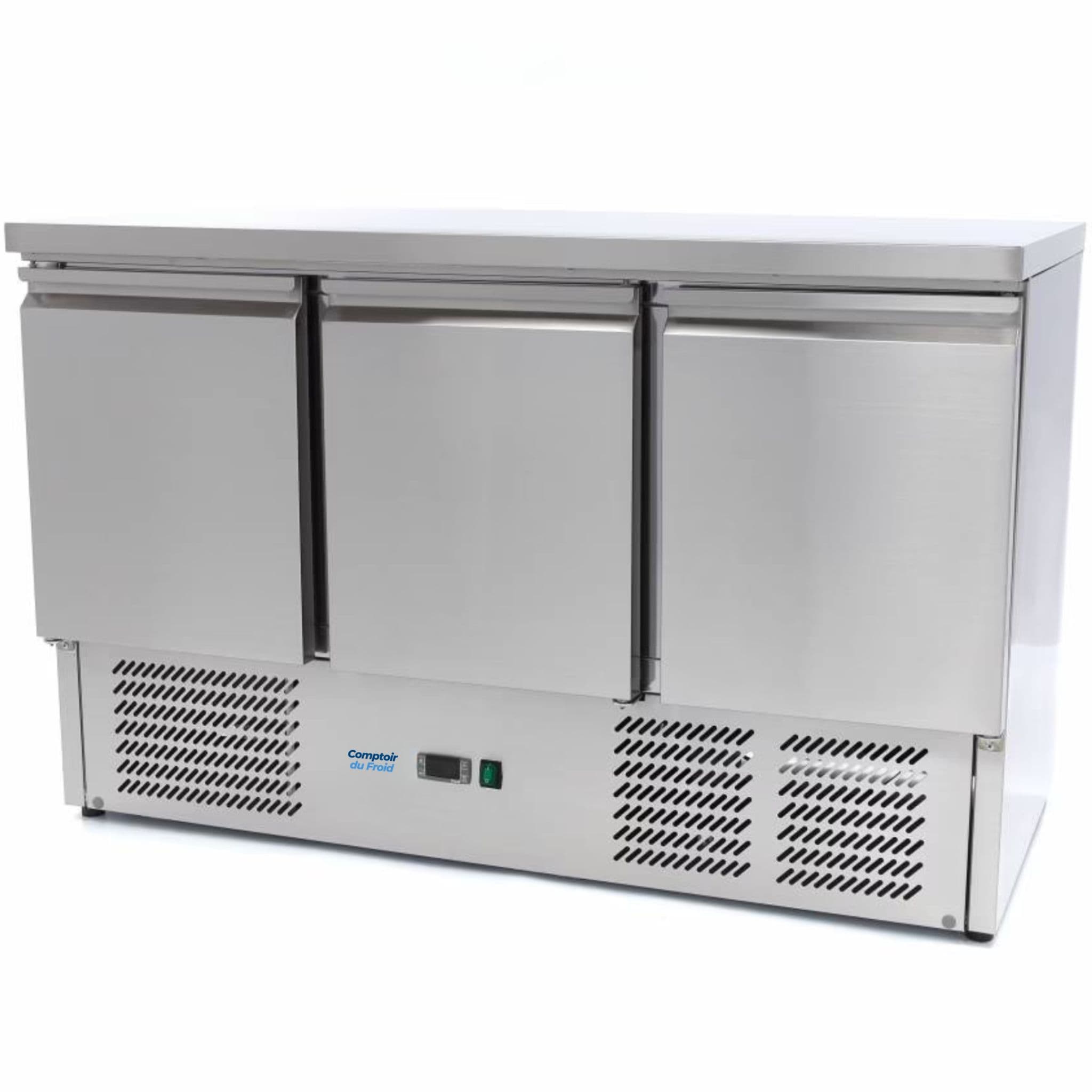
3-Door Refrigerated Base Unit 137 cm (Stainless Steel Top)
- More storage segmentation for active teams
- Interesting if you’re looking for volume without opting for a large tower
- Suitable for stations that want to combine a worktop and cold storage
Is a refrigerated drawer unit better for hygiene and productivity?
Yes, provided it is used with a true workstation logic. The Mayn advantage is not magical: it comes from the fact that food is better distributed, more quickly accessible, and easier to visually control.
In the field, this helps limit unnecessary cross-contamination, reduces long manipulations with open doors, and better maintains HACCP routines. In terms of productivity, the gain is especially visible when services are busy and each operator needs to immediately find their organization.
However, a poorly designed drawer unit can also become counterproductive if the drawers are overloaded, poorly identified, or used as a mere catch-all. The right piece of furniture is one that matches your actual workflow, not one that seems most technical on paper.
Need a cold base unit truly adapted to your workstation?
Discover our selection of professional refrigerated tables to compare the most useful formats for preparation, storage, and service.
FAQ on refrigerated drawer units
Is a refrigerated drawer unit mandatory in a professional kitchen?
No. It is not mandatory, but it can become the best option when speed of action and organization by containers are priorities.
Does the drawer format better preserve cold temperatures?
It can better limit long openings if each drawer is used in a targeted manner, but everything also depends on the quality of the unit and team habits.
Is this the best choice for large cold storage?
Not necessarily. For raw storage volume, door models or refrigerated towers are often more suitable.
What type of establishment benefits most from a drawer unit?
Snack bars, plating stations, fast-production kitchens, and establishments that work extensively with GN containers often benefit the most.