
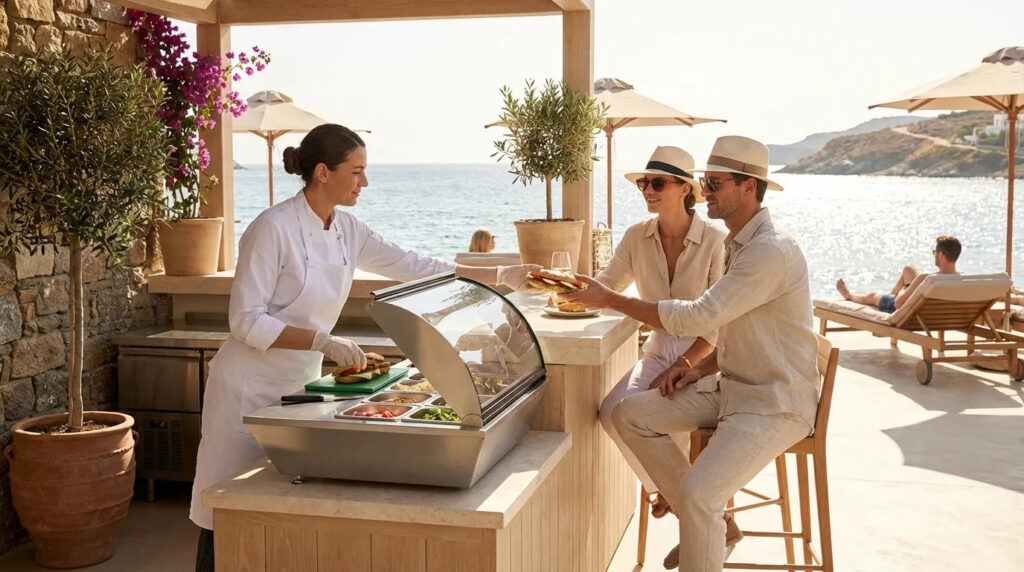
A countertop refrigerated saladette is often the best solution when a station needs to increase speed without sacrificing floor space. In fast food, snacking, or cold prep, this format keeps ingredients at hand while maintaining the cold chain on a compact line.
Its purpose is not to replace a large prep table, but to smartly equip a counter, a pass-through, a secondary station, or a small assembly area. This is precisely where this format becomes cost-effective.
When is a countertop refrigerated saladette truly the right choice?
The real question is simple: do you need immediate access to ingredients without adding a full base cabinet? If so, the countertop version makes perfect sense. It is particularly suitable for establishments that want to streamline a station without burdening the layout.
In practice, it is especially relevant for:
- snack bars and sandwich shops with an existing worktop;
- pizzerias that want a compact topping station;
- hotels or buffets setting up a temporary cold station;
- laboratories that need a satellite station dedicated to a few specific items.
If you are looking for a complete unit with a true under-counter refrigeration reserve, it is better to opt for a 2-door refrigerated saladette suitable for compact stations. However, if your challenge is to keep GN pans as close to the action as possible, the countertop format is often more logical.
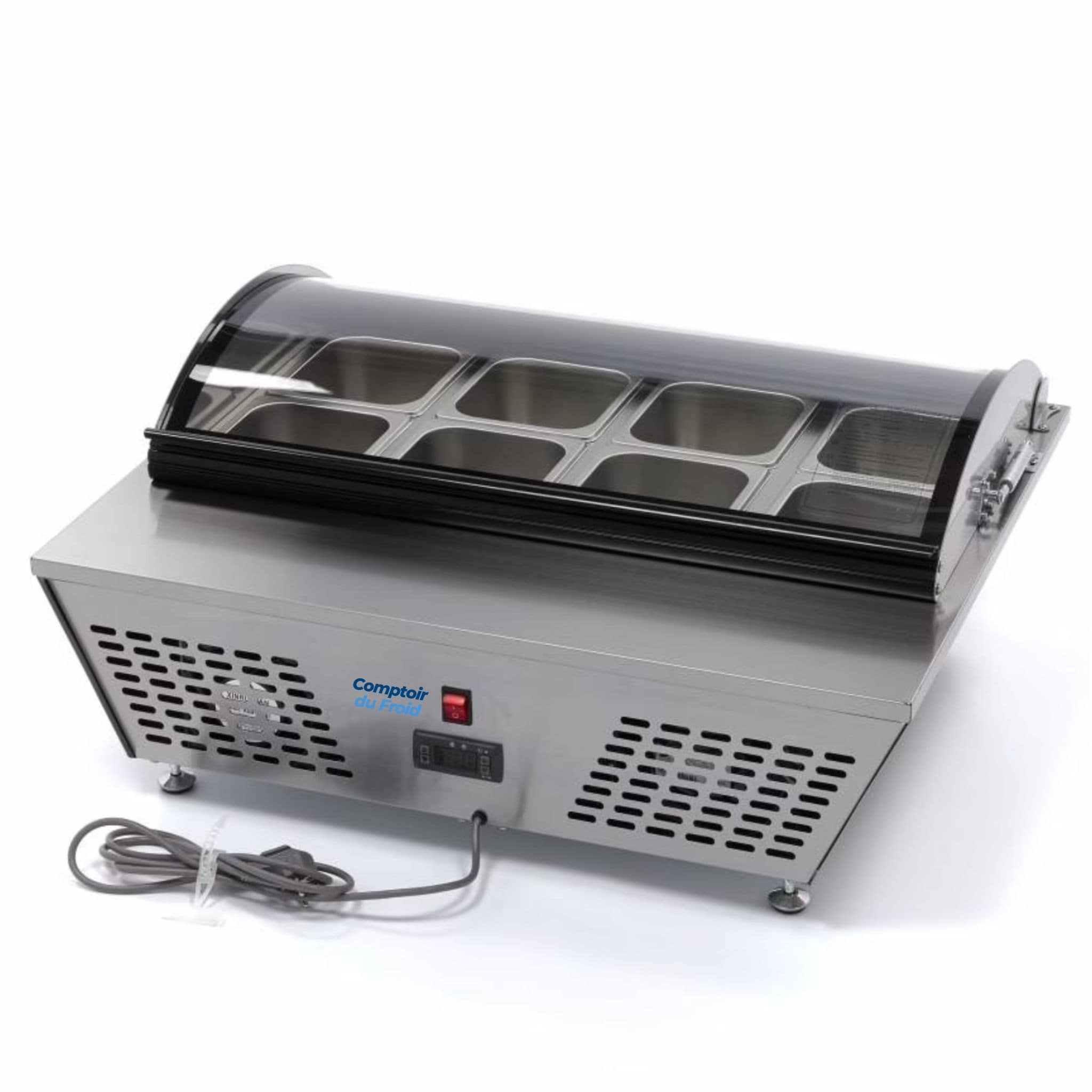
Mini Countertop Refrigerated Saladette, Stainless Steel, 67L (8x GN 1/6 Included)
- Compact format ideal for tight worktops
- GN pans included for quick setup
- Direct access to ingredients at a snack or sandwich station
What criteria truly matter before buying?
To choose well, you must first verify the actual use of the station: number of ingredients, service rate, available depth, and opening time of lids or glass covers. A well-chosen countertop saladette should save time, not create a bottleneck.
1. Useful capacity in GN pans
The first criterion is the number of pans actually needed during service. A simple snack station does not have the same needs as a point of sale that offers multiple sauces, toppings, and cold garnishes.
2. Actual footprint on the worktop
Width is not the only consideration. You also need to check the depth, the opening height, and the remaining space to work in front of the unit. In practice, the most common mistake is buying a model that is theoretically correct but too intrusive once the pans are installed.
3. Type of service
A low-rotation station can operate with a short format. Continuous service over several hours requires better thermal stability, a clearer organization, and sometimes a longer length.
Field Tip: Always measure the area with actual work movements: opening pans, picking up tongs, passing plates or bread, and cleaning at the end of service. A countertop saladette that is too deep can slow down the entire station despite good cold capacity.
What’s the difference between a closed mini saladette and an open ingredient display?
The right answer depends on the service volume and mode of operation. A closed mini saladette better protects ingredients when not in use or in a more exposed environment. An ingredient display, on the other hand, extends the useful linear space when the station needs to present more ready-to-grab items.
| Format | Main Advantage | Best suited for | Potential Limitation |
|---|---|---|---|
| Closed Countertop Mini Saladette | Maximum compactness and good pan protection | Snack bars, sandwich shops, small laboratories | Shorter capacity if the menu is extensive |
| VRX-type Refrigerated Ingredient Display | Longer linear space and quick visual access to ingredients | Pizzerias, high-speed assembly, buffets | Requires more counter space |
Verdict: If space is your Mayn constraint, the countertop mini saladette remains the best compromise. If your priority is to line up more GN pans for a fast-paced service, a VRX-type ingredient display becomes more appropriate.
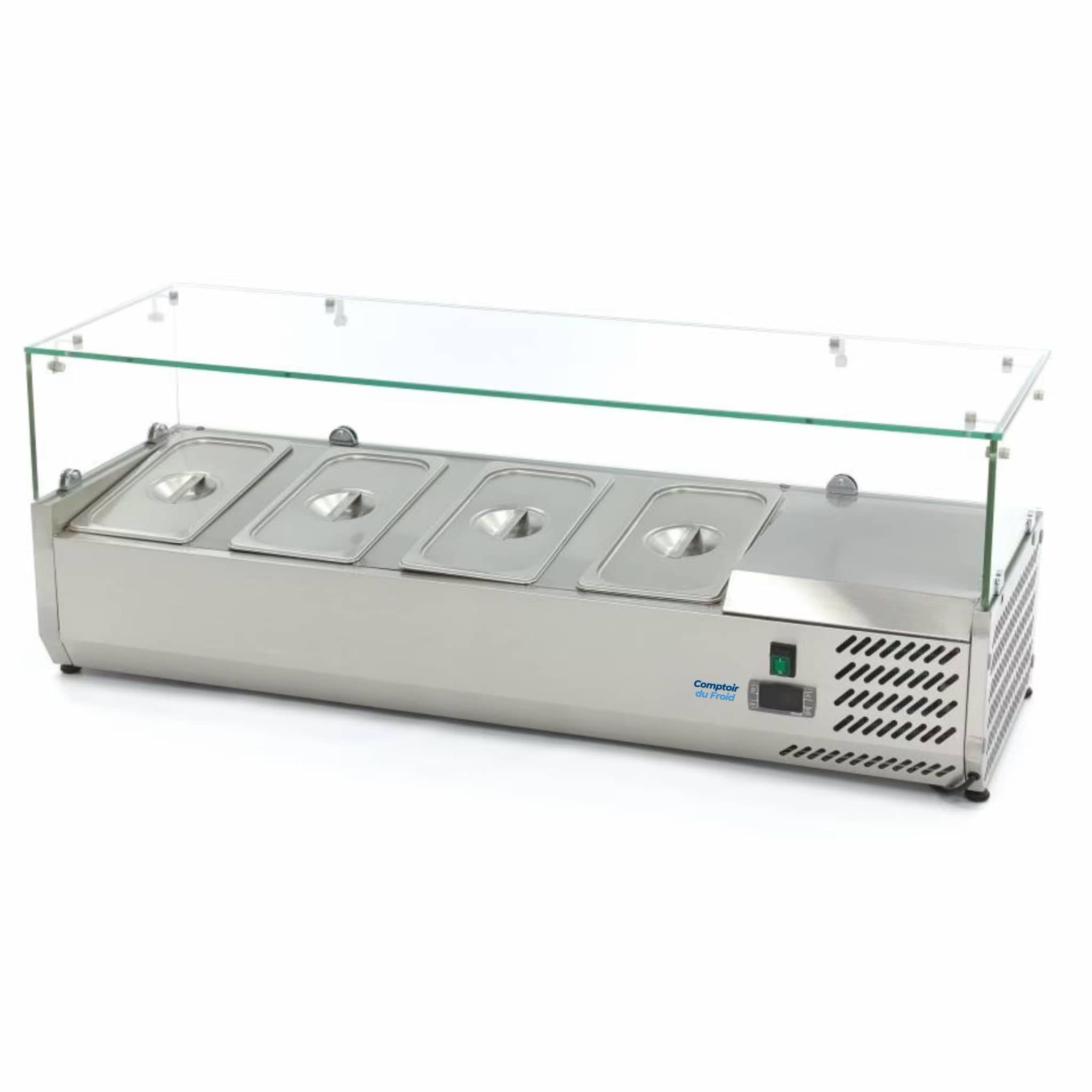
VRX Refrigerated Ingredient Display 120 cm with Pans Included
- More generous linear space for a wider range of cold items
- Suitable format for pizza, sandwiches, and rapid assembly
- Pans included to structure a clear and efficient station
How to avoid a disappointing purchase for a small prep station?
To avoid a poor choice, you need to answer another question: does the station need a complete reserve or just quick access to current ingredients? A countertop saladette is not a primary storage unit. It is a tool for efficiency and organization.
Before finalizing, at a minimum, check:
- the exact number of pans needed during rush hour;
- compatibility with your worktop depth;
- ease of cleaning and temperature recovery;
- consistency between actual flow and the length of the chosen model.
If your need is more focused on a complete setup with a base reserve and more volume, you can also compare with our article on choosing a professional refrigerated saladette. The idea is simple: the countertop version excels for short stations, not for extended storage needs.
Need to equip a compact station without losing efficiency?
Discover our selection of saladettes and prep tables to configure a cold station that fits your space and service pace.
FAQ on countertop refrigerated saladettes
Is a countertop refrigerated saladette sufficient for a snack station?
Yes, if the station works with a limited number of pans and if primary storage is handled elsewhere. It is primarily designed for quick access, not for a large reserve.
What is the difference between it and a 2-door saladette?
The 2-door version includes a complete refrigerated base cabinet. The countertop model focuses on the worktop and immediate access to ingredients.
Is this format suitable for a pizzeria?
Yes, for a small station or a limited menu. As soon as the number of ingredients significantly increases, a VRX or a dedicated pizza saladette often becomes more appropriate.
Can a countertop saladette be used on any counter?
No. You need to check the admissible load, the available ventilation around the unit, and the remaining workspace in front of the station.