
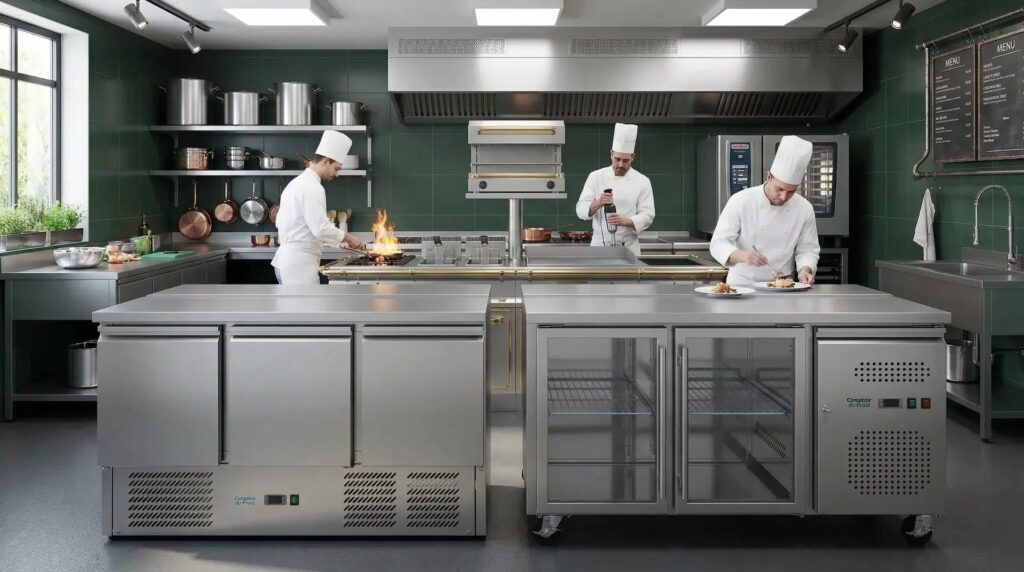
A 3-door refrigerated counter found at Metro can be a quick fix, but it’s not automatically the best choice for a professional kitchen. The real criteria lie elsewhere: cold stability, usable volume, stainless steel robustness, and compatibility with your service pace.
If your cold station operates all day, it’s better to compare the advertised price with the actual operating cost before buying. This is often where a truly professional model gains the upper hand.
Why a 3-door refrigerated counter attracts kitchens looking for a quick purchase
The question is simple: why does this format come up so often in Metro searches? Because it often represents a good middle ground between a compact prep counter and a large 4-door counter.
In practice, a 3-door counter is very suitable when you need to keep mise en place items close to the service area without monopolizing the entire cold line.
- It offers an immediately usable stainless steel worktop.
- It maintains a consistent usable volume for a medium-sized team.
- It limits trips to the cold room during service.
To put the topic in perspective, you can also consult our complete guide to professional refrigerated counters, then compare it with our analysis on the choice between 2 and 3 doors.
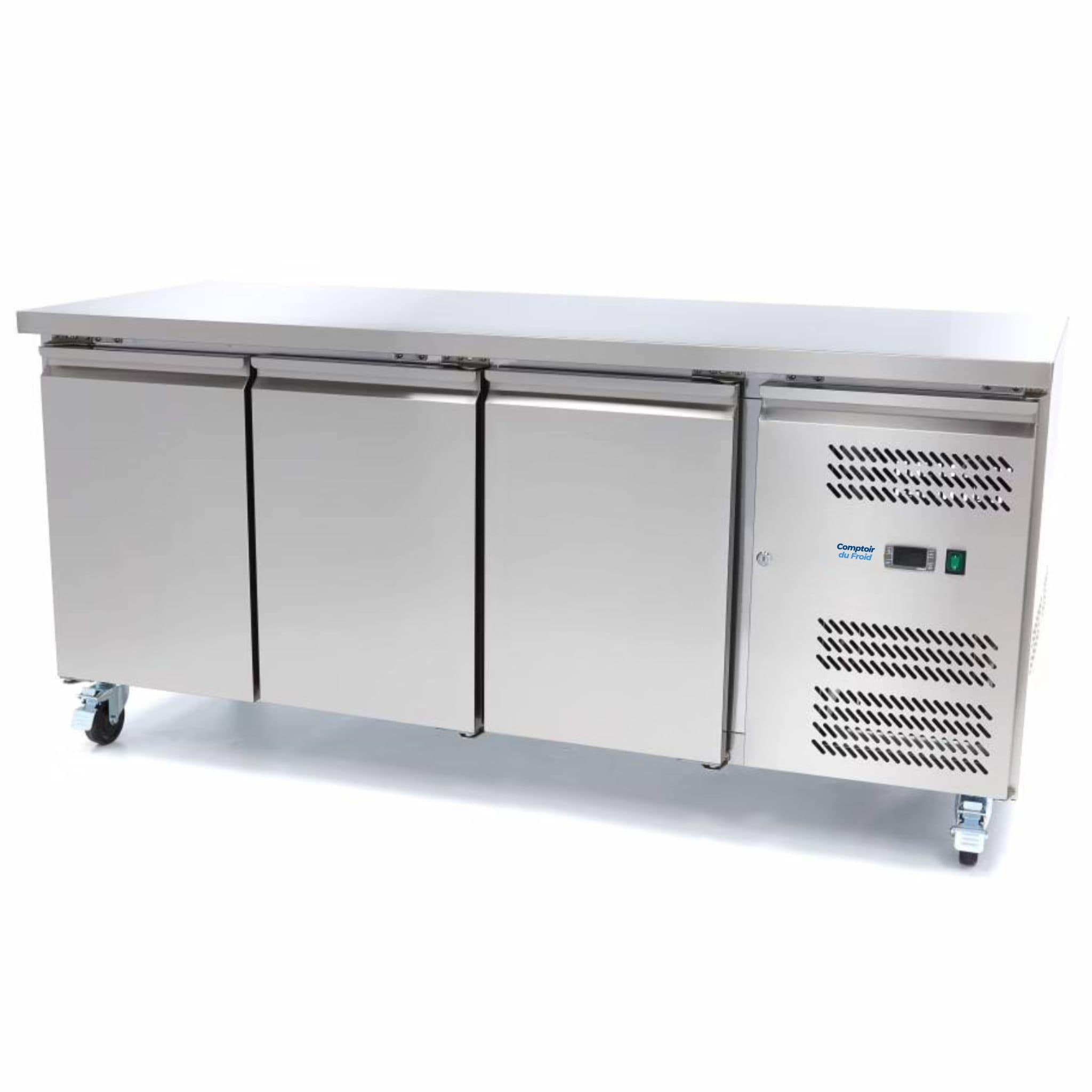
3-Door Positive Refrigerated Counter 180cm (GN 1/1)
- 3-door format designed for a real prep line
- GN 1/1 capacity suitable for regular service in a professional kitchen
- 180 cm stainless steel worktop useful for working and storing at the same station
Metro vs. dedicated professional equipment: where does the real difference lie?
The real question isn’t whether Metro sells refrigeration, but whether the model you’re considering will stand up to your actual use. A 3-door refrigerated counter for a professional kitchen must handle repeated openings, ambient heat, and the pressure of rush hour.
Well-chosen professional equipment is distinguished primarily by construction quality, maintenance logic, and consistent sizing. An introductory price quickly becomes less attractive if the unit lacks cold reserve or wears out too soon.
| Criterion | Quickly spotted offer | Truly well-sized professional equipment |
|---|---|---|
| Intended use | Immediate need, quick comparison | Daily use with stable pace |
| Cold stability | Very variable depending on the range | More consistent for a hot kitchen |
| Station ergonomics | May seem correct on paper | Designed for pans, flow, and cleaning |
| Durability | Highly dependent on the product range | Better if the stainless steel, seals, and unit are serious |
| Profitability | Purchase price sometimes attractive | More reliable overall cost if the unit works every day |
Verdict: if your 3-door refrigerated counter needs to support real lunch and dinner service, always compare Metro to a dedicated professional model, not just the entry price.
Field advice: an undersized 3-door counter is quickly identified during service, not upon unpacking. If openings are frequent, a slightly generous cold reserve is better than a unit that is just sufficient on paper.
How to know if the 3-door format is really right for your kitchen
The short answer: it’s relevant when you need a central cold prep station without opting for an XXL unit. It becomes less suitable if your brigade already lacks circulation space or, conversely, if throughput requires a 4-door counter.
To decide, consider primarily:
- The number of operators opening the unit during the same service
- The actual quantity of GN pans stored during mise en place
- The length of stainless steel worktop needed for plating, garnishing, or assembling
- The available space in front of and behind the station
In commercial catering, the 3-door counter is often the best compromise for kitchens that want true working comfort without unnecessarily extending the line.
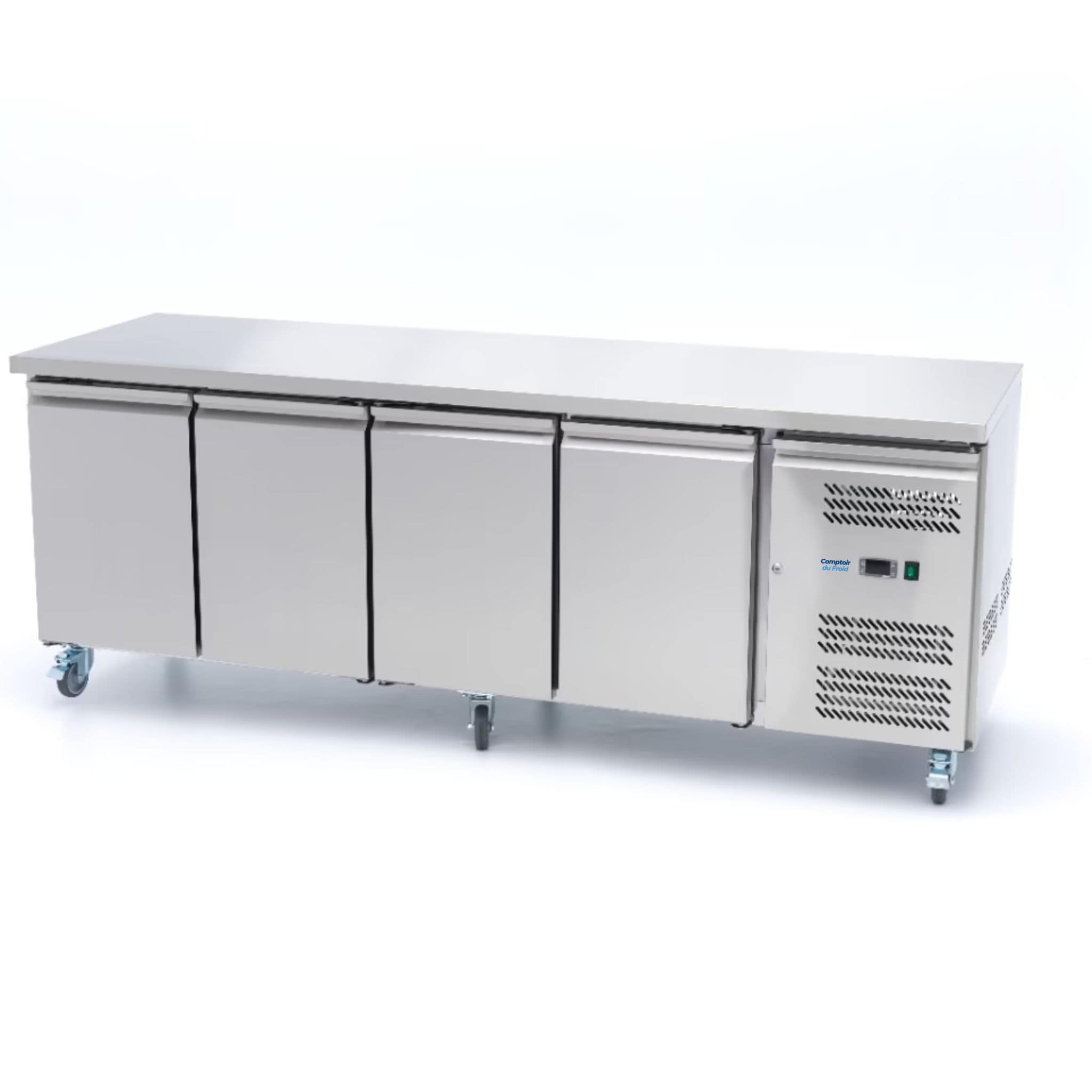
Large 4-Door Refrigerated Counter 223cm (XXL)
- 223 cm length for brigades that already saturate a 3-door unit
- 4 doors to better distribute storage areas during service
- XXL format designed for high-volume kitchens
What pitfalls to avoid before ordering
The question is direct: what causes a failed purchase? Most often, a unit is chosen based on a promotion or solely on its width, without checking the service pace and HACCP constraints.
Before validating, check at least the following points:
- Compatibility with your GN pans and internal organization
- The actual usable capacity, not just the announced gross volume
- Ventilation around the unit and the ambient temperature
- Ease of cleaning seals, corners, and grids
- Availability of parts and maintenance logic
In the field, a profitable refrigerated counter is one that withstands service, is simple to maintain, and doesn’t slow down the brigade.
Want to compare true professional refrigerated counter formats?
Consult the collection directly to see models adapted to your kitchen’s pace.
FAQ on the Metro 3-door refrigerated counter
Is a Metro 3-door refrigerated counter sufficient for a professional kitchen?
Yes, if it is correctly sized for your pace, pan volume, and work environment.
What is the difference between a 3-door and a 4-door counter?
The 4-door counter provides more reserve and worktop length, useful when multiple operators are working simultaneously.
Is the lowest price necessarily the best choice?
No, because a less robust unit can cost more in cold loss, maintenance, and service discomfort.
What is the top priority to check before purchase?
The consistency between your actual throughput, the unit’s format, and the construction quality for daily use.