
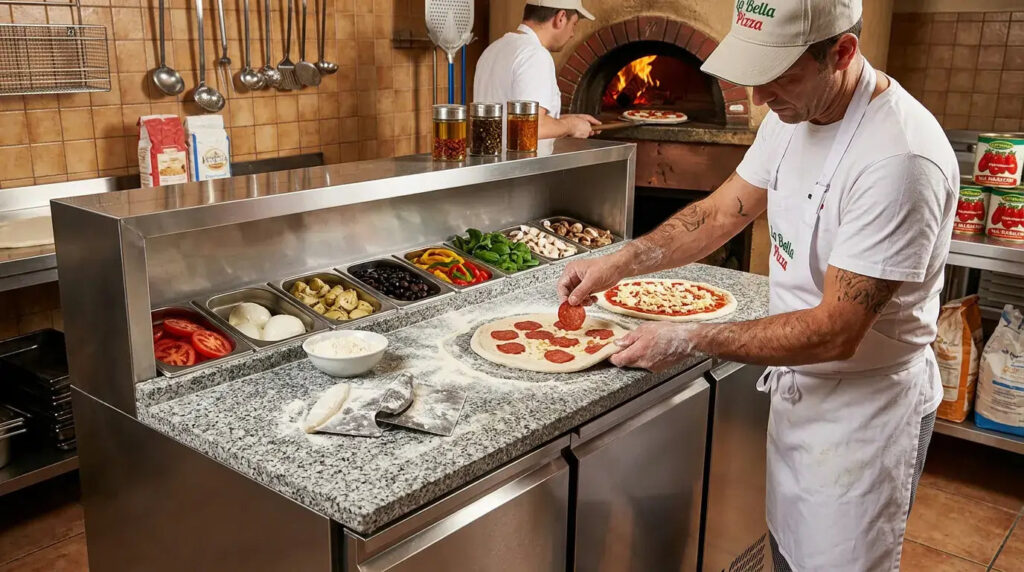
A pizza saladette really improves efficiency when it brings together ingredient bins, refrigerated storage, and a stable work surface for dough stretching at the same station. In a pizzeria, it doesn’t just keep things cold; it reduces unnecessary movements, limits disruptions during rush hour, and helps maintain a cleaner mise en place.
The right choice therefore depends less on a simple number of doors and more on the service volume, the available space behind the counter, and your preparation logic. It is precisely this trio that makes the difference between a fluid station and one that slows down production.
Why is a pizza saladette different from a classic saladette?
The real question is simple: why not just use a standard refrigerated saladette? The answer is that a pizza station imposes more specific constraints: dough within reach, highly segmented ingredients, flour, repetitive pace, and the need for a more suitable work surface.
In practice, a pizza saladette stands out with several useful daily features:
- a granite worktop, more comfortable for shaping dough balls and more stable for use;
- an organization designed for GN containers, to ensure continuous topping and service;
- a refrigerated lower reserve for refill products, dough balls, or sensitive ingredients.
If you’re still hesitating between different cold station formats, you can also read our article on the 2-door refrigerated saladette for a compact station and the one on the 3-door refrigerated saladette for busier services. These two readings help to better understand the use of a pizza station compared to a more general preparation station.
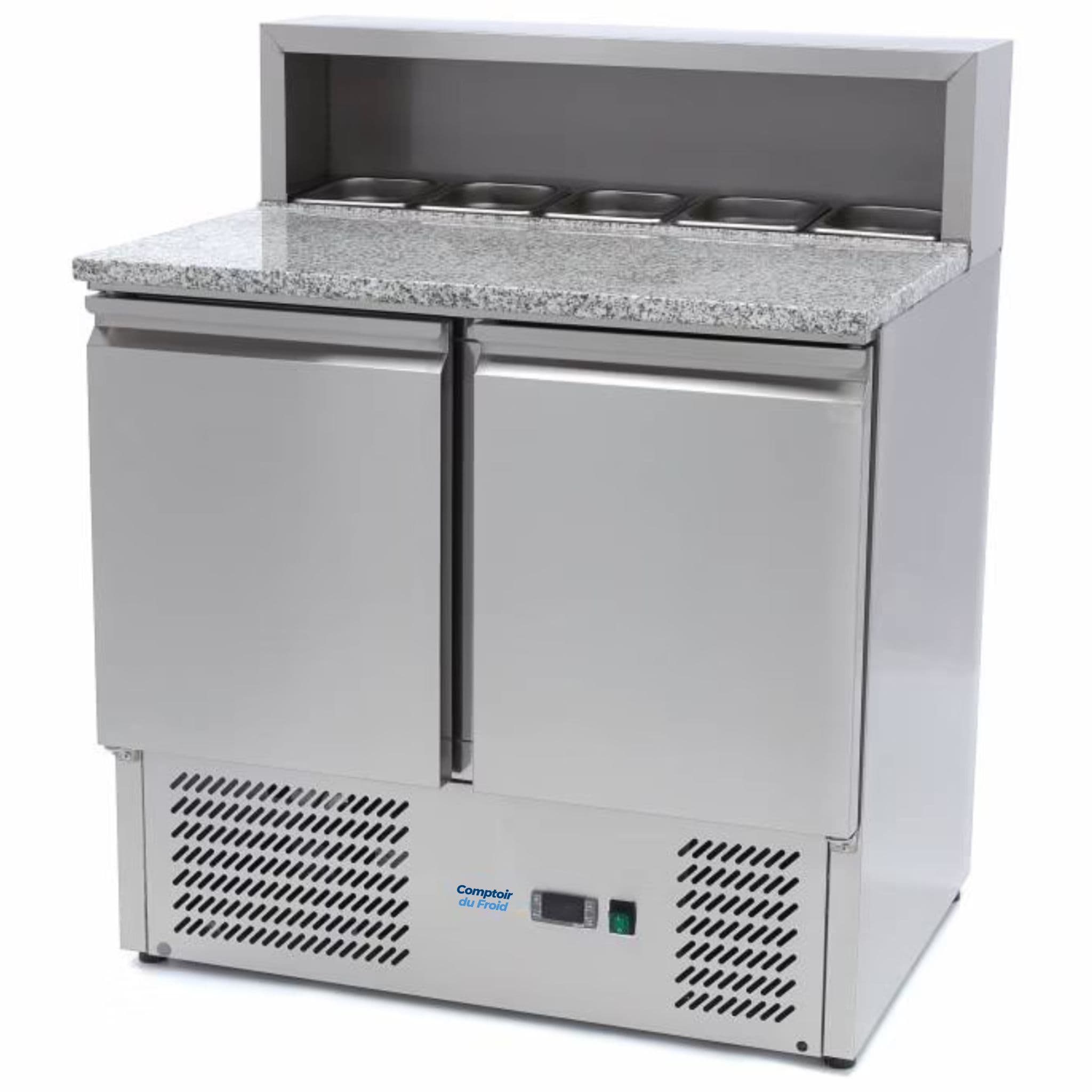
2-Door 90cm Pizza Saladette (Granite Top)
- Compact format, very suitable for a small pizzeria or pizza snack bar
- Practical granite top for quick dough stretching and dressing
- Double door useful for keeping buffer stock right under the top
How to size a pizza saladette according to your volume?
The question to resolve here is: what capacity do you really need during service? The answer depends on the number of pizzas going out during peak hours, the variety of your menu, and the number of operators at the station.
To guide your choice, focus on:
- the number of simultaneous recipes to assemble;
- the volume of dough balls and ingredients to keep immediately available;
- the frequency of restocking possible during service;
- the useful length of the worktop for working without hindrance.
| Configuration | When it’s suitable | Key advantage | Limitation to know |
|---|---|---|---|
| 2 doors 90 cm | Moderate volume, small menu, tight space | Excellent compromise between footprint / efficiency | Storage fills up faster if the menu is extensive |
| 3 doors 137 cm | Sustained service, multiple references, faster team | More comfortable working and fewer reloads | Requires significant available linear space |
| Large format with dough drawers | High-volume pizzeria or highly structured production | More industrial organization of the station | More demanding investment and implementation |
Verdict: If your station is narrow or if you are starting with a short menu, a well-organized 2-door saladette is largely sufficient. As soon as service intensity increases or references multiply, the 3-door becomes more cost-effective because it reduces reloads and micro-disruptions.
Field tip: In a pizzeria, the most common mistake is to choose the length of the unit based solely on floor space. You also need to anticipate door opening, the shaping area, staff movement, and the space needed for restocking bins during rush hour.
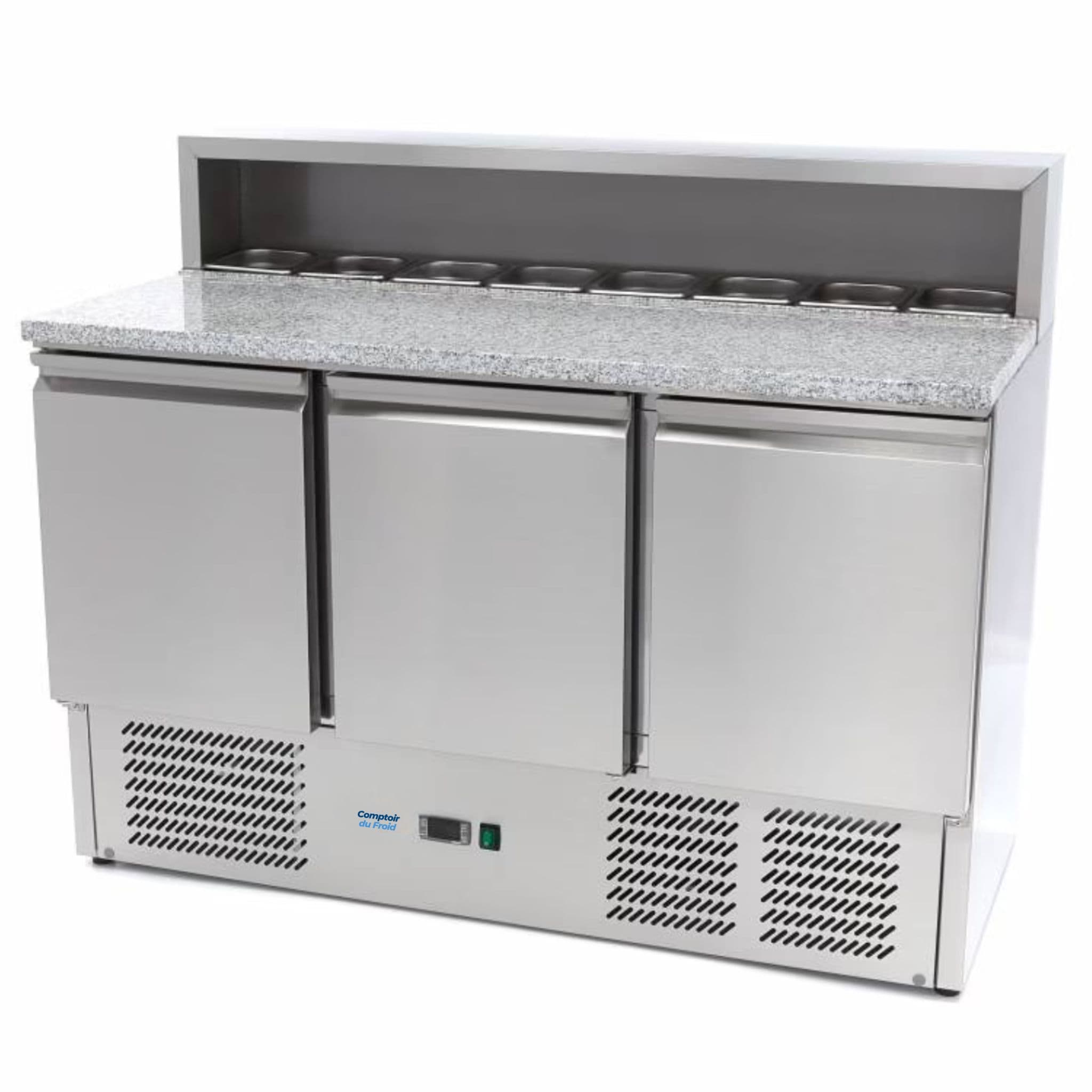
3-Door 137cm Pizza Saladette (Granite Top)
- More comfortable work surface for sustained output
- Three useful doors for better separation of dough balls, cheese, and restock
- Suitable format for a wider menu or a faster team
What technical criteria really matter before purchasing?
The question here is: what criteria prevent a bad purchase beyond simple volume? The answer lies in the compatibility between your workflow, station hygiene, and ease of restocking during service.
Before validating a model, primarily check:
- the GN container capacity on the top part to keep the most used ingredients close at hand;
- the quality of the worktop, especially if you stretch or top dough directly on it;
- air circulation and cold stability to comply with HACCP requirements;
- the practicality of cleaning, because a pizza station quickly accumulates flour, sauce, and splashes.
In practice, a good pizza saladette should not only keep products at the right temperature. It must also make the station more profitable, meaning saving time on each pizza, reducing handling, and better absorbing activity peaks.
When does the pizza saladette become a real lever for profitability?
The fundamental question is: is it just a refrigerated unit or a real production tool? In a pizzeria, the answer is clear: as soon as service intensifies, the preparation station becomes a performance hub in its own right.
A well-chosen pizza saladette concretely helps to:
- maintain a more consistent mise en place throughout the service;
- reduce back-and-forth trips to a cold room or an auxiliary cabinet;
- limit wasted time during topping;
- better preserve sensitive ingredients between rushes.
For a snack bar selling a few pizzas an hour, the gain may seem minor. For a pizzeria with real production peaks, it quickly becomes visible in the fluidity of service, team fatigue, and the consistency of movements.
Looking for the right cold station for your pizza workshop?
Discover our selection of saladettes and preparation tables designed for the most demanding Horeca uses.
Pizza Saladette FAQ
Is a pizza saladette mandatory in a pizzeria?
No, it is not mandatory as such. However, it becomes very relevant as soon as you need to maintain a fast, clean, and cold-chain compliant preparation station.
Should I choose 2 doors or 3 doors for a pizzeria?
A 2-door is often sufficient for small volume or a short menu. A 3-door is better if you have more ingredients, higher rotation, and less time to restock during service.
Is the granite top really useful on a pizza saladette?
Yes, especially if you work the dough directly at the station. Granite provides a stable, durable surface well-suited to the repetitive actions of shaping and topping.
Can a pizza saladette be used for preparations other than pizza?
Yes, but its maximum benefit remains the pizza station. For more versatile use in snacking or sandwiches, a classic refrigerated saladette might sometimes be more appropriate.