
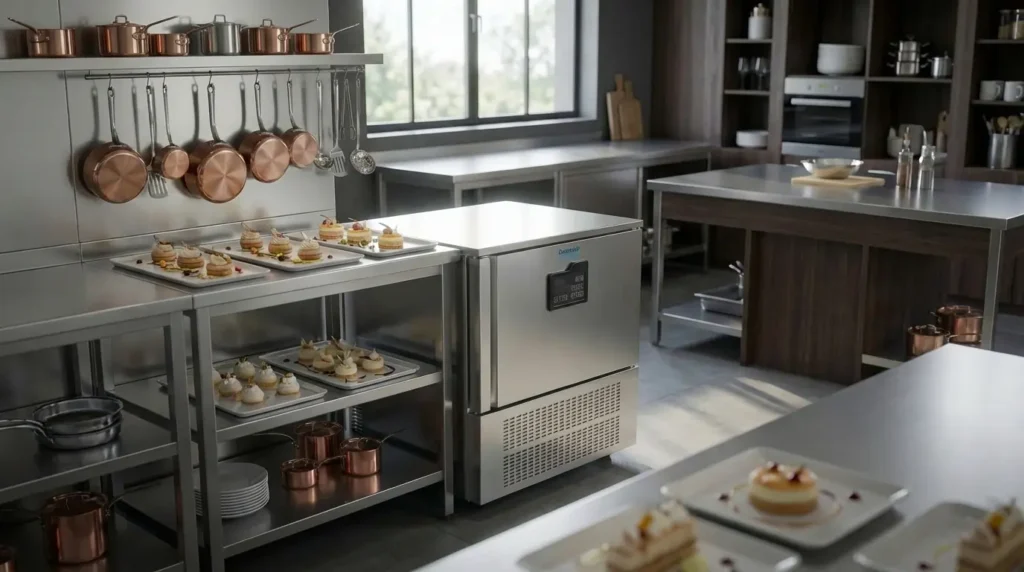
A GN 1/1 blast chiller is the most logical choice for a professional kitchen already working with standard gastronorm pans. It secures rapid chilling, simplifies HACCP workflows and avoids unnecessary transfers between cooking, chilling and storage.
The right model Maynly depends on the number of levels, the real volume per service and compatibility with your GN 1/1 pans or 600 x 400 trays.
What is the GN 1/1 format really used for on a blast chiller?
The key question is simple: does the GN 1/1 format reduce handling in the kitchen? Yes, if your production already comes out in gastronorm pans, because the same container can move from the hot section to the chiller and then into cold storage.
In practice, this format becomes worthwhile as soon as you regularly chill sauces, garnishes, prepared dishes, vegetables, prepared meats or production bases. It saves time and reduces handling, therefore limiting the risk of breaking the cold chain.
- Fewer transfers between cooking and chilling.
- Better HACCP organisation thanks to a clearer workflow.
- Professional kitchen compatibility with the most common gastronorm pans.
- Space saving when the chiller also accepts 600 x 400 trays.
If you are still clarifying the exact role of this equipment, our guide to using a blast chiller for HACCP usefully complements this approach.
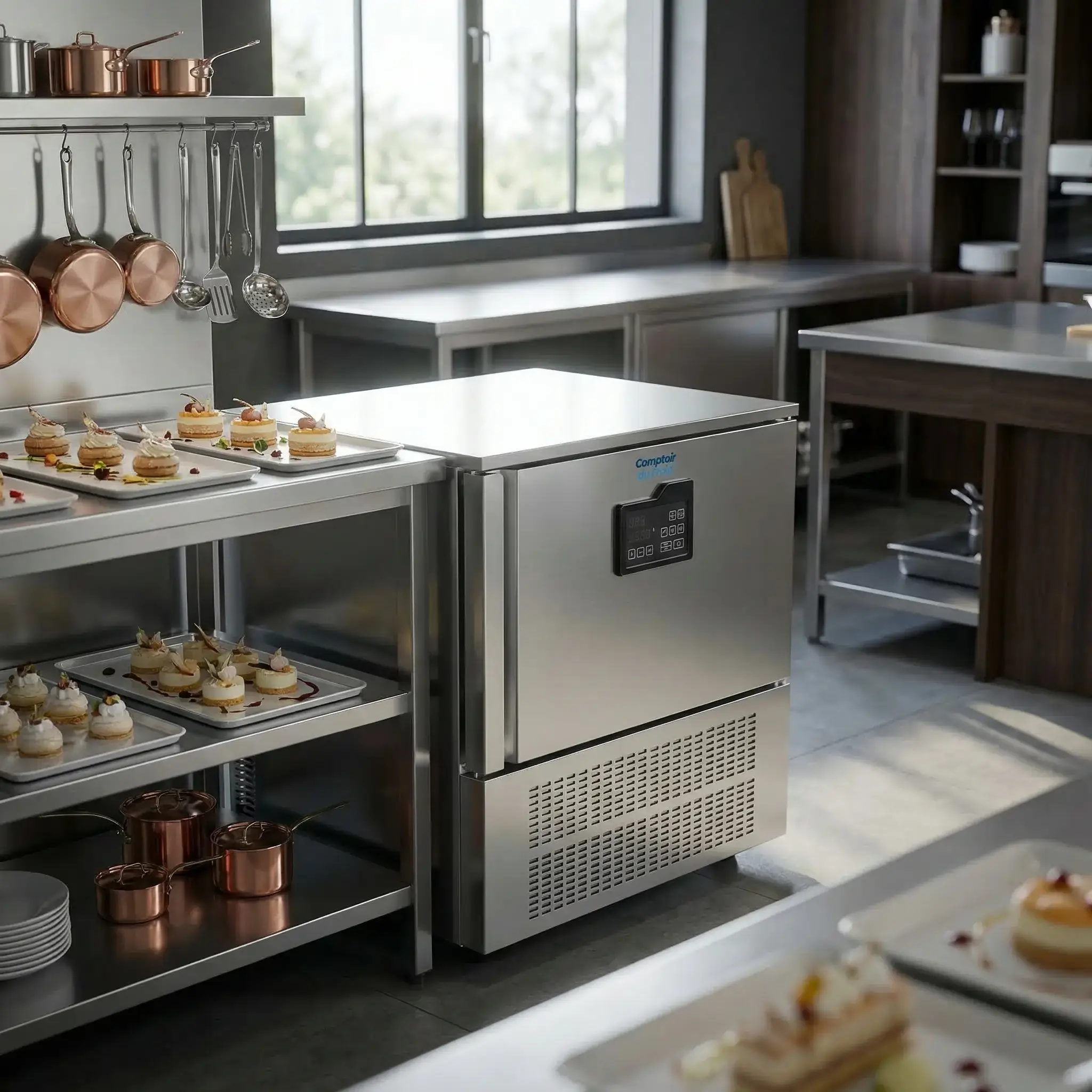
Stainless Steel Blast Chiller – 3 levels
- Mixed GN 1/1 and 60 x 40 compatibility to serve both kitchen and pastry needs
- AISI 304 stainless steel construction with core probe for more durable, better controlled professional use
- Compact 3-level version, rated for 10 kg in chilling and 5 kg in freezing per cycle
How many levels should you choose for a professional kitchen?
The right question is not only “GN 1/1 or not”, but how many pans do you need to chill at the same time? A small kitchen can work with 3 levels, while a restaurant with heavier production will quickly benefit from moving up to 5 levels or more.
The common trap is choosing too small a unit to save space. An overloaded chiller chills less efficiently, imposes successive cycles and creates a bottleneck just when the team needs to move quickly.
| Format | Suitable profile | Point to watch |
|---|---|---|
| 3 levels | Small restaurant, snacking, compact production lab, HACCP support | Reserve for controlled volumes and well-planned cycles |
| 5 levels | Restaurant with daily mise en place, light catering, mixed production | Check floor space and the frequency of production peaks |
| 10 levels and more | Caterer, central kitchen, high-volume service, batch production | Plan for power, ventilation, access and organisation of trolleys or pans |
Verdict: if you chill a few preparations per service, 3 levels are often enough. If the chiller becomes a true daily production station, 5 levels offer the best compromise between capacity, throughput and footprint.
To explore this intermediate capacity further, also see our dedicated guide to the 5-level blast chiller.
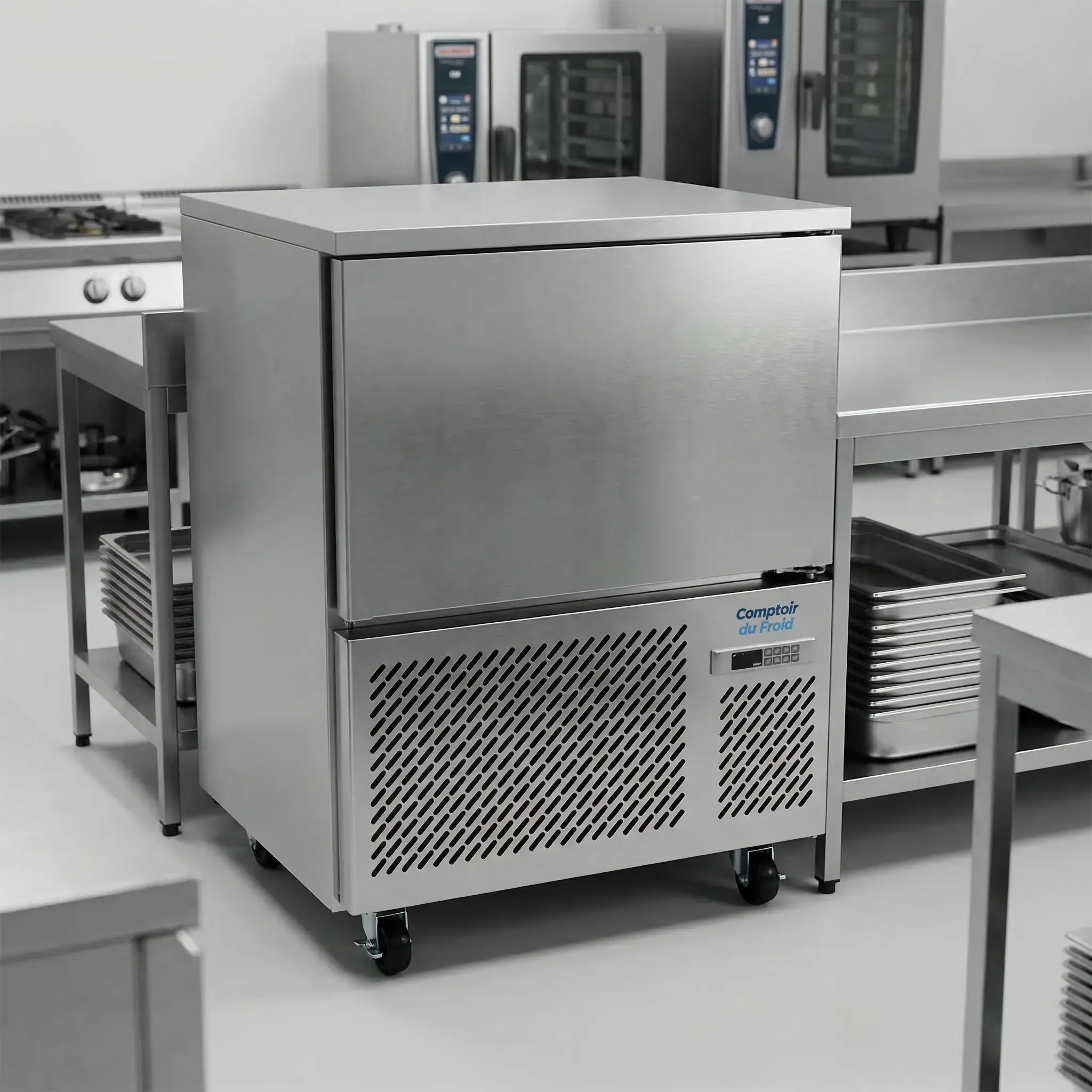
Stainless Steel Blast Chiller – 5 levels
- Practical GN 1/1 and 60 x 40 compatibility for alternating kitchen pans and pastry trays without an adapter
- AISI 304 stainless steel construction with automatic defrosting and antibacterial seals to simplify daily maintenance
- Mobile 5-level format on castors, specified for 20 kg in chilling and 15 kg in freezing per cycle
What mistakes should you avoid before buying a GN 1/1 chiller?
The priority is to check operational compatibility, not just the GN 1/1 mention on the product sheet. Measure your pans, trays, available depth, rear clearance and the route between cooking and the chiller.
A high-performance chiller that is poorly positioned will end up underused. It must be close enough to the hot section to chill quickly, but sufficiently ventilated to work properly without overheating the surrounding environment.
Field tip: keep a capacity margin. If you already fill every level during a normal service, the chosen model is too small to absorb a rush, catering production or an exceptional preparation.
- Do not confuse level capacity with the real kilogram capacity per cycle.
- Check that the containers you use fit without forcing and leave air space for circulation.
- Avoid overly deep pans that slow chilling at the product core.
- Plan for easy cleaning: stainless steel, accessible seals, drainage and defrosting matter every day.
Is the GN 1/1 format also suitable for pastry and catering?
Yes, provided you choose a chiller that also accepts 600 x 400 trays if your activity alternates between cooking, pastry and event production. This dual compatibility avoids buying an overly specialised machine.
For a pastry chef, caterer or restaurant preparing sweet and savoury bases, GN 1/1 + 600 x 400 versatility becomes a real advantage. It lets you chill gastronorm pans, trays, inserts or plated preparations with less friction in the workflow.
The best choice therefore remains the one that matches your actual containers. List your pans, trays and production volumes before comparing power ratings or prices.
Need a chiller compatible with your GN pans?
Compare compact, mobile and high-capacity formats to choose a chiller suited to your production pace.
FAQ on the GN 1/1 blast chiller
Does a GN 1/1 chiller accept all gastronorm pans?
It accepts GN 1/1 pans compatible with its runners, but you must check the pan depth and allow air to circulate around the preparations.
Should a restaurant choose 3 or 5 levels?
For small volumes, 3 levels may be enough. For more regular daily mise en place, 5 levels is often more comfortable.
Does the GN 1/1 format replace 600 x 400 trays?
No. The two formats meet different uses; a chiller compatible with both is more versatile for kitchen and pastry work.
Can very full pans be chilled in a GN 1/1 chiller?
It is better to avoid this. Layers that are too thick slow chilling at the core and make it harder to comply with HACCP best practice.