
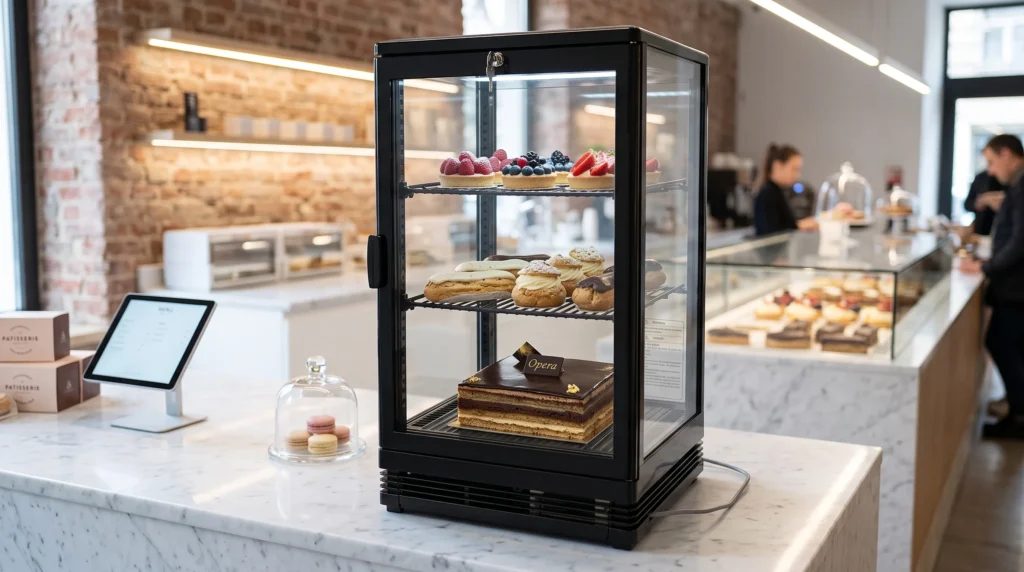
The correct setting of a refrigerated display case is not limited to the number shown on the thermostat. You must start with the temperature range required by the products, allow the unit to stabilize, then check the actual temperature held at several points before adjusting the setpoint.
This method avoids two costly errors: lowering the setpoint to compensate for improper loading, or believing that a correct display alone guarantees the cold chain.
How to set the temperature of a refrigerated display case at startup?
Begin with the setpoint prescribed for the displayed foodstuffs and the manufacturer’s operating range. A display case intended for beverages, desserts, or snacks does not necessarily have the same useful setting, even if the units look similar.
Proceed in this order:
- clean the display case and ensure air inlets and outlets remain clear;
- start it empty and allow the refrigeration to stabilize according to the instructions;
- place an independent control thermometer in the usable zone;
- load only products already brought down to their storage temperature;
- check again after stabilization, then correct the setpoint in small increments.
To distinguish technologies, formats, and uses before installation, also consult our professional refrigerated display case guide. The choice of unit and its setting are two complementary, but distinct, decisions.
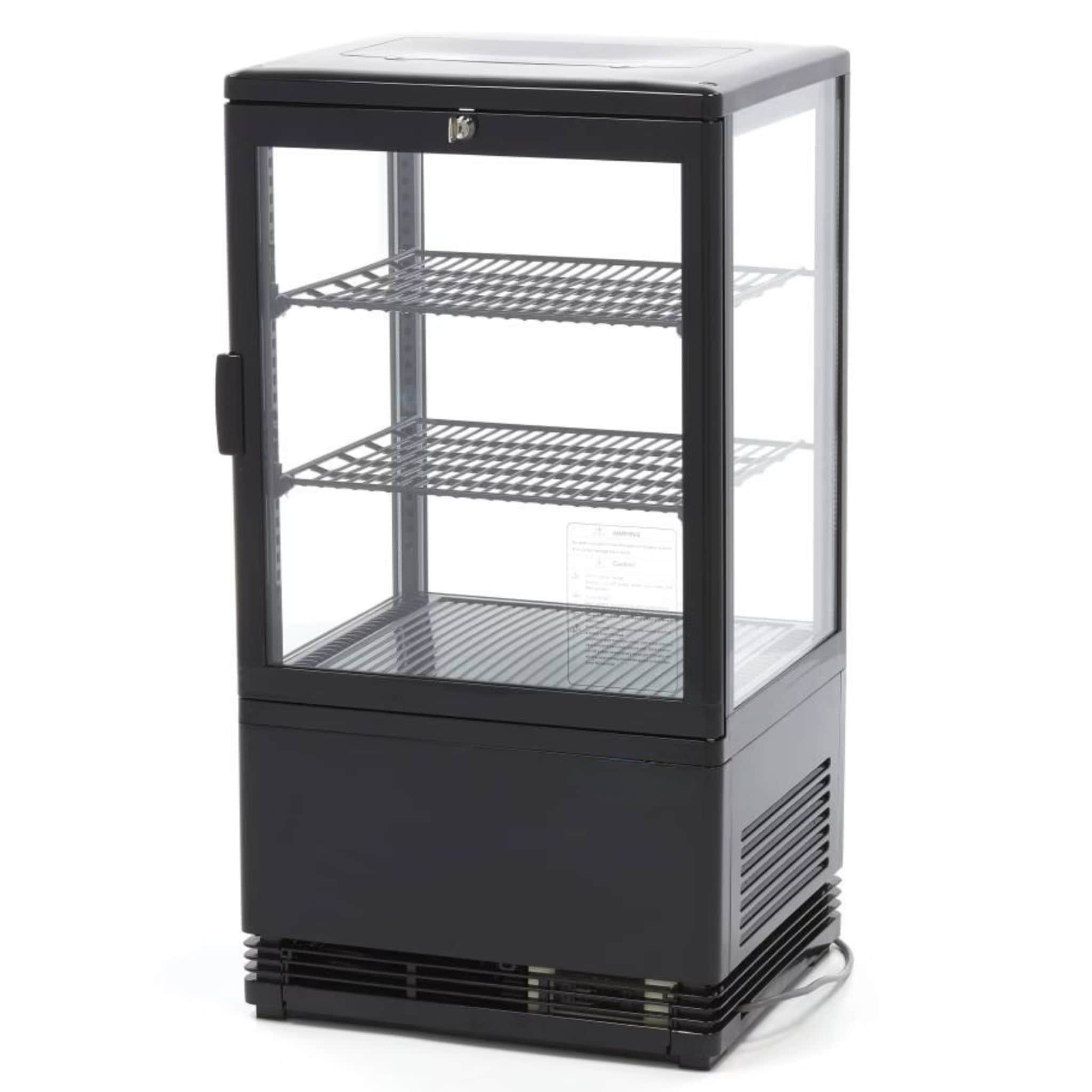
Black Countertop Refrigerated Display Case – 4 Glass Sides – 58 Liters (2 racks)
- 58-liter format with 2 racks for a concise selection on the counter
- Four glass sides to make beverages, desserts, and snacks visible from multiple angles
- Digital controller and advertised range of 0 °C to 12 °C, to be adapted to displayed products
Where should you measure to determine the actual product temperature?
Measure in the area occupied by the products, not just near the internal probe or the air outlet. The built-in controller regulates the unit; an independent check verifies the result obtained under actual sales conditions.
Take readings at several levels, especially in areas furthest from the airflow. If the display case has a service door, also observe the effect of repeated openings over a representative period.
Field tip: record the time, displayed value, independent measurement, monitored level, and load level. A series of comparable readings is more useful than an isolated measurement taken immediately after an opening.
For sensitive desserts, thermal stability must remain consistent with their composition and your food safety management plan. Our article on the refrigerated pastry display case details the specific constraints of this presentation.
Why does the temperature rise despite a correct setpoint?
A temperature that is too high is often caused by operating or installation conditions before it comes from the thermostat. Overloading, obstructed grilles, products introduced too warm, ambient heat, and frequent openings can prevent the unit from maintaining its operating regime.
| Symptom | Probable Cause to Check | Priority Action |
|---|---|---|
| Marked difference between top and bottom | Obstructed air circulation or too dense loading | Reorganize products and clear air passages |
| Rise during rush hour | Frequent openings or massive restocking | Divide restocking and prepare already cold products |
| Setpoint reached empty, not under load | Useful capacity exceeded or ambient conditions too demanding | Reduce load and check the installation conditions |
| Persistent difference between display and thermometer | Probe position, calibration, or technical fault | Compare multiple measurements, then have the unit inspected. |
Verdict: If the discrepancy disappears after clearing ventilation and stabilizing the load, do not compensate with an unnecessarily low setpoint. If it persists under normal conditions, have the probe, controller, and refrigeration circuit checked.
How to load the display case without disrupting refrigeration?
Load pre-chilled products, keep air discharge grilles clear, and avoid placing packaging against technical walls. A display case maintains a temperature; it is generally not designed to rapidly cool a large quantity of warm products.
Adopt a simple rule: less mass added at once, more circulation around products, and organized restocking before peak periods. This discipline improves thermal performance, offer visibility, and rotation.
- Before service: Pre-chill products and prepare for restocking.
- During service: Open briefly and restock in small quantities.
- After service: Clean, check drains, and note any unusual discrepancies.
When should you stop adjusting the setpoint and call a technician?
Stop successive corrections if the display case no longer stabilizes temperature despite a normal load, clear ventilation, and properly closed doors. A continuously lower setpoint can mask the symptom without resolving the cause.
Repeated drift, abnormal frosting, an irregular fan, unusual cycles, or a persistent discrepancy between the display and an independent measurement warrant a diagnosis. In the meantime, protect foodstuffs according to your HACCP procedure and do not assume they remain compliant without measurement.
Need a display case suited to your layout?
Compare countertop formats based on usable volume, visibility, and your point-of-sale constraints.
FAQ on Refrigerated Display Case Settings
What temperature should be set on a refrigerated display case?
Set it according to the foodstuffs, the unit’s manual, and your sanitary control plan. Then check the actual temperature of the products with an independent instrument.
Can a display case be loaded with products that are still warm?
No, unless specifically indicated by the manufacturer. Introduce pre-chilled products to avoid a prolonged temperature increase.
Why do the display and the thermometer not show the same value?
They do not necessarily measure at the same location or at the same time. Compare several readings after stabilization before concluding a defect.
Should the setpoint be lowered when the display case is very full?
Not automatically. Start by reducing the overload and restoring air circulation; a lower setpoint does not correct improper loading.