
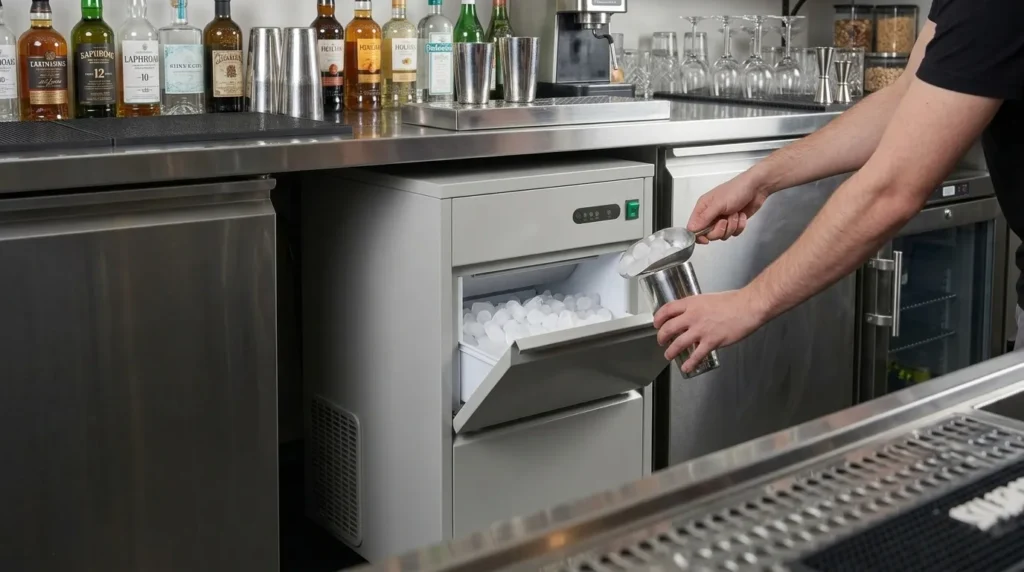
A built-in ice maker can maintain professional service provided four points are controlled: water supply, drainage, heat rejection, and maintenance access. The built-in installation must never enclose the machine; it must create a clean setup that preserves its actual output.
In a narrow back bar or a hot kitchen, water cooling often facilitates integration. However, it does not eliminate the need for a properly sized connection, reliable drainage, or technical access.
What should be planned before building in an ice maker?
The installation location must be validated before ordering the machine. External dimensions are not enough: connections, hoses, drainage passage, and the opening required for cleaning also take up space.
- An accessible water inlet, equipped with a shut-off valve that the team can reach without disassembling furniture.
- Continuous drainage, without pinched hoses or reverse slopes that could cause backflow.
- Technical clearance in accordance with the model’s instructions, especially around air inlets and outlets.
- A dedicated electrical supply, protected and away from splash zones.
- A removable front panel or side access for maintenance, descaling, and troubleshooting.
The choice of water circuit is central. The guide on the ice maker with water inlet details the points to check to obtain a regular and usable supply in hotels, restaurants, and cafes.
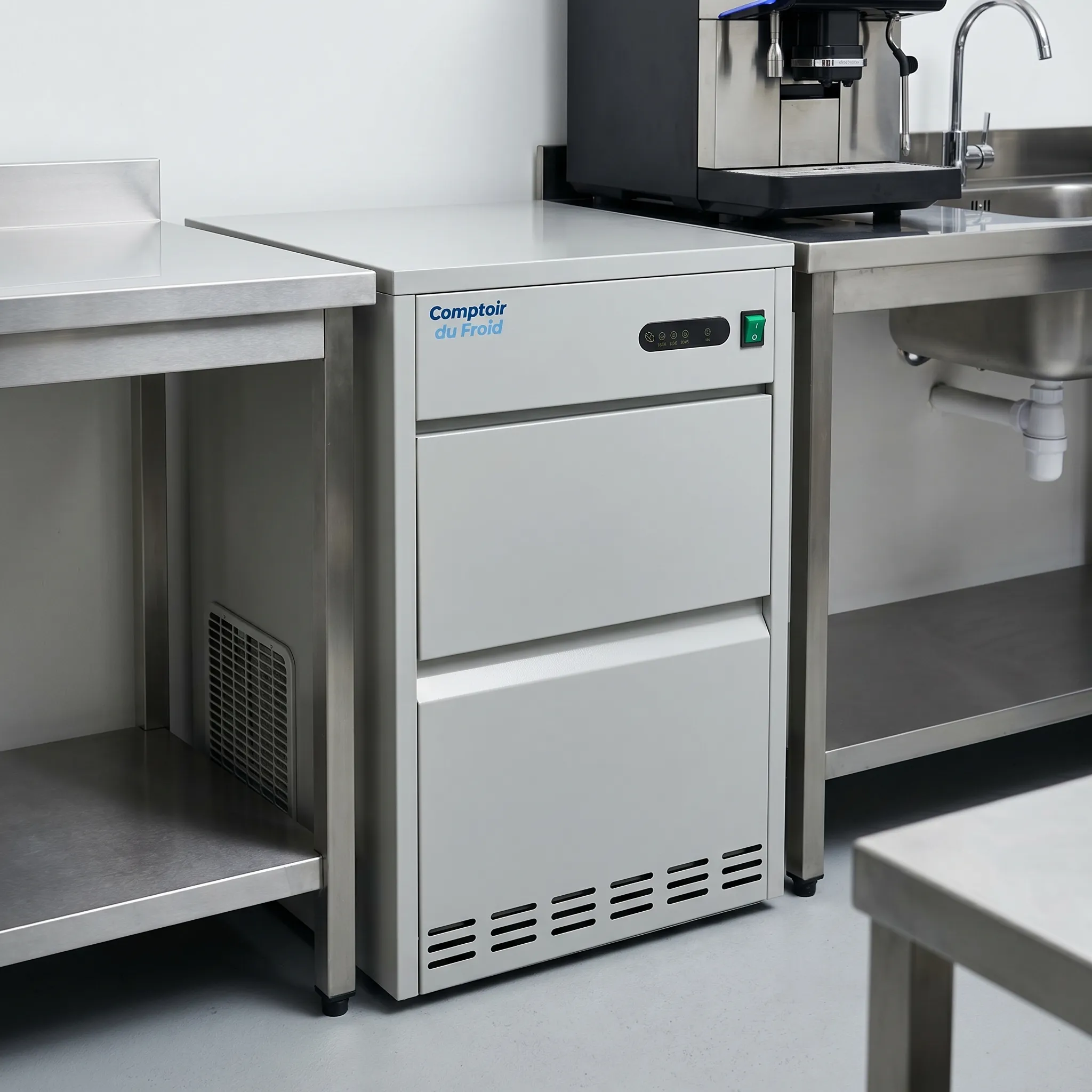
Professional Hollow Ice Maker – 45 kg per day – Water Cooling
- Production of 45 kg per day suitable for sustained output in a bar or restaurant
- Water cooling recommended in hot back bars or built-in installations
- Hollow ice cubes and stainless steel structure designed for intensive beverage service
Air or water cooling: which best supports built-in installation?
Water cooling is generally the most tolerant in a closed cabinet or a hot room. An air-cooled model remains relevant if its air intake and exhaust remain unobstructed and if the ambient temperature remains compatible with the instructions.
| Criterion | Air Cooling | Water Cooling |
|---|---|---|
| Installation | Requires genuinely unobstructed air circulation | More suitable for controlled built-in installation |
| Hot Environment | Efficiency more sensitive to room heat | Generally more consistent performance |
| Water Consumption | Limited to the production cycle and cleaning | Higher due to condenser cooling |
| Network Constraints | Water inlet and drainage for production | Water inlet, drainage, and flow rate to be carefully sized |
| Maintenance | Condenser to be dusted regularly | Water circuit and scale to be monitored more closely |
Verdict: for a tight built-in installation or a hot back bar, prioritize a water-cooled version if the network and operating cost are acceptable. If the cabinet can be largely ventilated, an air-cooled version remains more water-efficient and often simpler to operate.
How to avoid loss of efficiency after installation?
The advertised output is only achievable under favorable conditions. Hot supply water, an overheated room, a fouled condenser, or faulty drainage reduce the available production during service.
- Measure needs during peak times, not just average daily consumption.
- Check the room temperature at the machine’s actual location.
- Provide water filtration suitable for water quality and scheduled descaling.
- Ensure the storage bin remains accessible without blocking staff passage.
- Allow for a simple disassembly solution to intervene without removing the entire back bar.
Refrigeration technician’s tip: Draw the actual path of hoses and cables before building the cabinet. A bend that is too tight behind the machine can negate the planned clearance and complicate every maintenance task.
What capacity should you choose for a built-in back bar?
Size the production based on rush hour needs, then check the reserve. A compact machine can have a decent daily output but a bin that is too small to handle two hours of high demand.
To decide between ice cube format, bin capacity, and production rate, also consult the professional ice maker buying guide. In practice, a 45 kg/day model is suitable for sustained service only if instantaneous consumption and stock replenishment phases remain consistent.
Also, keep a margin for hot days, events, and an increase in the number of covers. Slightly oversizing production is often safer than relying on permanent maximum output.
Which built-in errors are the most costly?
The most costly errors are those that make maintenance difficult. A high-performance machine quickly becomes unavailable if you have to dismantle an entire counter to clean the condenser, change a filter, or access the shut-off valve.
- Choosing an air-cooled machine and then obscuring its ventilation grilles.
- Placing the water valve behind a fixed panel.
- Creating an upward or pinched drain.
- Forgetting the necessary space to open the bin and remove the machine.
- Installing the appliance near a heat source without checking the actual temperature.
The correct installation must allow staff to clean areas in contact with ice and technicians to access Mayn components. This accessibility protects hygiene, machine availability, and total cost of ownership.
Need a machine adapted to your installation?
Compare capacities, reserves, and cooling methods before finalizing the cabinet and connections.
FAQ on built-in ice makers
Can any ice maker be built-in?
No. You must respect the clearances and cooling method specified by the manufacturer. An air-cooled model must not be enclosed without adequate ventilation.
Does a water-cooled machine need a drain?
Yes. It requires properly sized water supply and drainage for ice production and the cooling circuit.
Is a water filter necessary?
It is generally recommended. The treatment should be chosen according to water quality to limit scale and ice defects.
How much clearance should be left around the machine?
The clearance depends on the model. Follow its instructions and add the necessary space for connections, bin opening, and machine removal.