
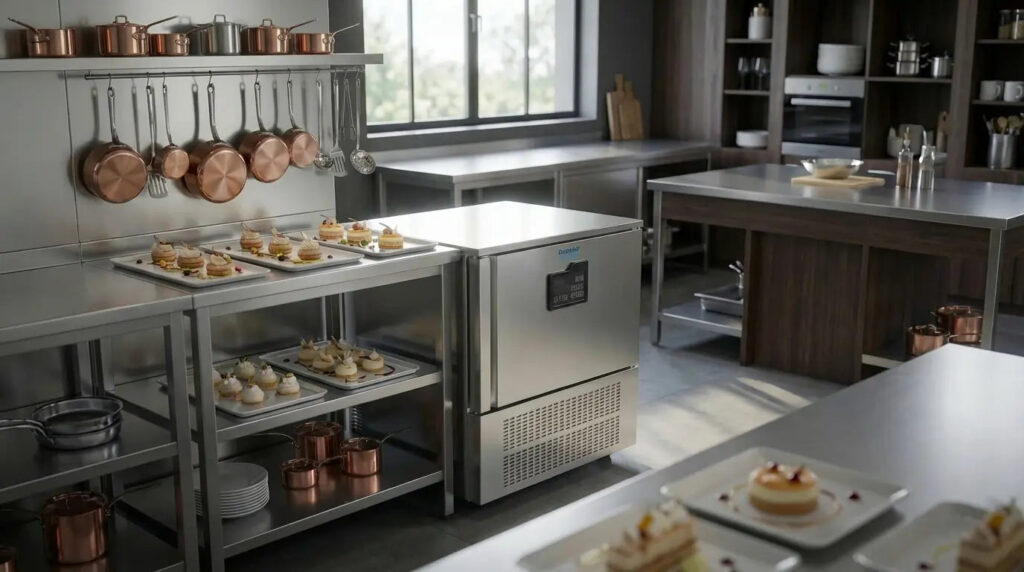
A blast chiller for a professional kitchen quickly becomes essential as soon as you produce in advance, work with cold connection, or need to secure regular volumes without breaking the cold chain. In practice, it serves less to “produce cold” than to rapidly bring down the temperature at the right moment, to protect the quality of dishes, meet HACCP requirements, and keep the kitchen running more smoothly.
The right choice Maynly depends on your actual throughput, the GN or pastry format used, and the available space around the workstation. If you are still unsure about the exact role of this equipment, you can also read what a rapid blast chiller is for and the difference between a freezer and a blast chiller.
Why does a professional kitchen really need a blast chiller?
The real question is simple: can you cool quickly and cleanly without stopping your production? In a professional kitchen, the answer is often no as soon as volumes increase slightly.
A blast chiller prevents preparations from sitting at warm temperatures for too long, limits improvised handling, and secures the transition between cooking, storage, and service. This is particularly useful for sauces, prepared meals, catering preparations, pre-assembled desserts, and pastry production.
- You save time on advanced preparations.
- You reduce microbiological risk on sensitive products.
- You better stabilize the texture, hold, and visual quality of dishes.
- You relieve cold storage units, which are not designed to absorb massive heat.
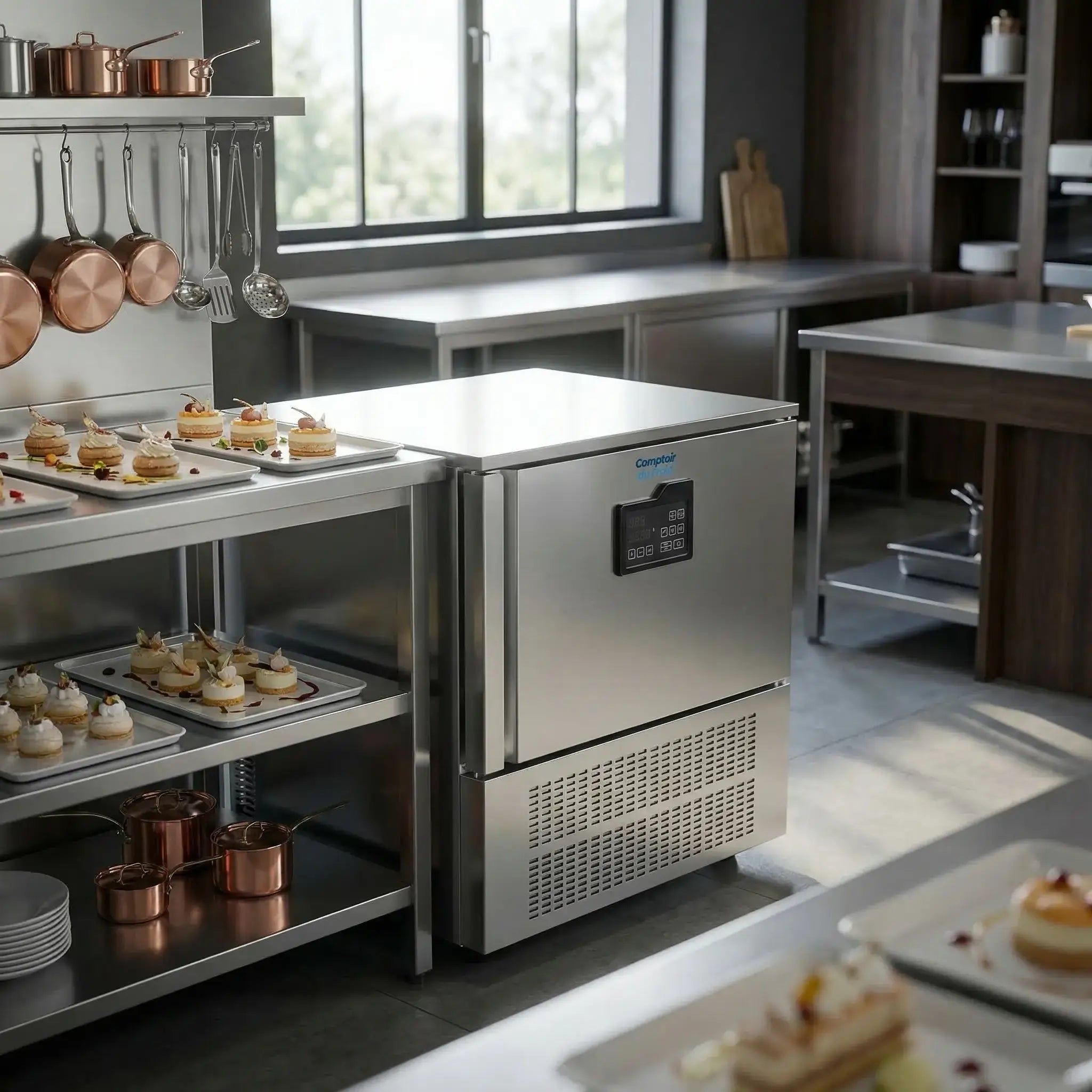
Stainless Steel Rapid Blast Chiller – 3 levels
- Mixed compatibility GN 1/1 and 60 x 40 trays to serve both kitchen and pastry
- AISI 304 Stainless Steel construction with core probe for more durable and controlled professional use
- Compact 3-level version, rated for 10 kg in chilling and 5 kg in freezing per cycle
Which blast chiller size to choose depending on your kitchen’s pace?
You need to choose a size that can absorb your peak production, not just your average. A chiller that is too small creates internal bottlenecks, while one that is too large ties up budget and unnecessary space.
The right approach is to start with your volume per cycle, the number of trays or containers to process, and the frequency of service rounds. This logic makes the difference between cost-effective equipment and a machine quickly bypassed by the team.
| Kitchen Profile | Recommended Size | Why |
|---|---|---|
| Small restaurant, premium snack bar, compact lab | 3 levels | Good entry point to secure preparations without overcrowding a small space. |
| Structured restaurant, regular caterer, more varied production | 5 levels | Best compromise between throughput, versatility, and daily working comfort. |
| Brigade, high volume, strong production anticipation | 7 to 10 levels and more | Allows absorbing multiple batches without slowing down cooking pace or setup. |
Verdict: if your kitchen produces several hot preparations to cool within the same time slot, the 5-level option is often the best balance. The 3-level option remains relevant when space is limited or activity is just starting.
Field Tip: the chiller must be sized for production peaks, not for quiet days. This is where kitchen fluidity is truly determined, not just by the technical specifications.
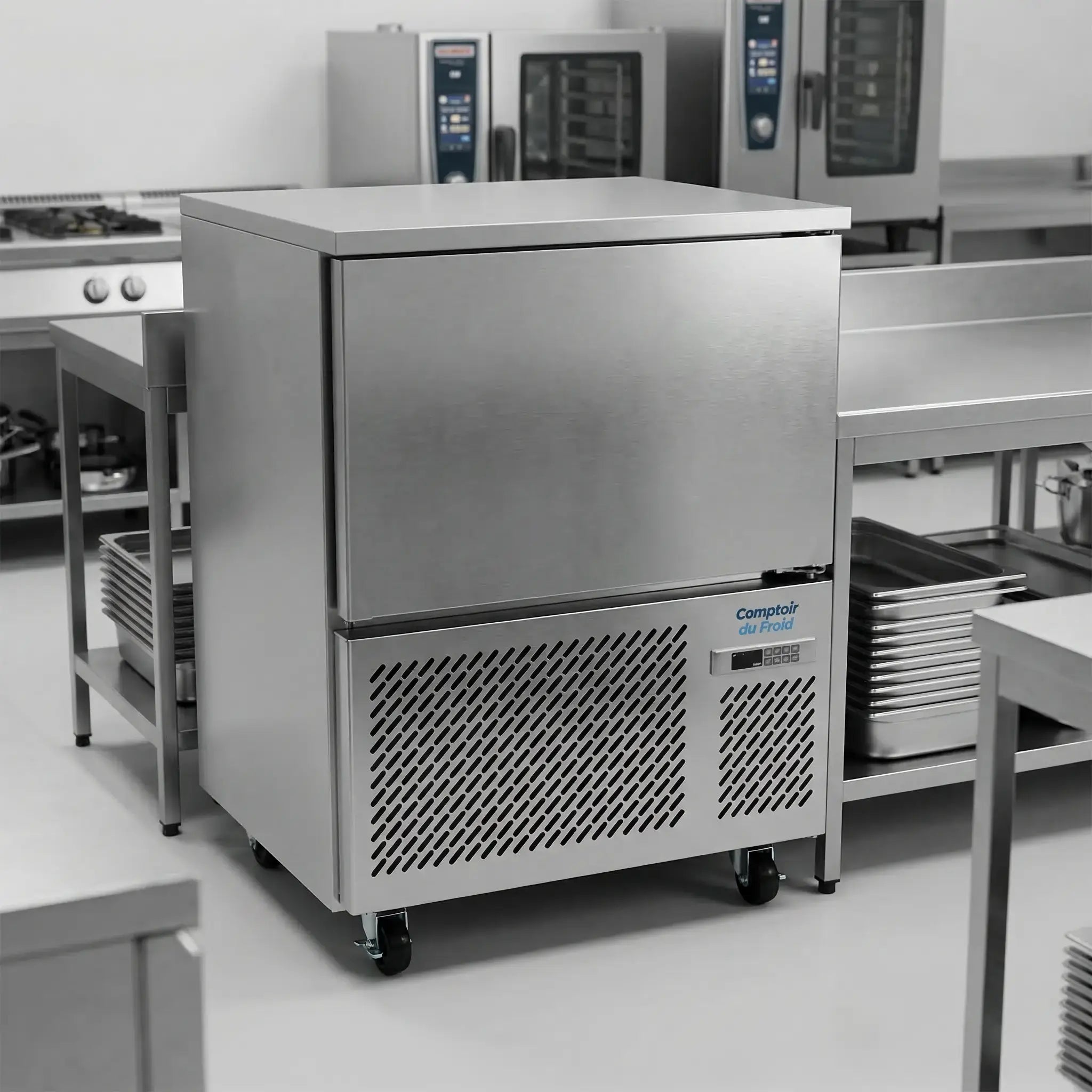
Stainless Steel Rapid Blast Chiller – 5 levels
- Practical GN 1/1 and 60 x 40 compatibility for alternating kitchen containers and pastry trays without an adapter
- AISI 304 Stainless Steel construction with automatic defrost and antibacterial seals to simplify daily maintenance
- Mobile 5-level format on casters, rated for 20 kg in chilling and 15 kg in freezing per cycle
What technical criteria should you look at before buying?
The question to ask is whether the equipment will be compatible with your actual production method. You need to look at criteria that influence operation, not just raw capacity.
In a professional kitchen, the most important points are often the following:
- Format compatibility: GN 1/1, 600 x 400 trays, or mixed use.
- Capacity per cycle: it must match your actual hot volumes.
- Core probe: useful for better cycle control and ensuring HACCP compliance.
- Footprint and mobility: door access, circulation, cleaning, cold station layout.
- Ease of maintenance: stainless steel, seals, defrosting, cleaning ergonomics.
In practice, a machine well-integrated into your workflow is better than an oversized, poorly placed model. This is also why a well-chosen compact chiller can be more cost-effective than a large, underused machine.
When does the blast chiller become profitable in a professional kitchen?
It becomes profitable as soon as it prevents production losses, wasted time, and improvised cooling. In catering, profitability rarely comes from a single argument, but from a set of very tangible gains.
You gain in production lead time, service regularity, food safety, and organizational comfort. It also allows for better separation of cooking, chilling, and reheating times, which greatly helps when the team is working under pressure.
If your team anticipates preparations the day before, manages batch cooking, cold connection, or delicate desserts, the chiller is no longer a luxury. It becomes a piece of organization.
Need to compare the right sizes for your kitchen?
Explore the complete selection of professional blast chillers to find the capacity level truly suited to your production.
FAQ about blast chillers for professional kitchens
Does a blast chiller replace a cold storage unit?
No. It is used to quickly bring down the temperature of a hot product, then storage is done in preservation equipment.
Is a 3-level format sufficient for a restaurant?
Yes, for small regular production or a compact space. Beyond that, a 5-level often provides true comfort.
Why not just place hot dishes in a cold room?
Because a cold room is not designed to quickly absorb a large hot load, and this can degrade the rest of the stock.
Is the core probe really useful?
Yes, especially for monitoring cycles more precisely and better securing HACCP procedures for sensitive products.