
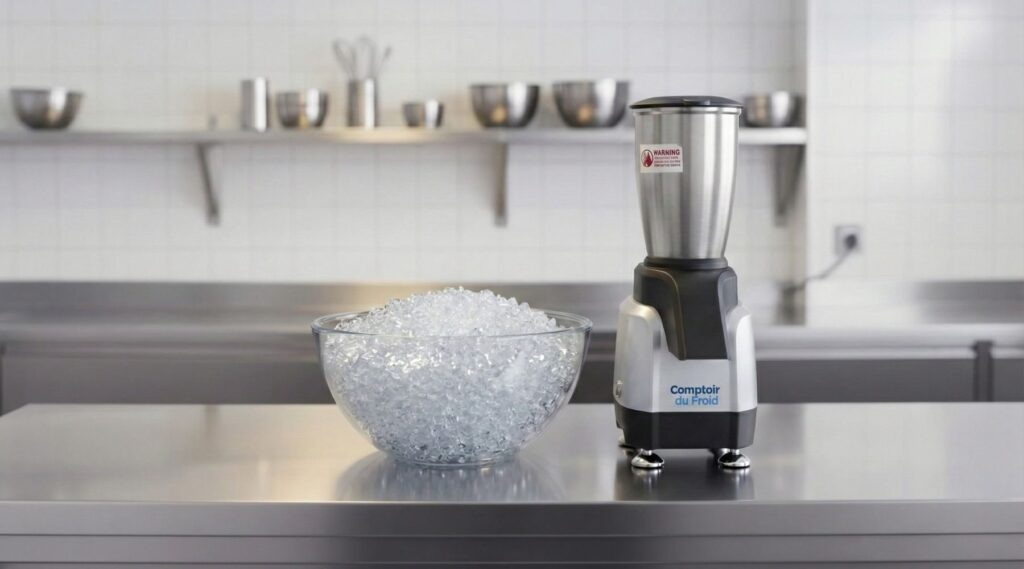
Yes, a blender can sometimes crush ice, but certainly not all blenders can. Between motor power, blade shape, and bowl resistance, it only takes one weak link to turn a simple attempt into a tired appliance, a cracked bowl, or an unnecessarily strained motor.
The right question, therefore, is not just “does it work?”, but rather: is your blender truly designed to do this without premature wear and tear? And if you need to crush ice frequently, the real comparison quickly comes down to a versatile blender versus a dedicated ice crusher.
What are the 3 criteria to check before trying?
To crush ice without breakage, you need an appliance that is robust enough in three areas: power, blades, and bowl. If one of these elements is weak, ice can quickly become a bad test for the equipment.
- Power: Below 400 W, it’s best to forget it. Above 600 W, we start talking about a truly credible threshold.
- Blades: Thick blades designed for impact are more reassuring than thin blades made for blending fruits.
- Bowl: Reinforced glass, solid Tritan, or stainless steel. Thin plastic is the classic weak link.
In other words, crushing ice is not just a simple extension of making a smoothie. It’s a tougher, more brutal, and more repetitive mechanical strain on the appliance.
Why isn’t power alone enough?
A powerful motor helps, but it doesn’t guarantee good crushing. A classic blender relies heavily on its rotation speed, whereas a specialized crusher works more with torque and mechanics better suited for crushing.
This is why a dedicated professional appliance may sometimes seem less impressive in terms of watts, while being much more consistent in real use. The logic is not to “spin faster”, but to crush properly without unnecessarily stressing the motor.
| Criterion | Classic blender / mixer | Dedicated crusher |
|---|---|---|
| Principle | Rotation speed | More targeted crushing force |
| Versatility | Yes, for multiple uses | Less versatile, but more specialized |
| Comfort with regular ice | Variable | Much better |
| Risk of wear | Higher if used frequently | Better suited for repetition |
Verdict: For a few ice cubes from time to time, a good blender might suffice. For regular crushed ice, a dedicated crusher remains much more logical.
Why is the bowl often the real weak point?
Because ice acts like a hard projectile in the container. When ice cubes hit the walls at high speed, a fragile bowl can micro-fissure, become opaque, or eventually break.
If you have any doubts, it’s better to consider ice as an exceptional use, not a routine without consequence.
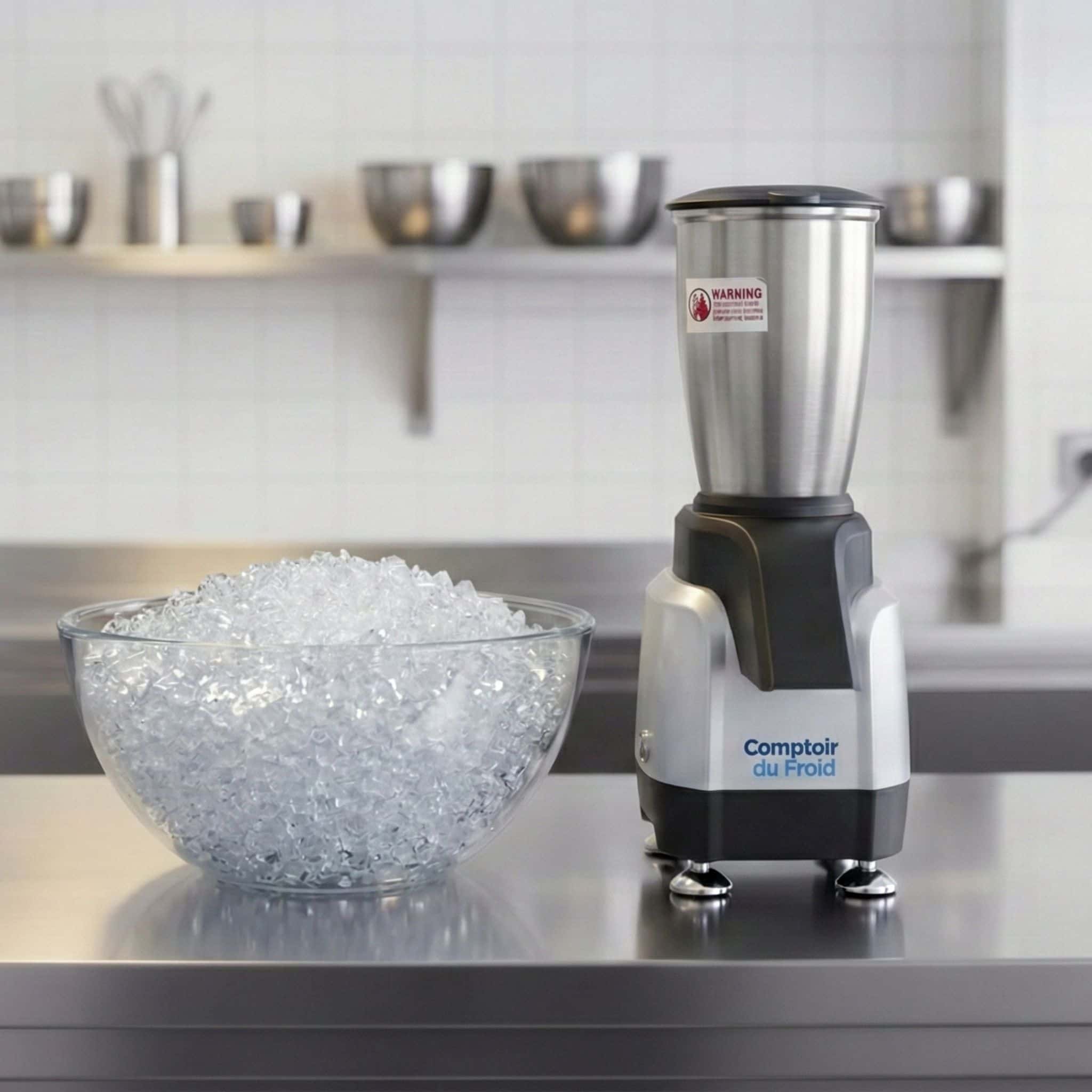
Professional 3L Ice Crusher
- Designed to crush ice without asking a blender to do a job that isn’t its own
- 3L stainless steel bowl, more reassuring for intensive use
- Much more consistent for cocktails, granitas, and regular service
When should you switch to a real dedicated machine?
As soon as crushed ice becomes a regular need, not an occasional test. If you serve cocktails, seafood platters, iced drinks, or summer preparations at a steady pace, a dedicated ice crusher quickly becomes more cost-effective than a blender forced out of its comfort zone.
- Occasional home use: A good blender may suffice with caution.
- Regular use in catering: Better to switch to a dedicated ice crusher.
- Need for large volumes of crushed ice: You should also look at professional crushed ice machines.
If your need is really oriented towards large volume rather than occasional crushing, you can also read our article on choosing a professional crushed ice machine or our guide on how to make crushed ice with or without a professional crusher.
Need a truly ice-friendly appliance?
Explore our selection to choose a crusher or a professional solution consistent with your frequency of use and level of demand.
FAQ
Can a 300 or 400 W blender crush ice cubes?
It is not recommended. At this power level, the motor is likely to strain quickly, especially if the appliance is not explicitly designed for this use.
Are smooth blades suitable for ice?
Not ideally. They are often designed for cutting and blending, not for repeatedly withstanding the impact of ice.
Why can a dedicated crusher be better even with fewer watts?
Because it doesn’t work like a classic blender: it is designed to transmit a crushing force more consistent with ice.
When should you stop risking your blender?
As soon as ice becomes a frequent use. In this case, a dedicated crusher becomes safer, more consistent, and often more cost-effective in the long run.