
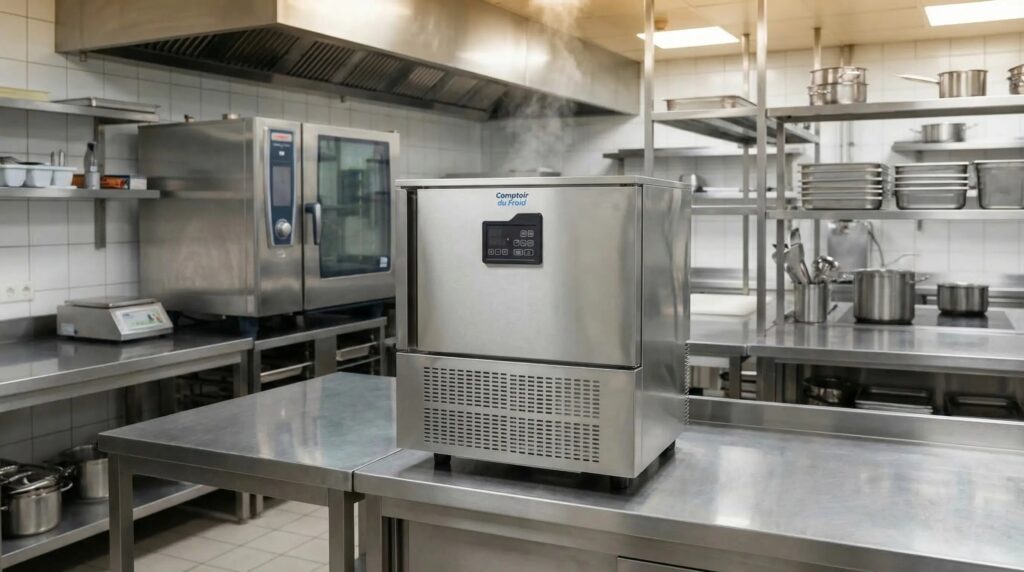
In institutional catering, for caterers, or in central kitchens, the HACCP protocol for a blast chiller is not limited to “putting a dish in the cold.” The objective is to rapidly lower the temperature of preparations to limit bacterial proliferation, secure cold storage, and protect product quality.
In practice, the blast chiller is integrated into a comprehensive method: portioning, loading, temperature control, traceability, and maintenance. If you first want to understand the precise role of the equipment, you can read our article what a blast chiller is for and how to use it. And if you’re still hesitating between different formats, our guide on the 5-level blast chiller provides good sizing benchmarks.
Why the HACCP protocol requires rapid cooling
The Mayn danger after cooking is keeping food in the temperature zone favorable for microbial development for too long. Overly slow cooling increases health risks and weakens your food safety management plan. The blast chiller thus serves to significantly shorten this critical phase.
- Food safety: reduced time spent in the sensitive zone.
- HACCP compliance: more reliable control of critical steps.
- Product quality: better texture retention for sauces, meats, and pastries.
- Organization: advance preparation, controlled storage, and smoother service.
The Mayn steps of the HACCP protocol with a blast chiller
1. Properly prepare dishes before entering the blast chiller
The protocol begins even before the cycle is initiated. Preparations must be distributed in suitable containers, with a reasonable thickness to facilitate heat exchange. Stainless steel GN containers are generally preferable to overly deep containers, which slow down temperature reduction.
It is also recommended to avoid loading the blast chiller with dishes that are too tightly packed or poorly ventilated. Cold air must circulate freely around the products. Overloading reduces actual efficiency, even on a powerful machine.
2. Start the correct cycle according to the type of production
The correct HACCP protocol involves choosing a cycle consistent with the volume, product nature, and production rhythm.
| Situation | Best practice |
|---|---|
| Small daily productions | Compact chiller, shallow trays, simple manual control |
| Regular production kitchen | 5-level model, repeated cycles, systematic temperature readings |
| Cold chain or sustained volume | Chiller on a trolley or large capacity, written procedures, and enhanced traceability |
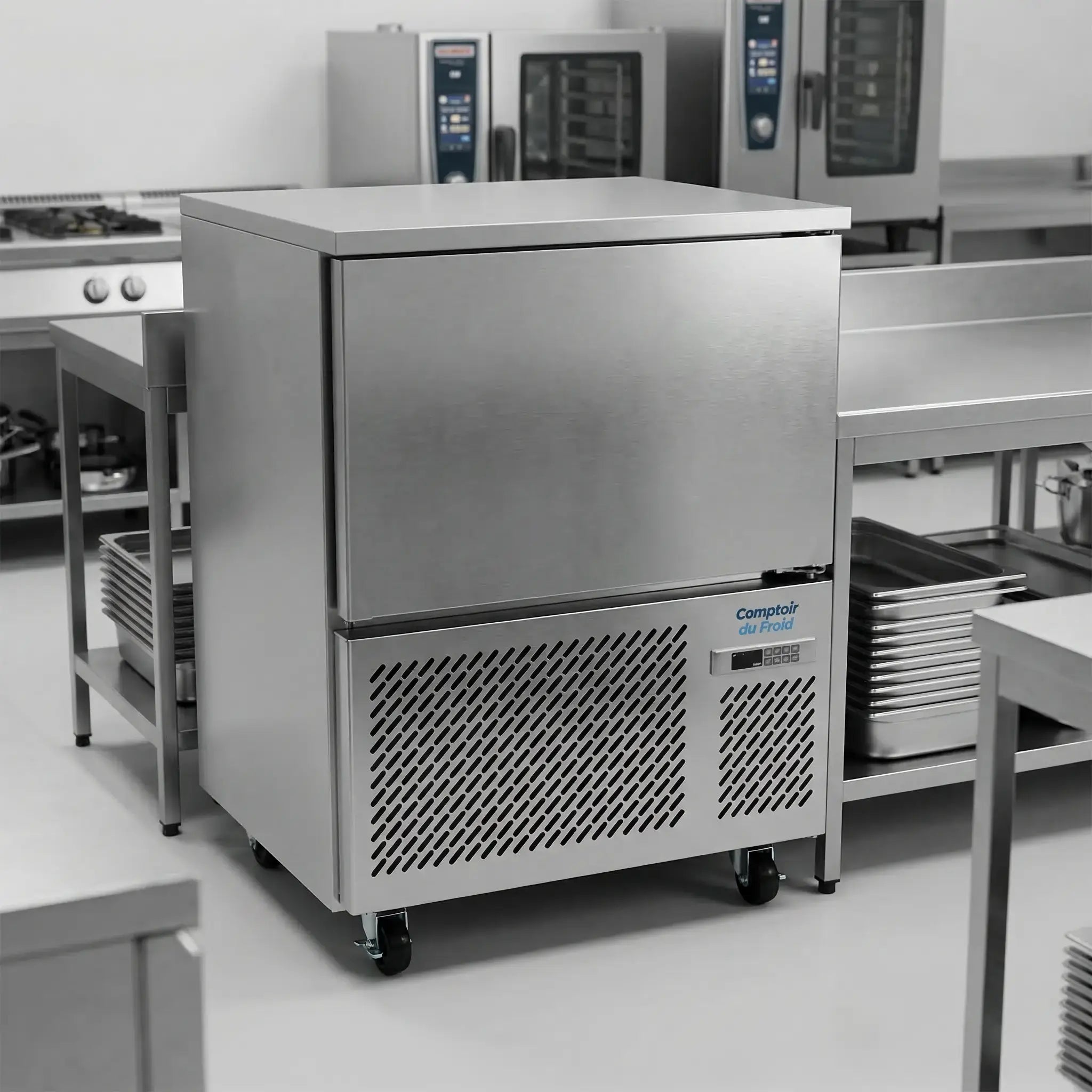
- Versatile format for restaurants, pastry shops, and laboratories with regular production
- Consistent capacity to formalize HACCP cycles without over-dimensioning the investment
- Excellent compromise between footprint, productivity, and cold chain control
3. Control and record temperatures
The critical HACCP point is not limited to the “start” button. It is necessary to verify that the target cooling is effectively achieved within the deadlines defined by your internal method. This involves reliable readings, a clean probe, and recording on a sheet or digital medium.
- Preparation name
- Date and time of cooking completion
- Date and time of entry into the chiller
- Starting temperature and final temperature
- Operator’s name
- Corrective action in case of deviation
4. Store without breaking the cold chain
Once the cycle is complete, dishes must be quickly transferred to appropriate positive storage, labeled, and integrated into stock rotation. A blast chiller does not replace a storage cabinet: it secures the temperature reduction, then the relay must be taken by appropriate preservation equipment.
The most common errors in an HACCP cooling protocol
Many discrepancies come less from the equipment than from production habits.
- Using trays that are too deep, which slows down cooling at the core of the product.
- Overloading the chiller, thinking it saves time.
- Leaving dishes to wait too long before placing them in the chiller.
- Forgetting readings or filling out forms afterward.
- Neglecting to clean walls, slides, handles, and probes.
On this last point, rigorous maintenance is an integral part of the protocol. We detail this topic in our guide how to clean a blast chiller.
What equipment to choose to apply a true HACCP protocol?
The right choice depends on daily volume, the number of services, the tray format used, and your production logic. A small establishment does not have the same constraints as a catering laboratory or a collective kitchen.
For sites with higher output, more trays, or internal rolling needs, it is advisable to opt for a more mobile, higher-capacity model to standardize processes and reduce handling.
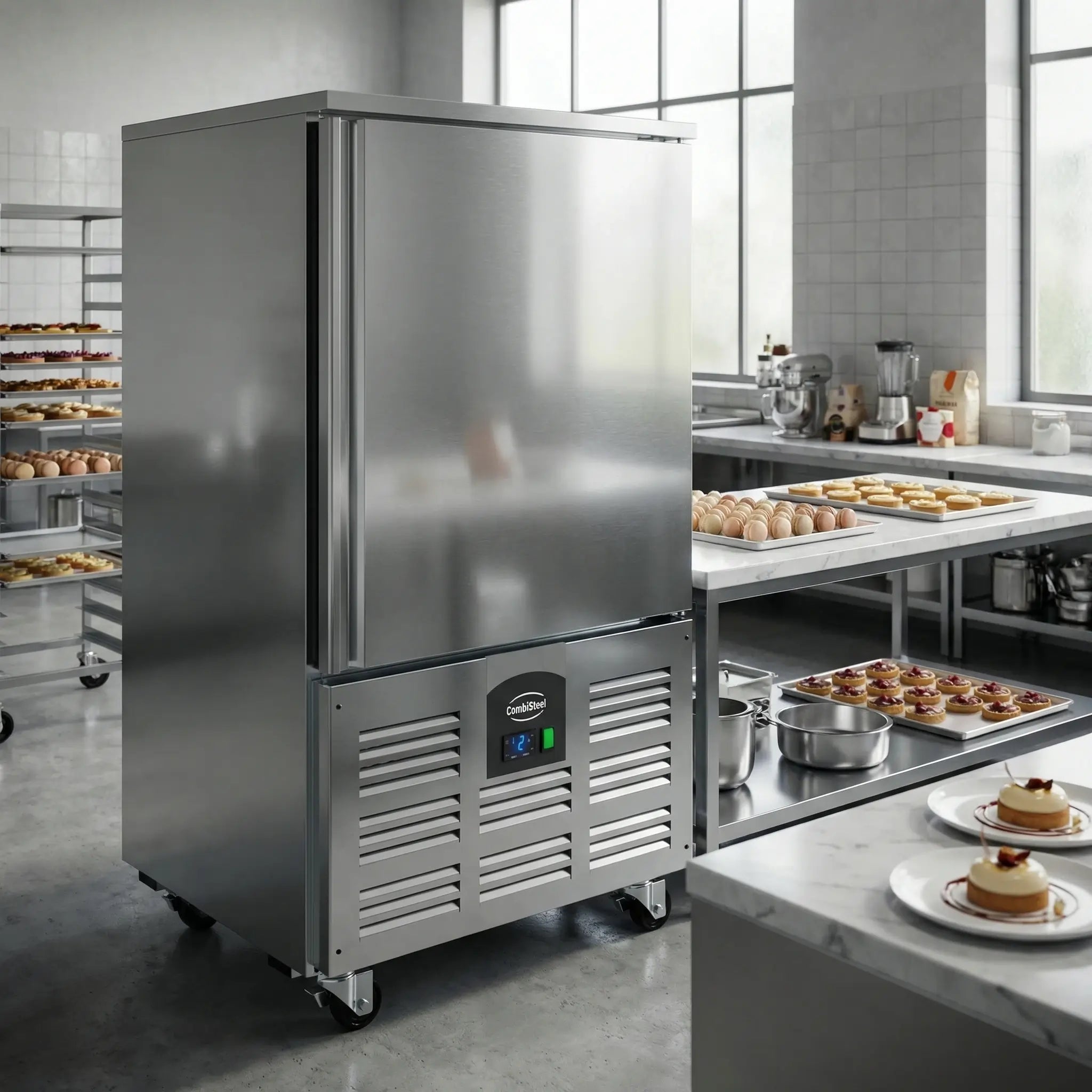
- Ideal for kitchens with multiple productions requiring strict traceability
- Practical mobile configuration to optimize flows between preparation, chilling, and storage
- Robust solution to increase output while maintaining a clear HACCP protocol
Simple HACCP checklist for the blast chiller
- Verify that the chiller is clean, clear, and at the correct operating temperature.
- Distribute preparations into suitable, unoverloaded trays.
- Identify each production before or immediately after chilling.
- Measure temperature according to your internal procedure.
- Trace results on a form or in software.
- Transfer quickly to refrigerated storage.
- Correct any detected deviation and record the action taken.
An effective HACCP protocol relies on method as much as on machine
A high-performance blast chiller significantly improves safety and organization, but it does not provide compliance on its own. The true professional level comes from combining well-sized equipment, trained teams, and regular traceability.
Need a chiller adapted to your HACCP protocol?
Discover our selection of professional blast chillers to structure a truly safe and clear cold chain.
FAQ
What is the HACCP function of a blast chiller?
It allows for the rapid lowering of dish temperatures after cooking to limit microbiological risks during the most sensitive phase.
Should temperatures be recorded for each cycle?
Yes, traceability is part of good HACCP practices. The exact frequency then depends on your organization, your food safety management system (FSMS), and your activity.
Does a blast chiller replace a refrigerated cabinet?
No. The chiller is for rapid cooling, while the refrigerated cabinet ensures product preservation once the temperature is reached.
Which format to choose for a traditional restaurant?
In many cases, a 3 to 5-level chiller is sufficient. Beyond that, you need to consider the number of covers, production peaks, and the use of the cold chain.