
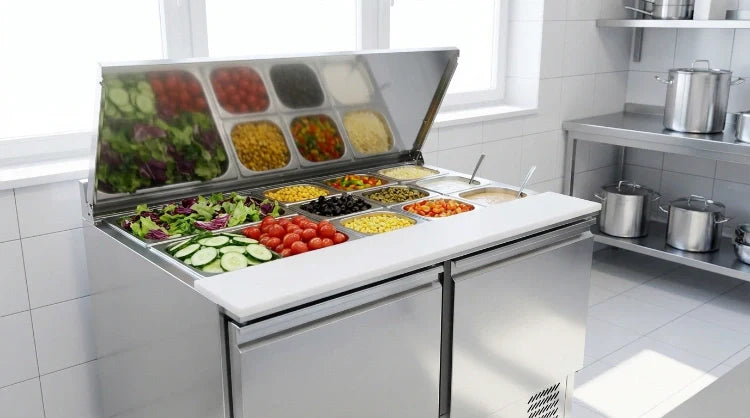
A 2-door refrigerated prep counter is often the best compromise for a compact preparation station in fast food, snacking, or small production kitchens. It provides enough volume to handle service without unnecessarily extending the counter length or hindering workflow around the workspace.
In practice, this format is suitable when you need to prepare quickly, keep ingredients within reach, and maintain HACCP cleanliness, all while managing space constraints. The challenge isn’t just about capacity; it’s primarily about smooth workflow during peak hours.
When is a 2-door refrigerated prep counter truly the right choice?
The real question is simple: do you need a complete preparation station without transitioning to an overly long unit? If so, the 2-door format is often the most suitable.
It works particularly well for establishments that need to handle a good volume but on a shorter line: snack bars, sandwich shops, local pizzerias, deli corners, or secondary kitchens.
- You are short on space, but still want a proper refrigerated work surface.
- Your menu is concise, with a controlled number of ingredients.
- Service demands speed, but not the high volume of a 3-door unit.
- You are looking for a versatile station to prepare, garnish, and store all in one unit.
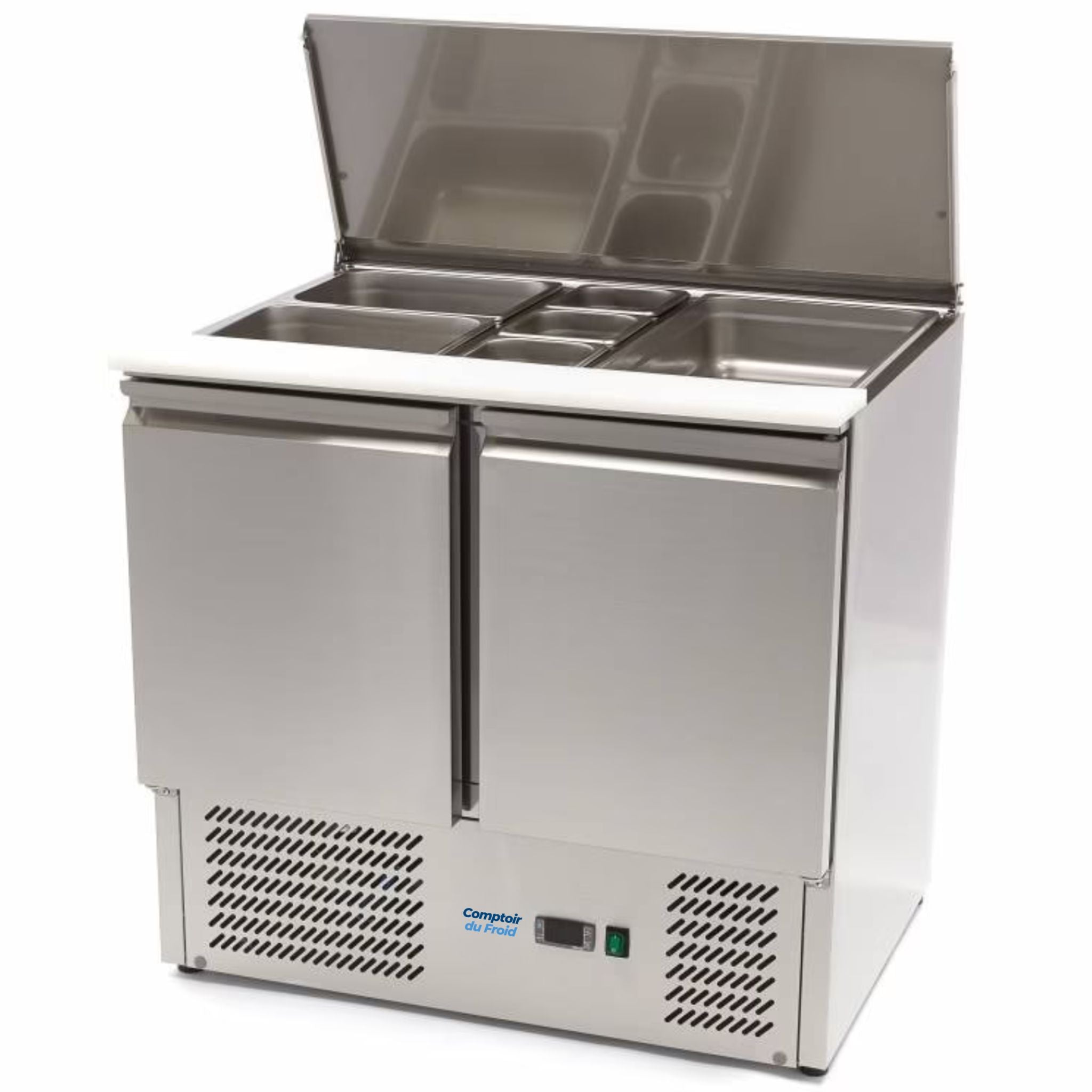
Stainless Steel 2-Door Refrigerated Prep Counter 90cm (Stainless Steel Lid)
- Short format ideal for kitchens where every centimeter counts
- Refrigerated storage and preparation combined in one unit
- Configuration adapted for fast service with simple setup
Why this format is often more cost-effective than a larger unit
The short answer: a 2-door often prevents oversizing the station. You invest in equipment that truly works, instead of occupying space with rarely used volume.
In practice, an overly large station often creates the opposite effect of what was intended: less fluid circulation, unnecessary back-and-forth, longer cleaning times, and more complicated setup. A well-designed 2-door unit allows for daily production with a better balance between useful capacity and occupied surface area.
For many teams, the right calculation is therefore operational:
- less bulk upfront,
- closer proximity between pans, ingredients, and plating area,
- more reasonable cleaning time,
- often a more modest purchase cost than a 3-door unit or a long pizza prep counter.
How to decide between 2-door, 3-door, and mini countertop formats?
To choose wisely, you need to answer just one question: how many ingredients and how many simultaneous tasks does your station need to handle during peak activity?
If your service is compact but consistent, the 2-door is often the best balance. If you work with more items or multiple operators, you might need a larger size. Conversely, for very light supplemental use, a countertop version might suffice.
| Format | When it’s relevant | Limitations |
|---|---|---|
| Mini countertop prep counter | Small snack bar, supplemental use, very limited offerings, extremely tight space | Capacity and work surface quickly saturated |
| 2-door prep counter | Main compact station, good volume, controlled menu | Can become insufficient if the product range expands significantly |
| 3-door prep counter | Higher volume, more ingredients, multiple preparations simultaneously | Takes up more space and requires a larger setup |
Verdict: If you are looking for the best compromise for a compact but serious preparation station, the 2-door refrigerated prep counter remains the safest format. Only switch to a 3-door unit if your volume or product range truly justifies it.
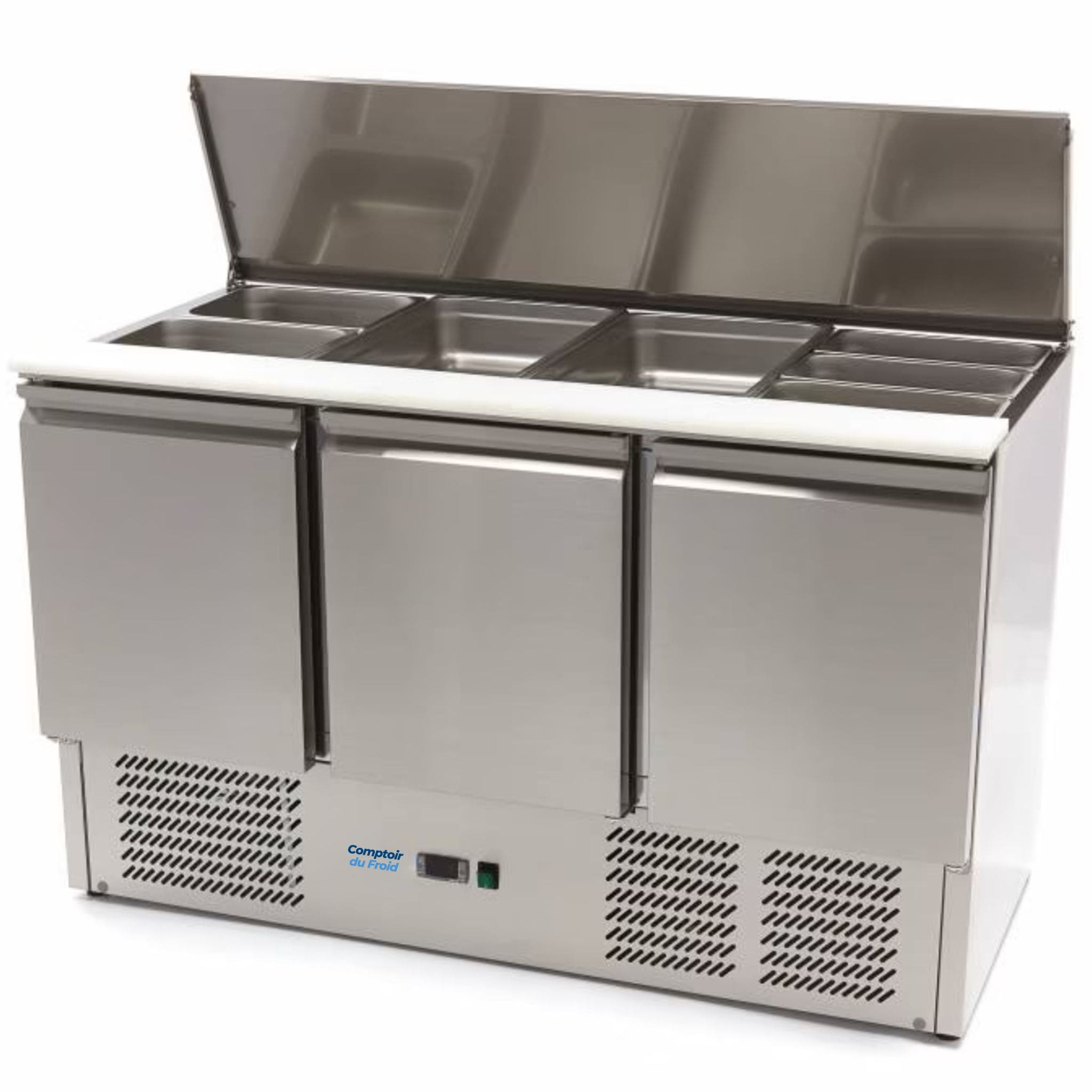
Stainless Steel 3-Door Refrigerated Prep Counter 137cm (Stainless Steel Lid)
- More volume for extensive menus and more intense services
- Excellent choice if multiple preparations coexist at the same station
- Allows for anticipating increased volume without changing workflow logic
What criteria to check before purchase to avoid a poor setup?
Before purchasing, first ask yourself how the unit will integrate into your preparation chain. A good prep counter isn’t chosen solely based on raw capacity.
In practice, the points to check are:
- available length in front of the wall or on the preparation line,
- door opening and staff circulation,
- number of pans truly useful for your menu,
- type of top surface according to your use,
- ease of cleaning to maintain daily cleanliness and HACCP compliance.
If you are still undecided with other similar formats, also consult our article on how to choose a professional refrigerated prep counter as well as our analysis on the 3-door refrigerated prep counter for higher volume stations.
Need a format truly suited to your station?
Explore our selection of prep counters and preparation tables to find the right balance between space, capacity, and service pace.
FAQ
Is a 2-door refrigerated prep counter sufficient for a snack bar?
Yes, in many snack bars or sandwich shops, it is the most suitable format if the menu remains concise and the station is well organized.
What is the difference between a 2-door and a 3-door prep counter?
A 3-door unit offers more volume and work width, but it requires more space and is only cost-effective if the volume justifies it.
Can a mini countertop prep counter replace a 2-door unit?
Only for supplemental use or a very small offering. As soon as service becomes busy, a 2-door unit provides much more comfort and stability.
Why is this format interesting for HACCP?
Because it helps keep ingredients cold, within reach, on a clean station that is easier to clean daily.