
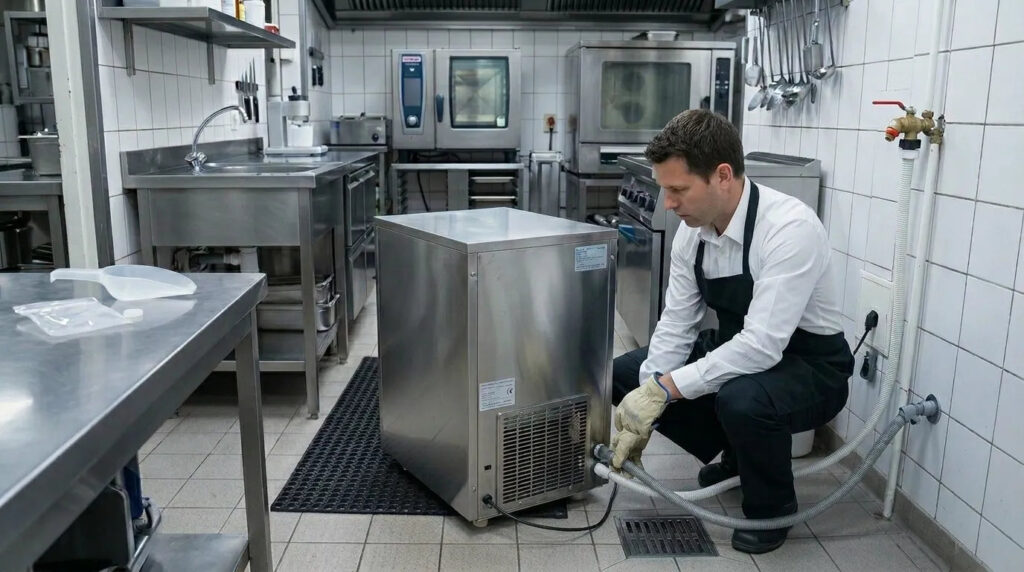
An ice machine with a water inlet becomes the right choice when your flow is regular, manual refills waste time, or you want more stable production during service. In restaurants, bars, or snack bars, a connection primarily prevents ice shortages at critical moments.
The real issue isn’t just having a machine connected to the network. It’s especially important to check if your service rhythm, location, and level of demand justify a plumbed-in model rather than a reservoir-based machine or a small, auxiliary unit.
On our models, this connection remains easy to understand, with one water inlet and one drainage outlet, whether the machine is air-cooled or water-cooled.
When does a plumbed-in ice machine truly become relevant?
The right question is simple: do you have a continuous need for ice for several hours? If so, a direct water supply quickly becomes more logical than manual refilling.
In practice, a connection becomes interesting in three cases: a bar serving non-stop, a restaurant combining drinks, desserts, and auxiliary cold storage, or an establishment looking to secure its service without relying on human intervention.
- you produce ice every day, not just as a backup
- you experience rushes where an ice shortage costs sales or slows down the bar
- you are looking for more regular production with less handling
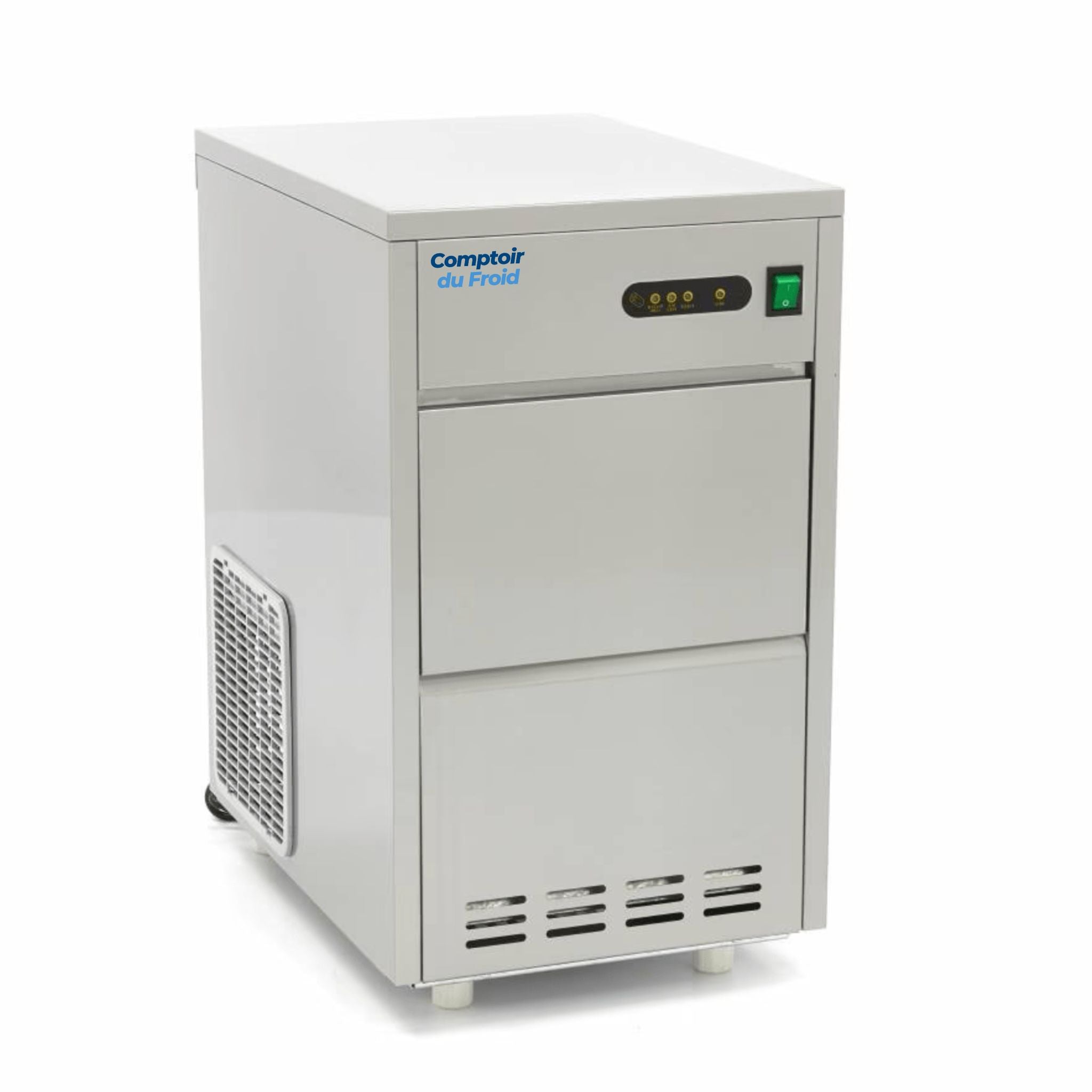
Professional Hollow Ice Machine – 24 kg per day – Water Cooling
- Production of 24 kg per day with water cooling, preferable for built-in spaces or very hot areas
- Hollow ice cubes suitable for bars and restaurants that want fast drink chilling
- 18/8 stainless steel structure, overload protection, and injected ABS tank for a more durable machine in daily use
Water inlet or reservoir, what’s the difference in practice?
The Mayn difference is production continuity. A reservoir machine remains useful for occasional use, but it quickly becomes limiting as demand increases or when the team has other things to do than fill the tank.
A plumbed-in machine operates with a more stable supply and integrates better into a true hospitality industry logic. This is particularly true if you have already read our guide to choosing a professional ice machine and are still hesitating between a small auxiliary unit and genuine service equipment.
| Criterion | Reservoir machine | Machine with water inlet |
|---|---|---|
| Autonomy | Limited by manual refills | Much more stable during service |
| Recommended flow | Small or auxiliary use | Regular to intensive use |
| Installation | Flexible but often less professional | Requires a proper connection |
| Operating comfort | More handling | Fewer interruptions and less oversight |
| Reliability during rush hours | Adequate if demand remains low | Much more reassuring |
Verdict: If ice is part of daily service, plumbing is often the best compromise between comfort, regularity, and professional image. A reservoir remains defensible Maynly for occasional or very limited use.
Should you choose air or water cooling?
The question to ask is this: will your machine be installed in a hot or enclosed environment? If yes, a water-cooled model is often safer. If the location is well-ventilated, air cooling is generally simpler and more economical to operate.
The choice therefore doesn’t depend solely on the daily kilogram capacity. It primarily depends on the actual service conditions, ambient heat, and available space around the machine.
It’s also important to distinguish what we call a water inlet. In our range, our ice machines simply connect with a single water inlet and a single drainage outlet, regardless of the type of cooling chosen. This is an important point, as many buyers mistakenly believe that a water-cooled model requires a significantly more complex installation.
How many water connections should be planned?
The answer is simple: on our models, you only need to plan for one water inlet and one water outlet, no more. Whether the machine is air-cooled or water-cooled, the installation remains clear, practical, and compatible with a typical professional setup.
- Air-cooled machine: one water inlet and one drain
- Water-cooled machine: one water inlet and one drain
- Main difference: the choice between air or water primarily affects the machine’s behavior in hot or confined environments, not the number of connections required
In other words, a ventilated machine also needs a water inlet to make ice, but the connection remains simple. A water-cooled model also maintains this logic on the machines we offer, with an easy-to-understand installation that can be integrated into a bar, snack bar, or professional kitchen.
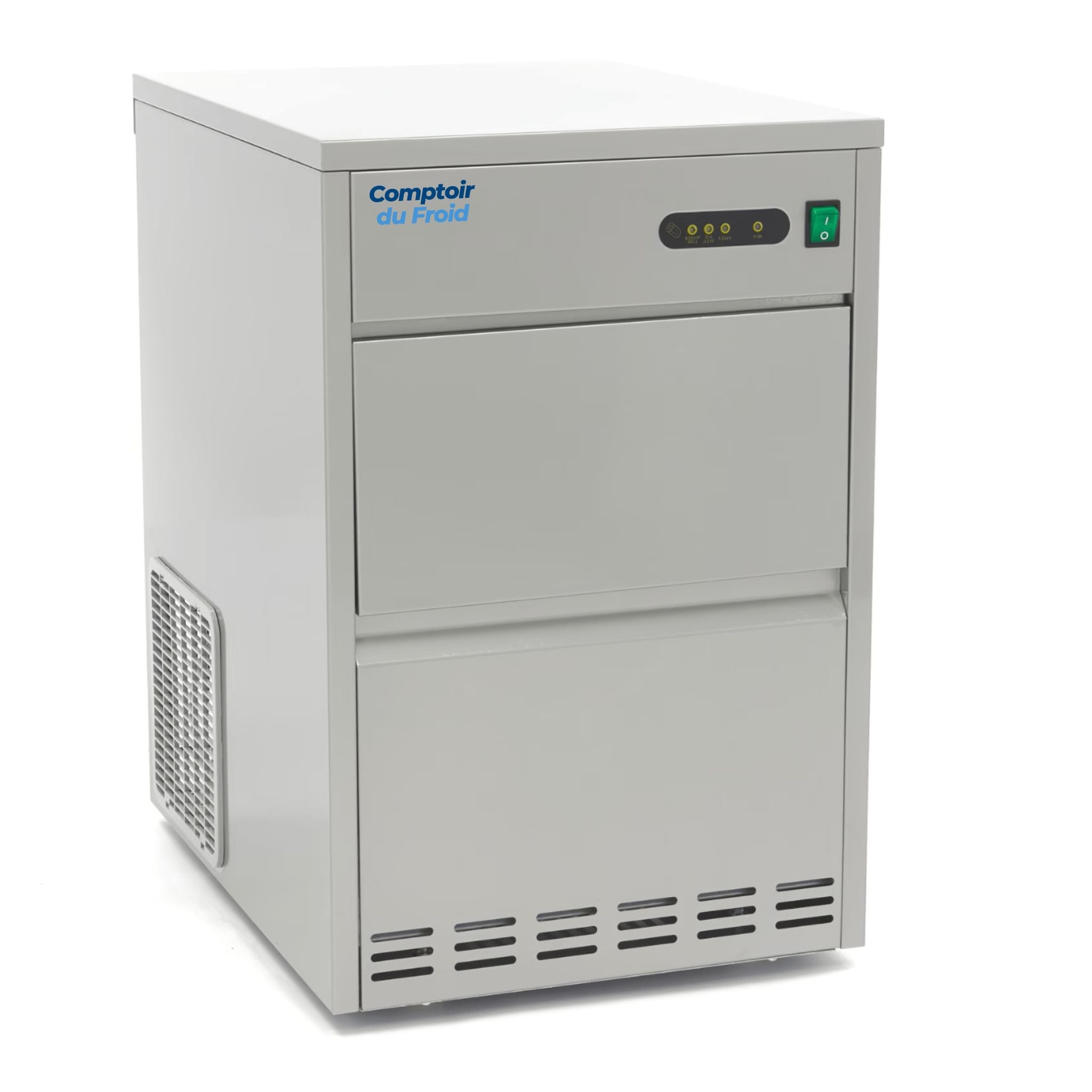
Professional Hollow Ice Machine – 45 kg per day – Water Cooling
- Production of 45 kg per day with water cooling, recommended for hot back bars or built-in installations
- Version designed to maintain good performance even when ambient temperature becomes detrimental
- Hollow ice cubes and stainless steel structure useful for more reliable beverage service in intensive use
Useful benchmarks for deciding
Here’s the short answer: air is suitable for open, well-ventilated installations, while water better secures difficult environments. This is often the point that makes the difference between a machine that looks good on paper and one that is reliable in daily use.
- Air cooling if the machine is accessible, ventilated, and outside hot zones
- Water cooling if the machine is built-in, near an oven, or in a hot back bar
- Higher capacity if ice directly contributes to sales, cocktails, soft drinks, iced coffee, or continuous service
If your priority is the quality of the ice served in a glass, the article on the full cube ice machine for bars can also refine your choice between fast chilling and premium presentation.
What signs indicate that a plumbed-in model is undersized?
The right question is: does your machine produce ice fast enough to replenish stock during service? If the answer is no, the problem isn’t the connection but the sizing.
In the field, an undersized machine is quickly identified: an empty bin before the end of service, cycles that can’t keep up, staff compensating with emergency purchased ice. The correct approach is to consider the actual flow rate, not just an impressive figure in kg/24 h.
For a small bar, a beverage station, or an organized snack bar, 24 kg/day may suffice. As soon as service becomes more intense or longer, a 45 kg/day base often provides more peace of mind and limits shortages.
Need an ice machine truly suited to your service?
Compare plumbed-in formats and choose a model consistent with your flow, location, and level of demand.
FAQ about ice machines with water inlet
Is an ice machine with a water inlet mandatory in catering?
No, but it is highly recommended as soon as ice is produced daily with a real need for continuity.
Can a plumbed-in machine be installed under a counter?
Yes, and this is even one of the cases where a water-cooled model makes perfect sense. However, it is still necessary to maintain proper technical access and a well-designed drainage system to maintain good performance over time.
Does water cooling consume more than an air-cooled model?
Yes, it involves water consumption, but it often remains more reliable in hot environments or confined installations.
What capacity should I aim for a small bar or snack bar?
Light needs can be met with 24 kg/day. If service is sustained or prolonged, it is often better to aim for 45 kg/day or more.